View Details
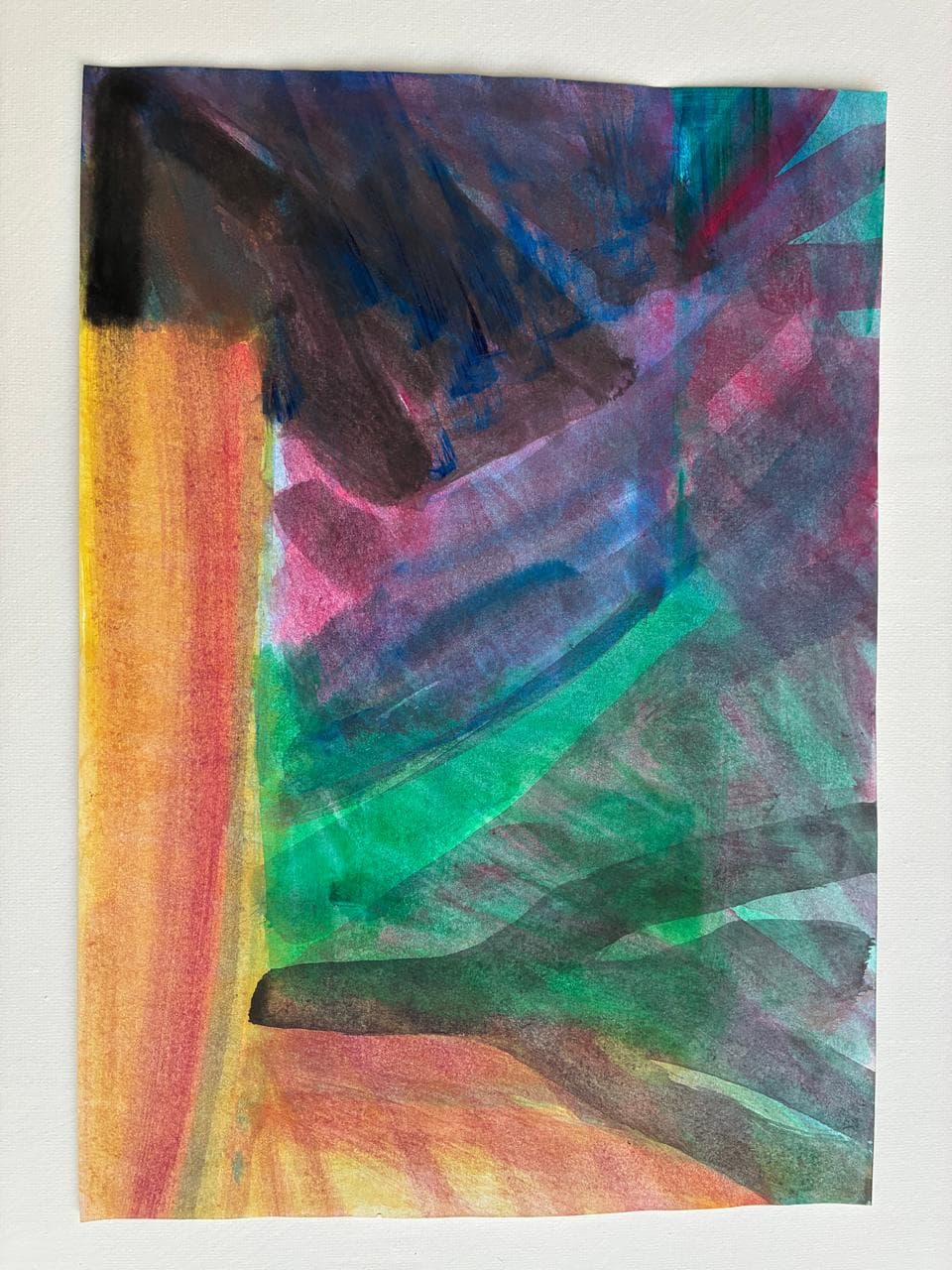
Chromatic Territories
Point d'Azur
Acrylic on paper·18 × 24"
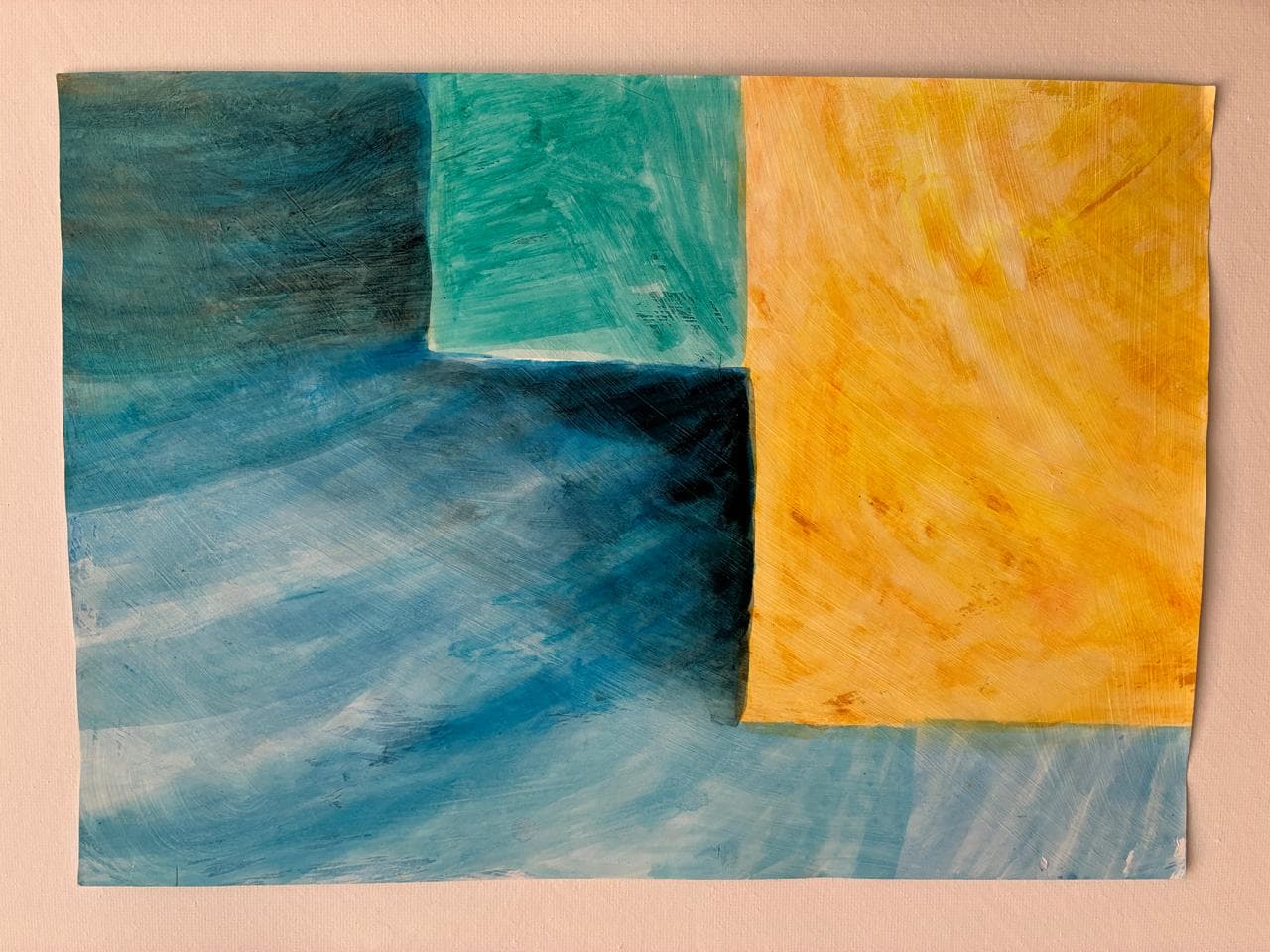
Original contemporary paintings exploring the boundaries between landscape, memory, and abstraction. Each work is a window into the chromatic language of the Indo-Pacific.
Each painting is a unique, museum-grade original. Explore by series or browse the full body of work.
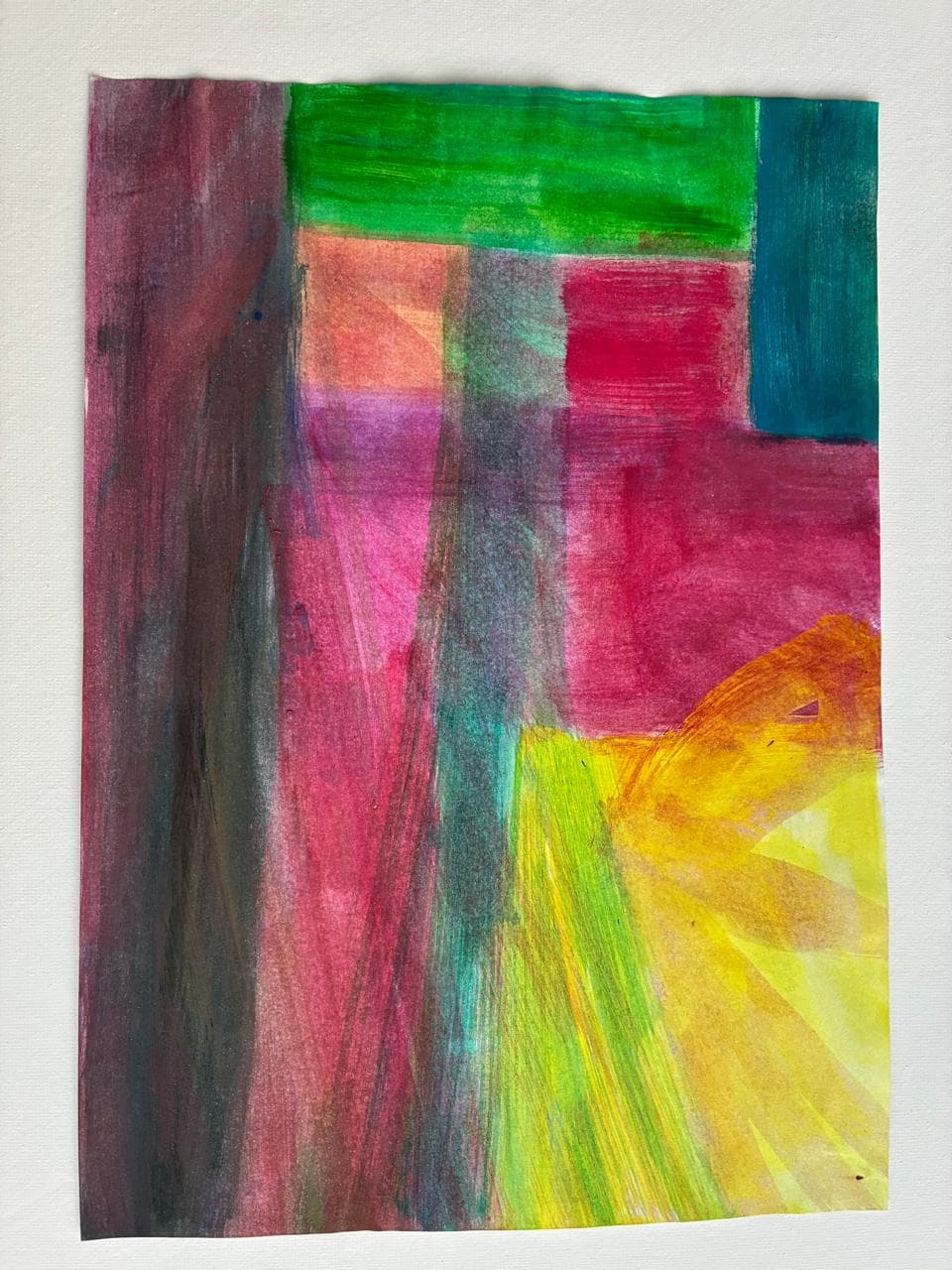
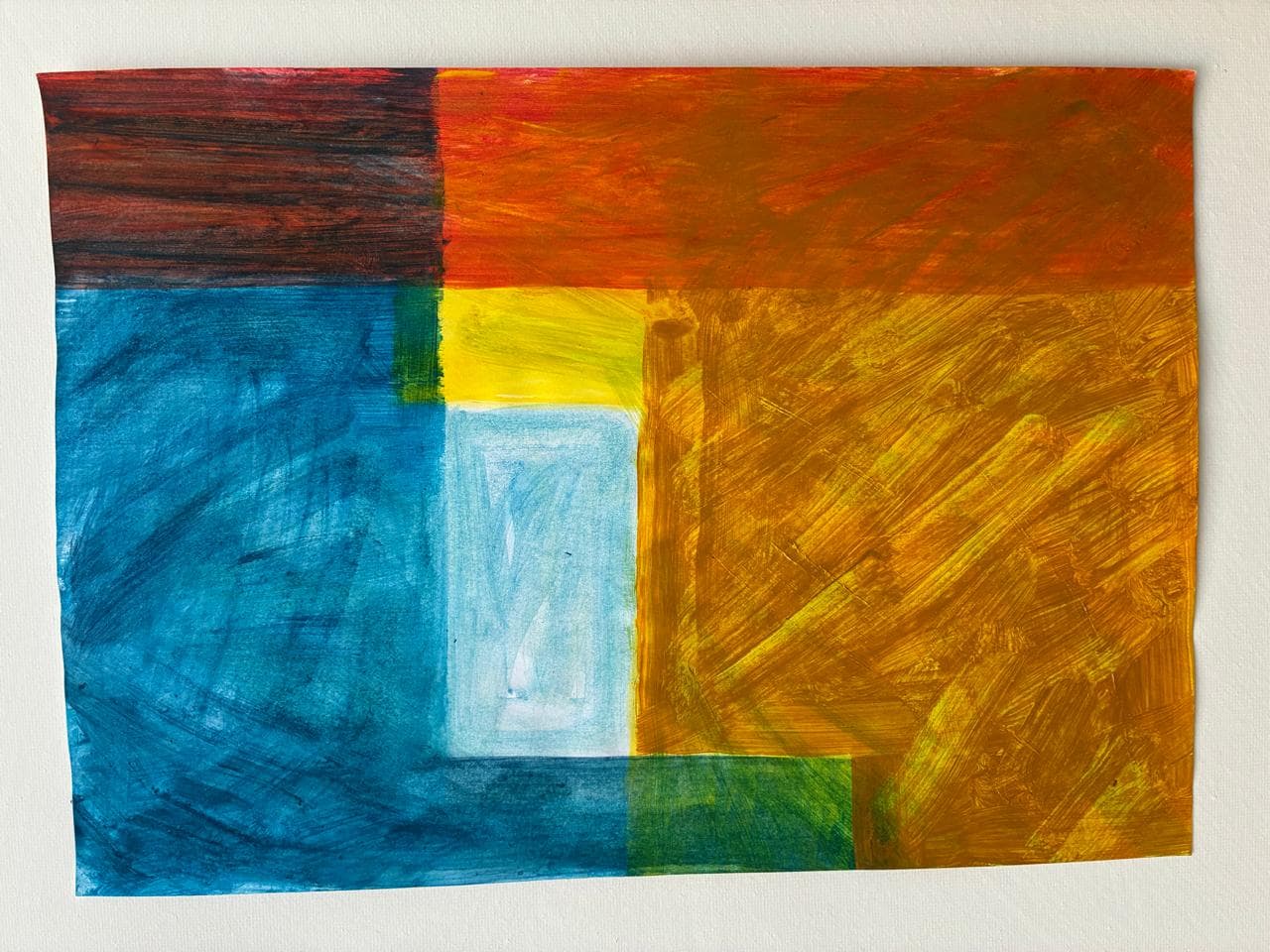
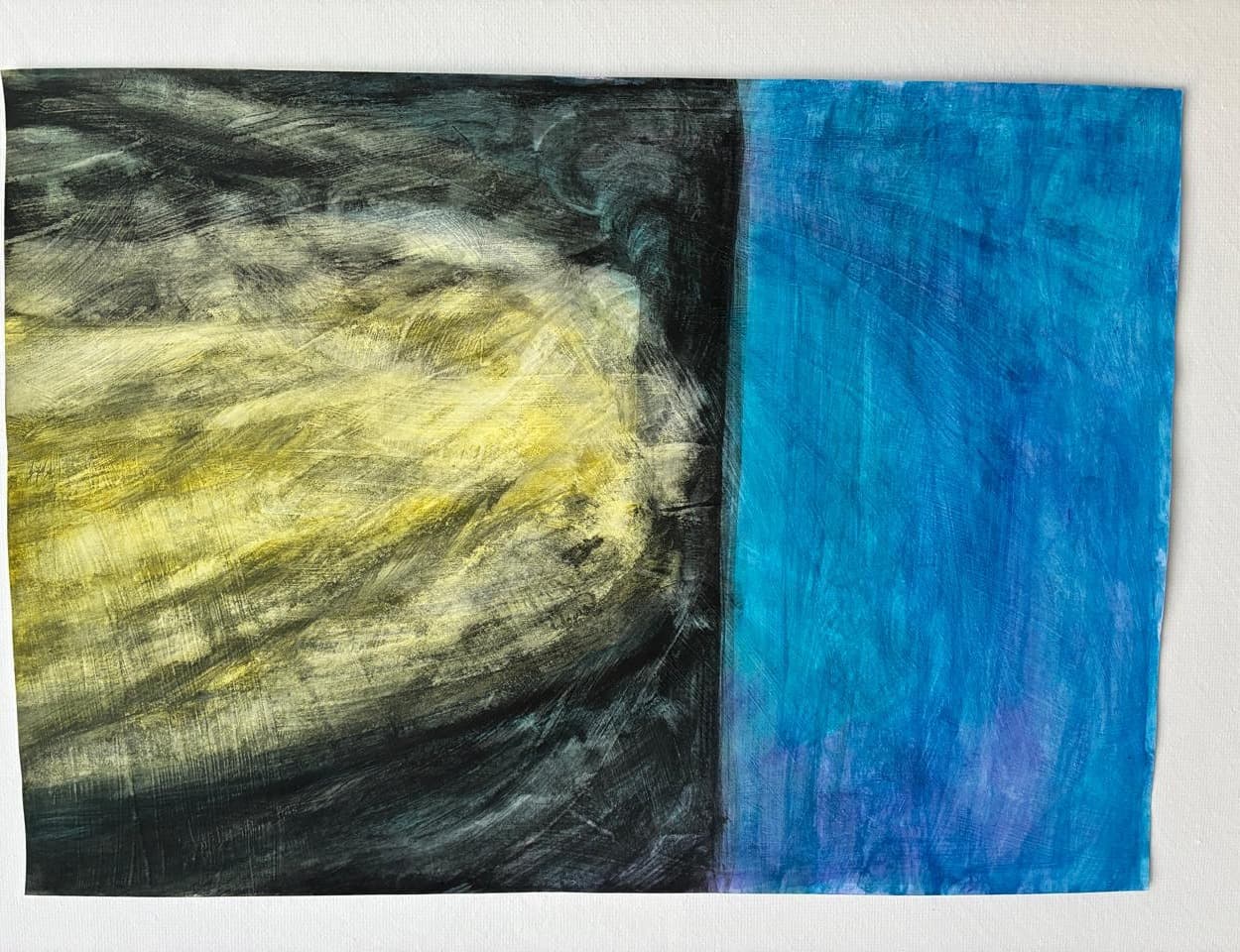
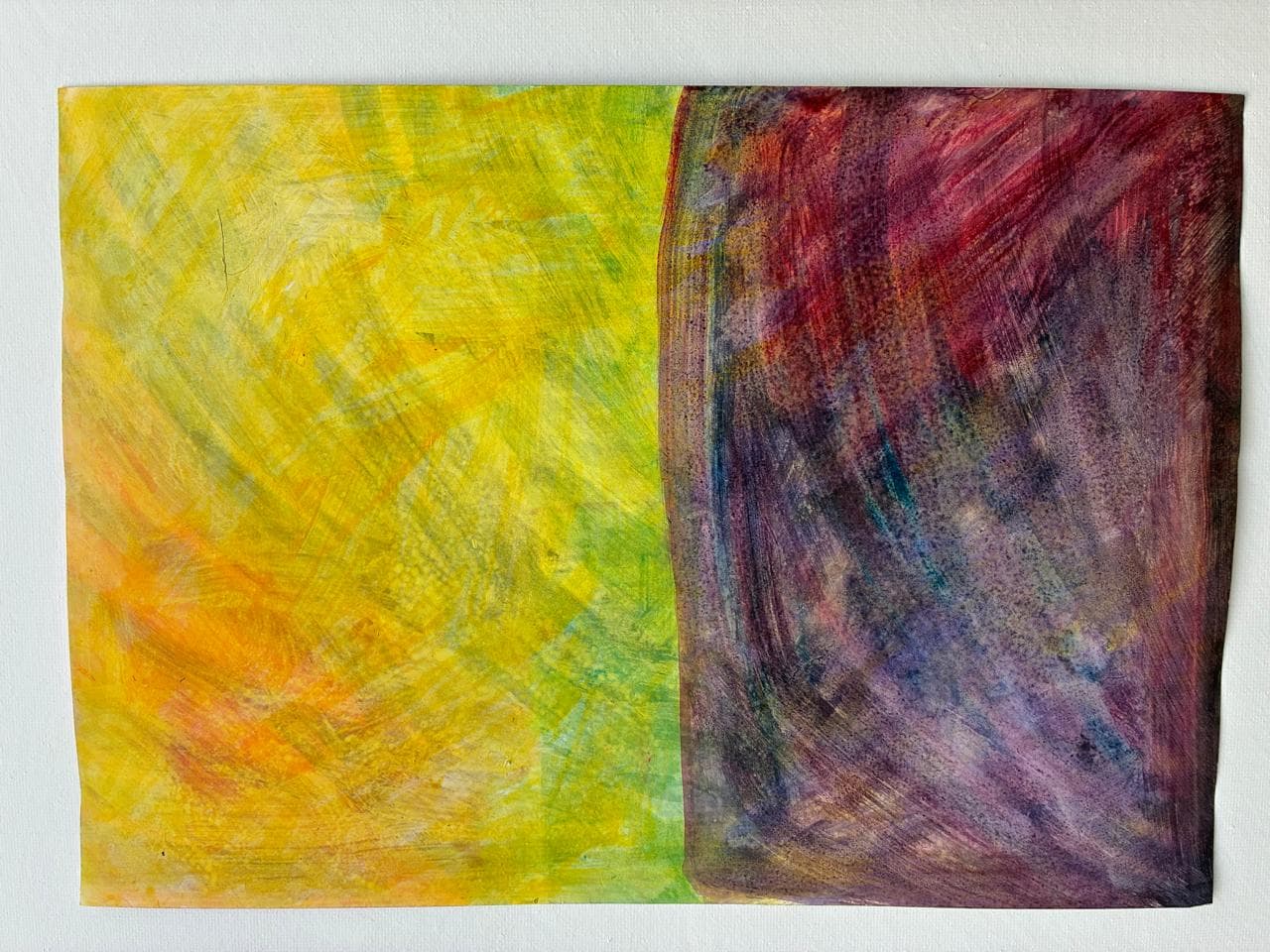
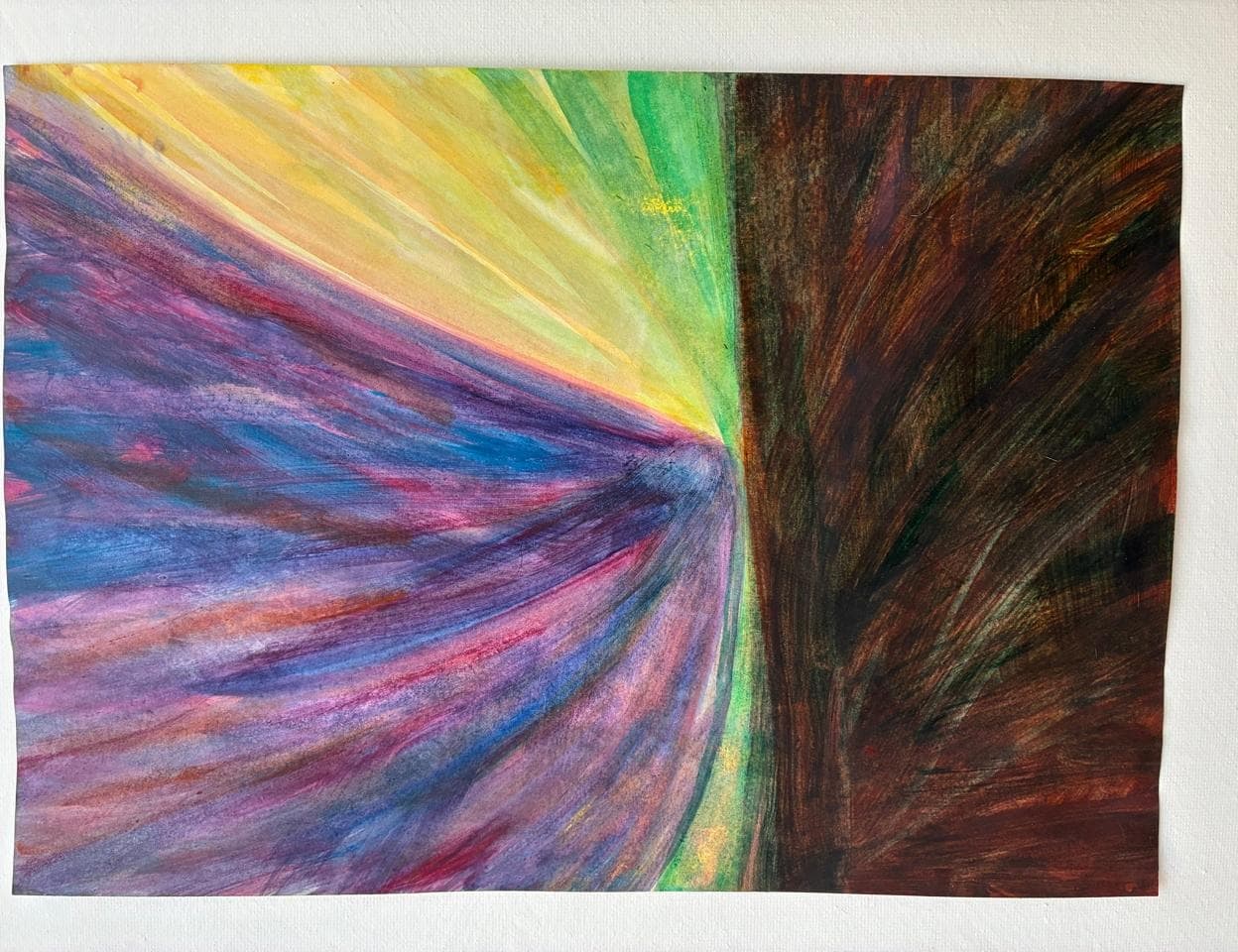
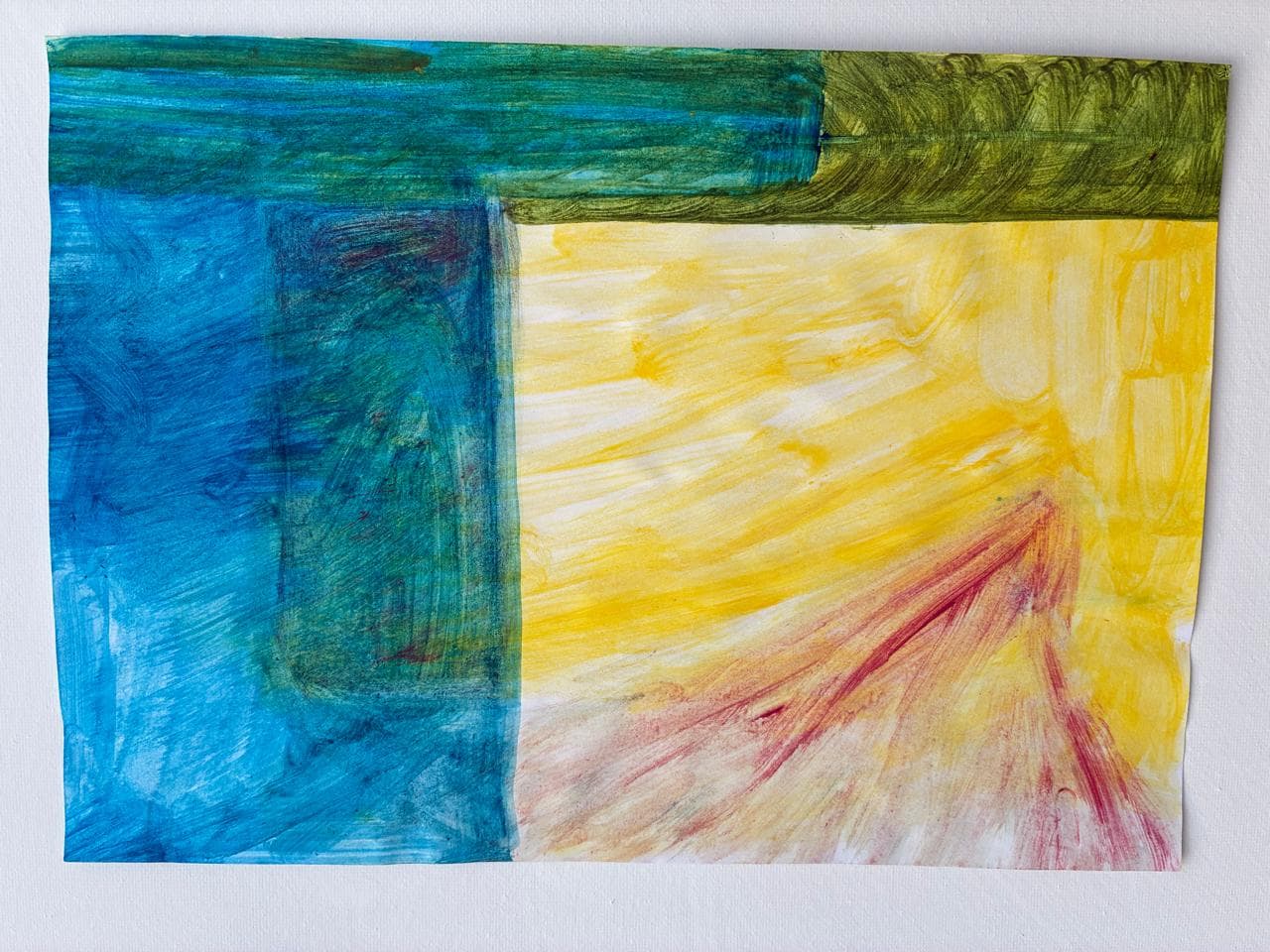
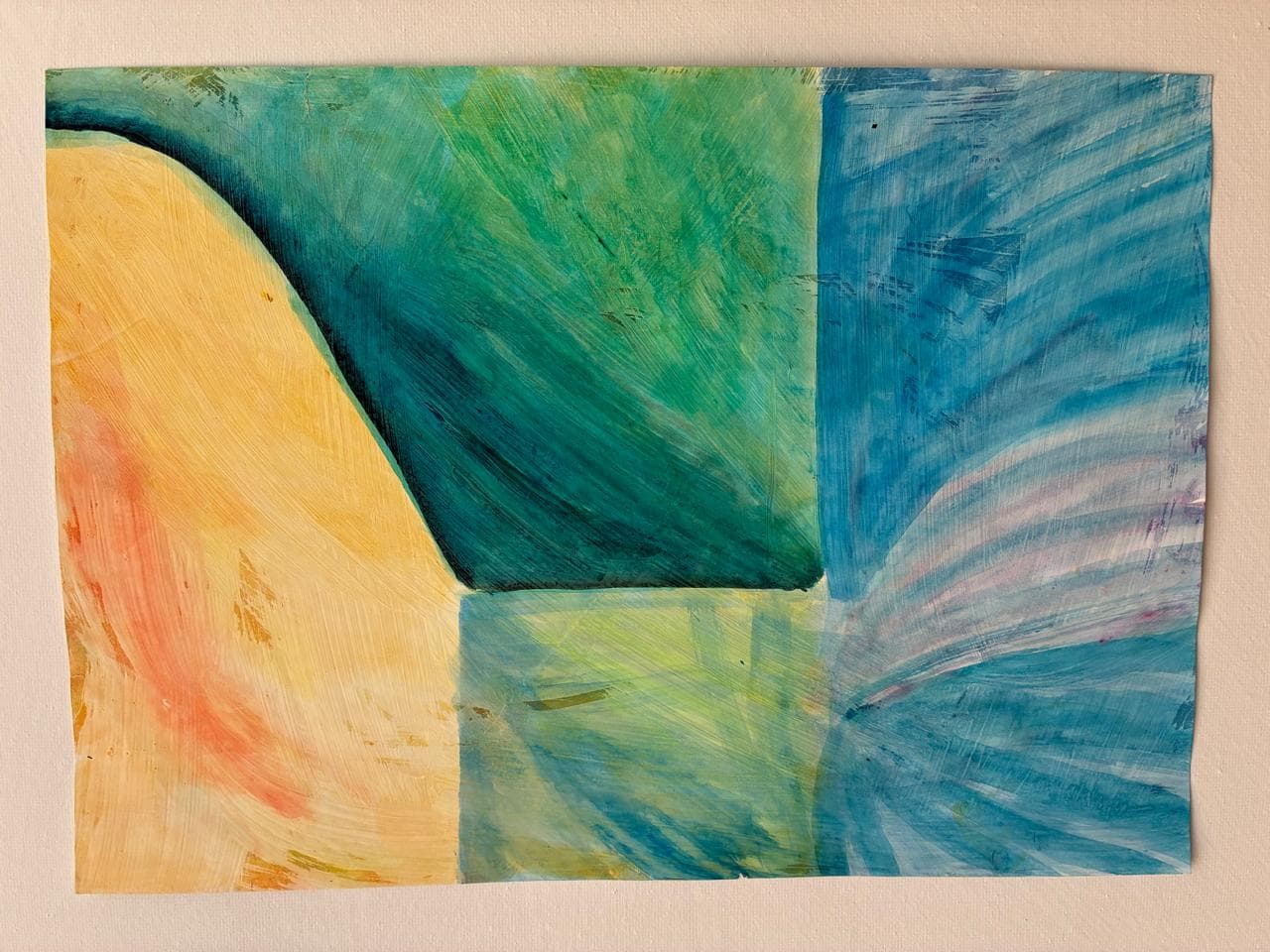
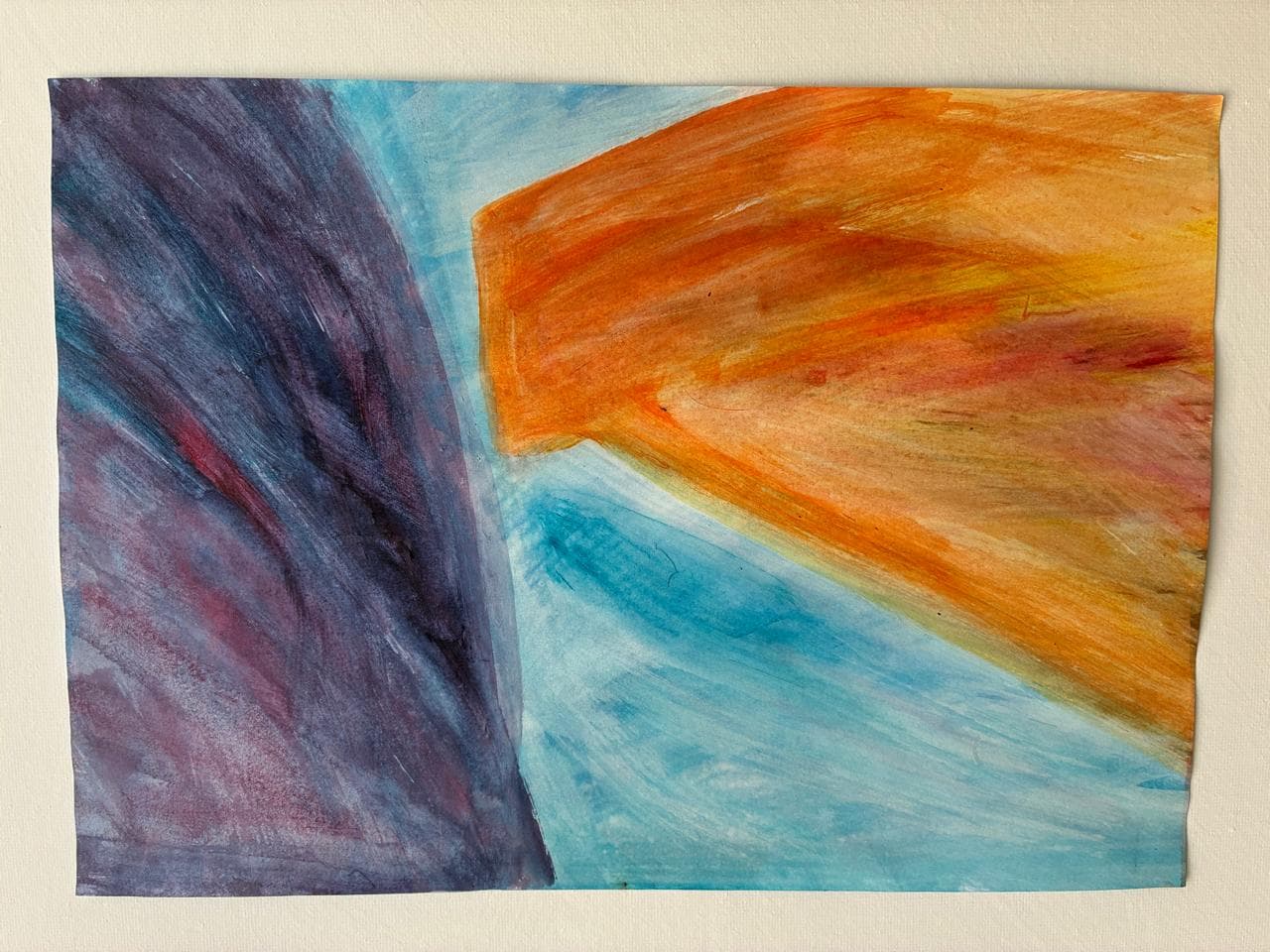
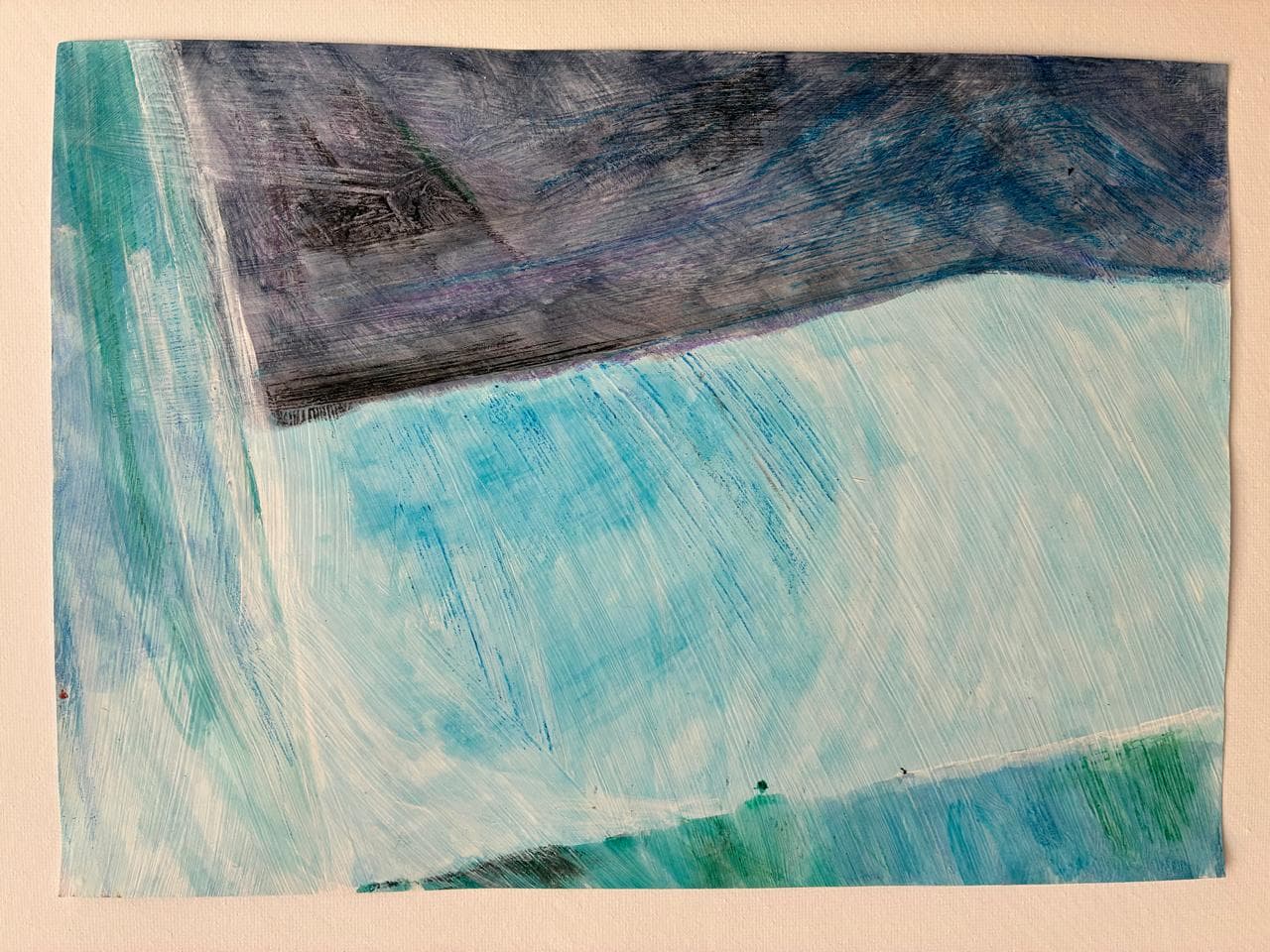
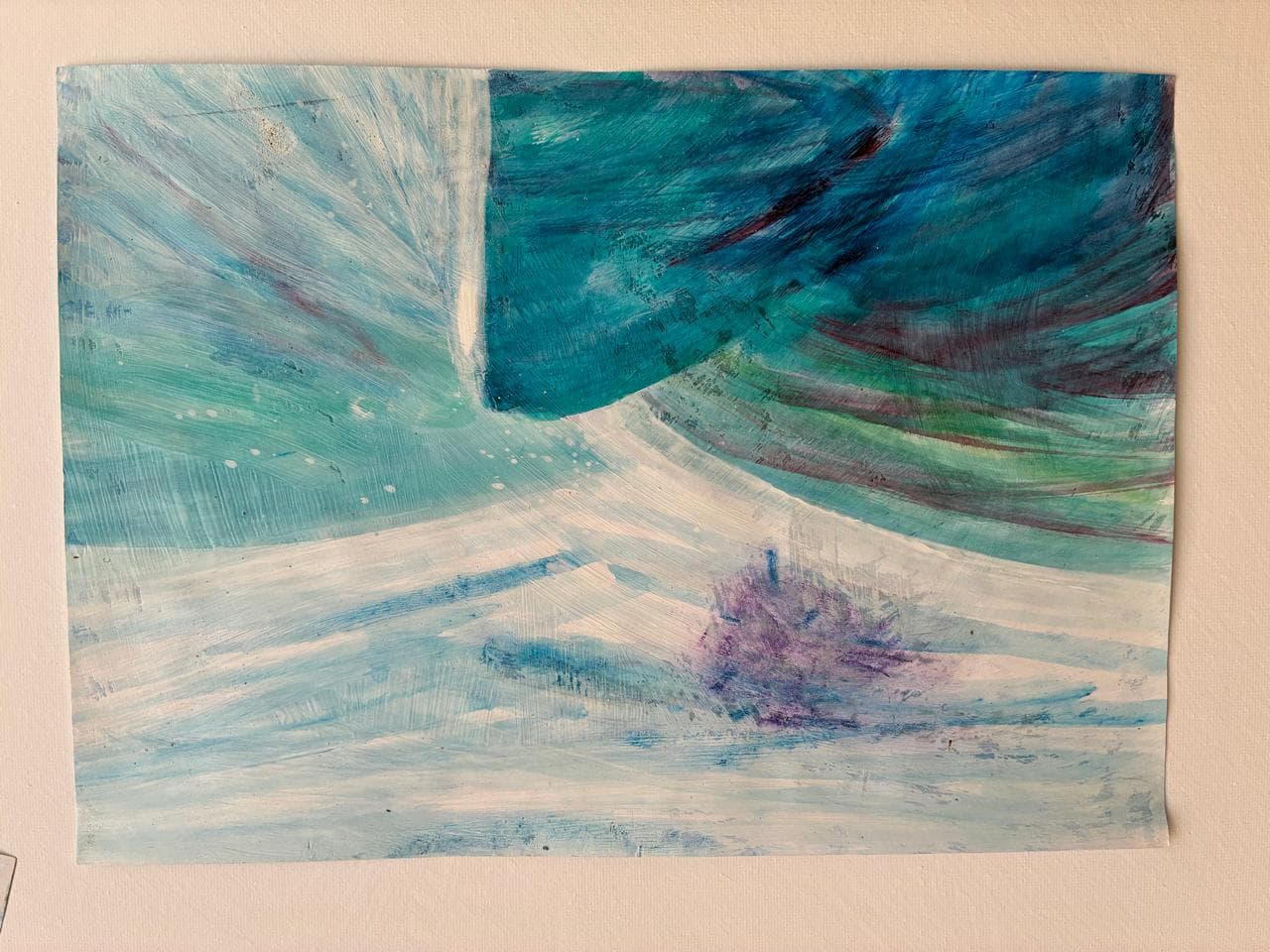
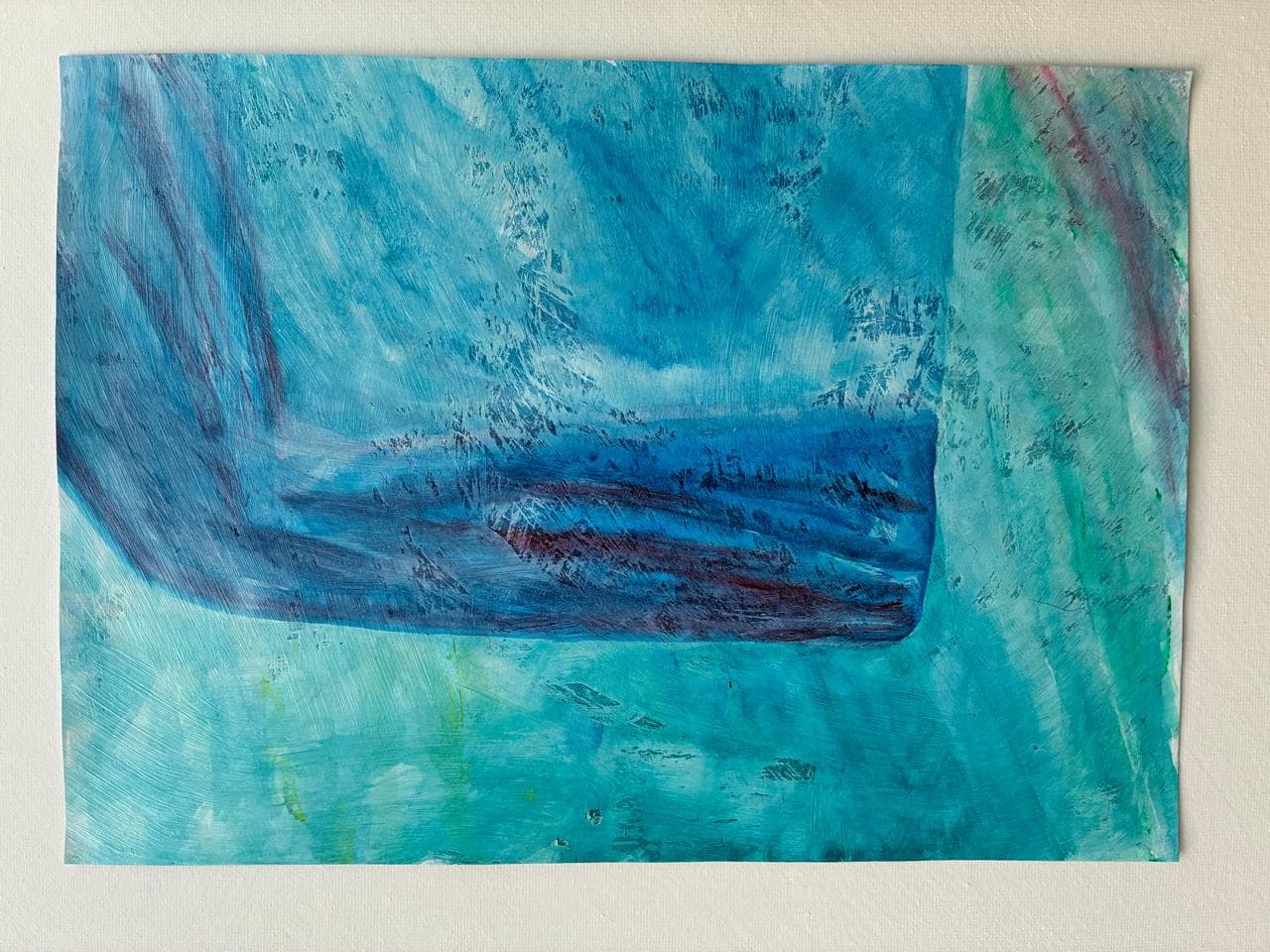
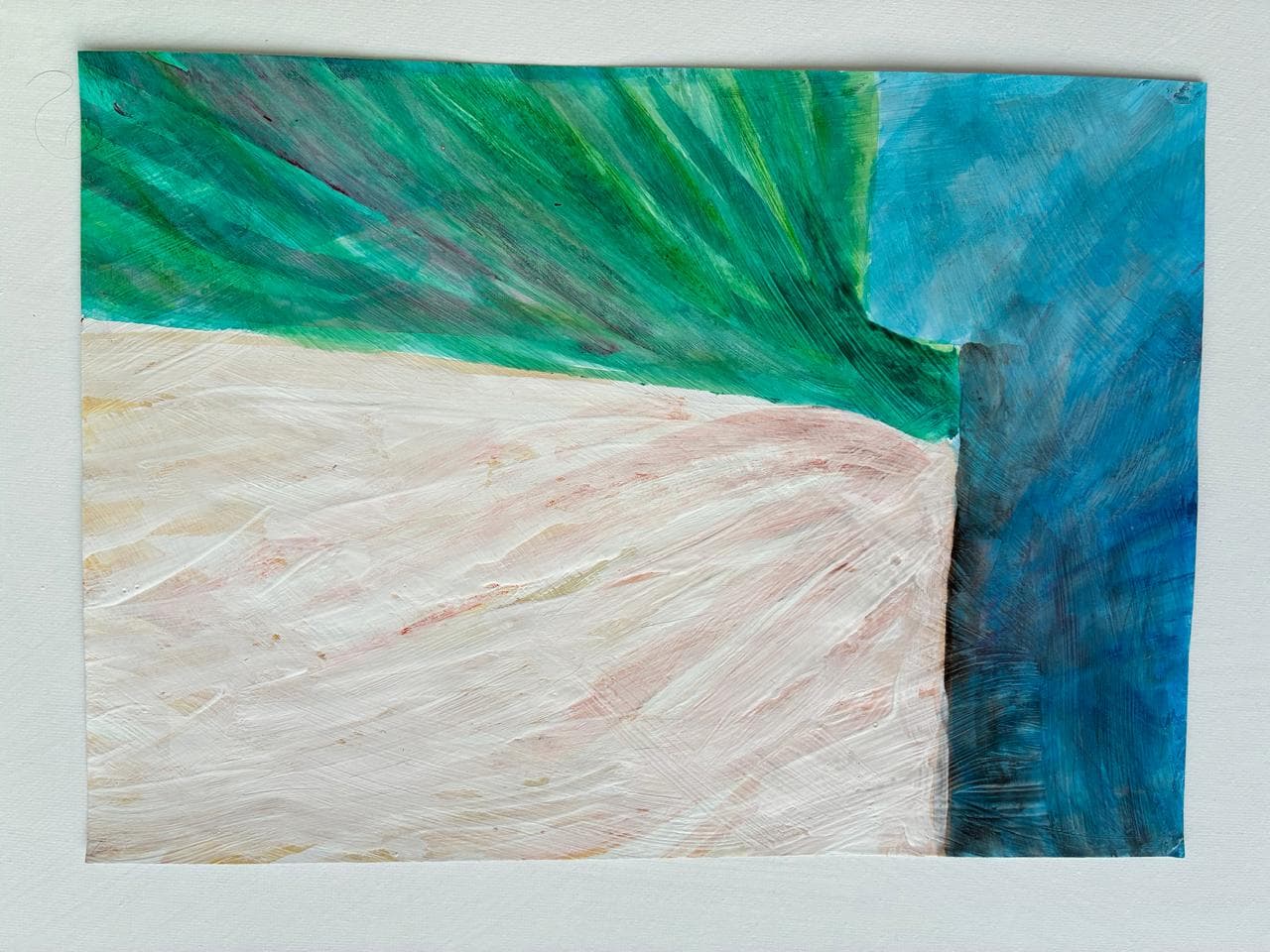
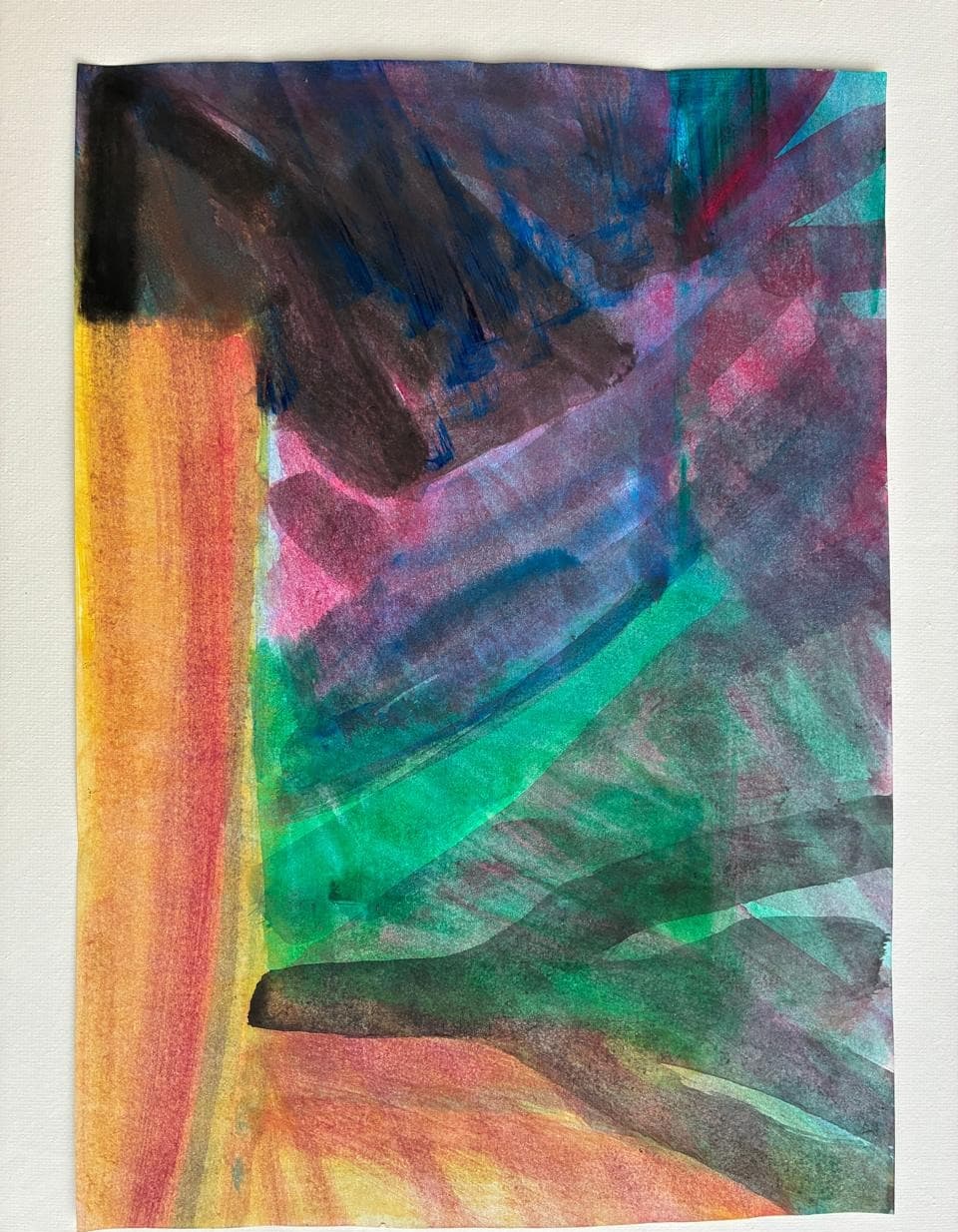
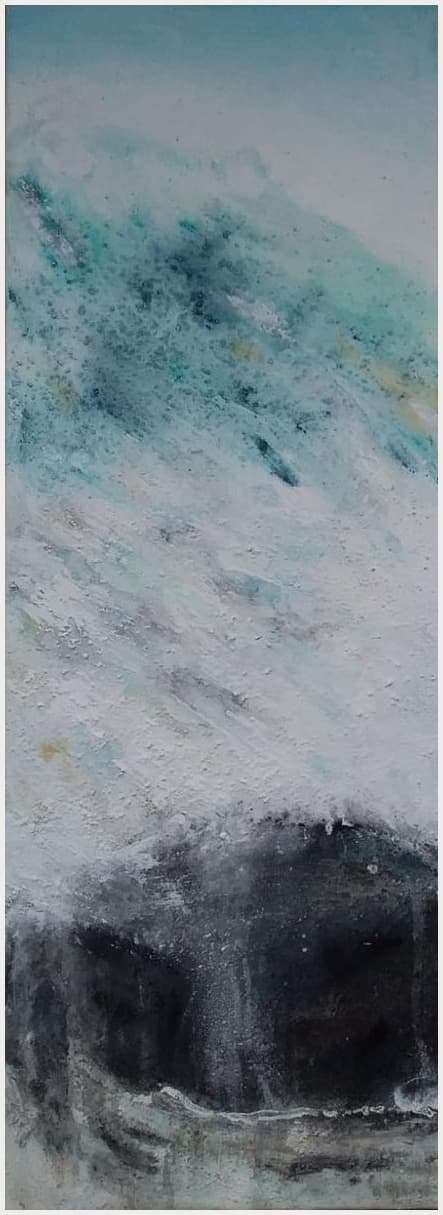
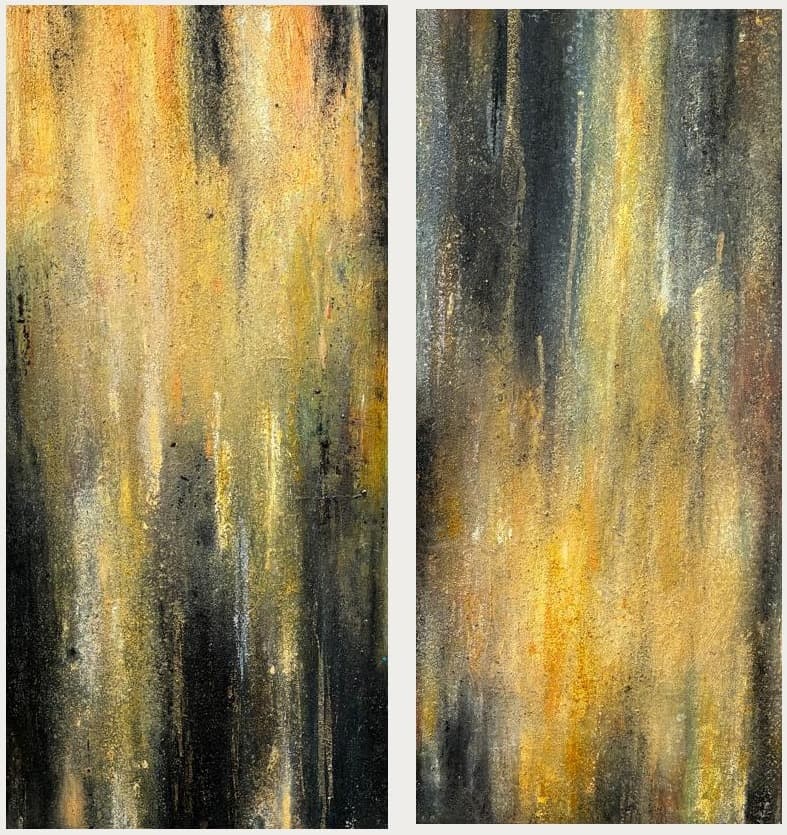
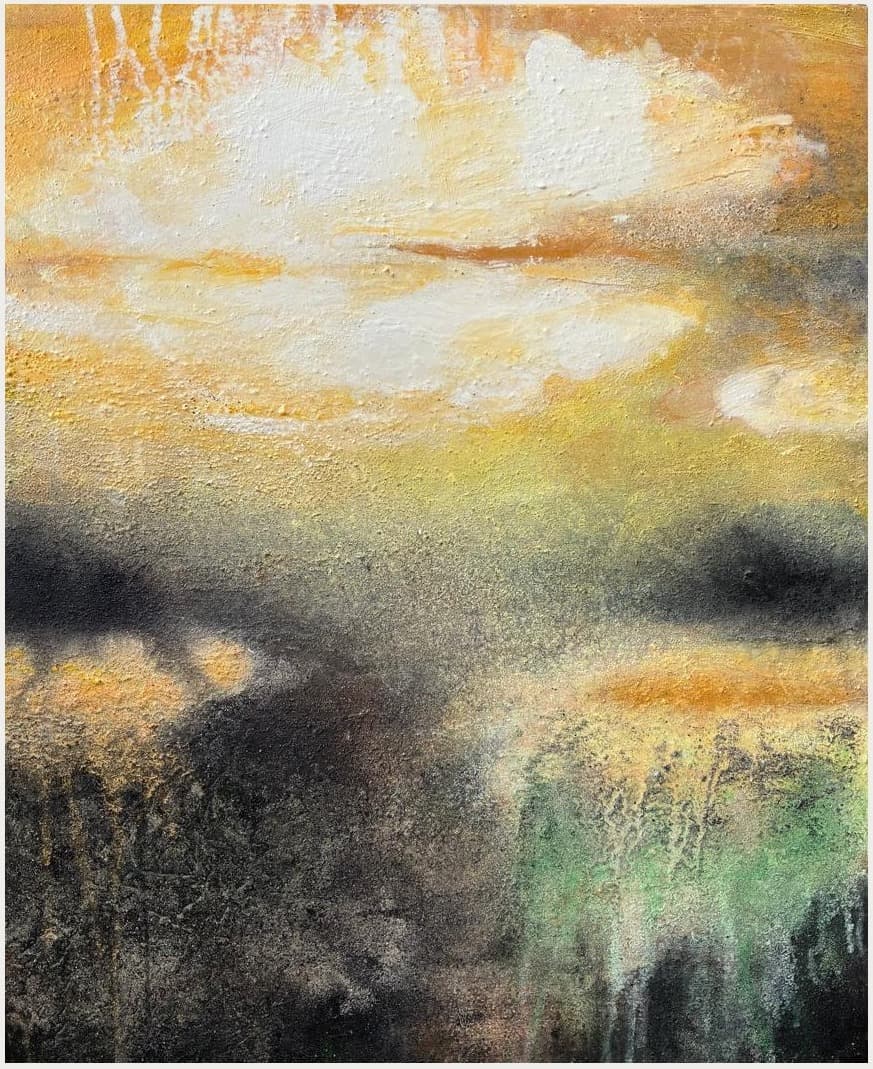
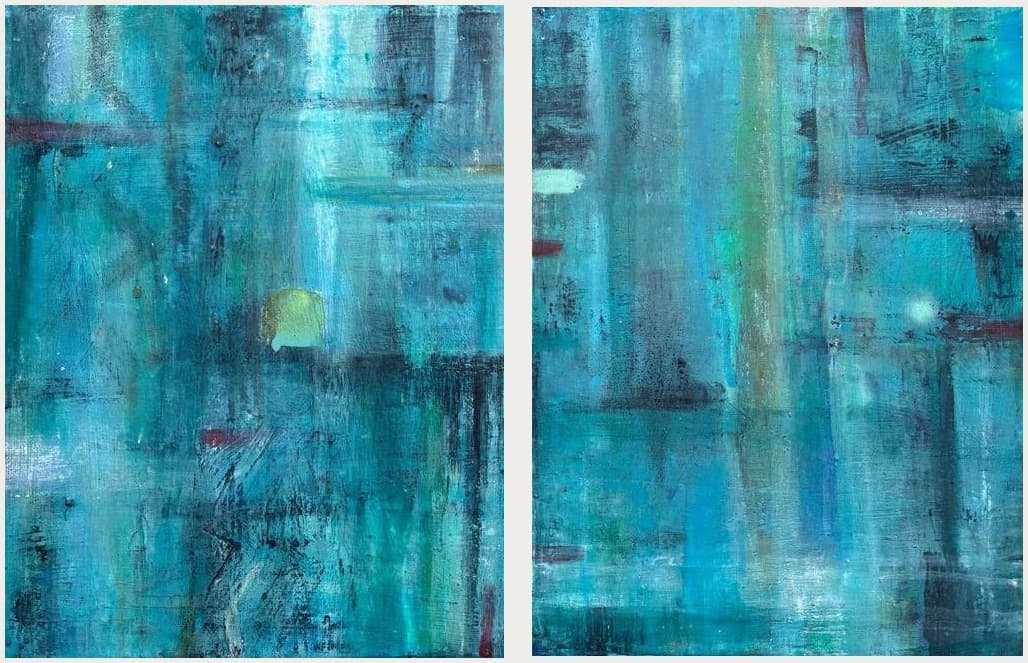
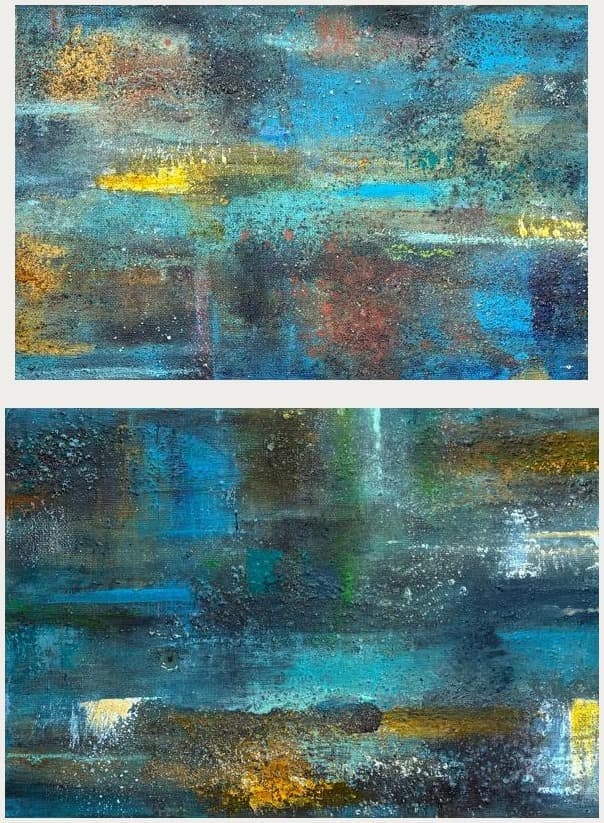
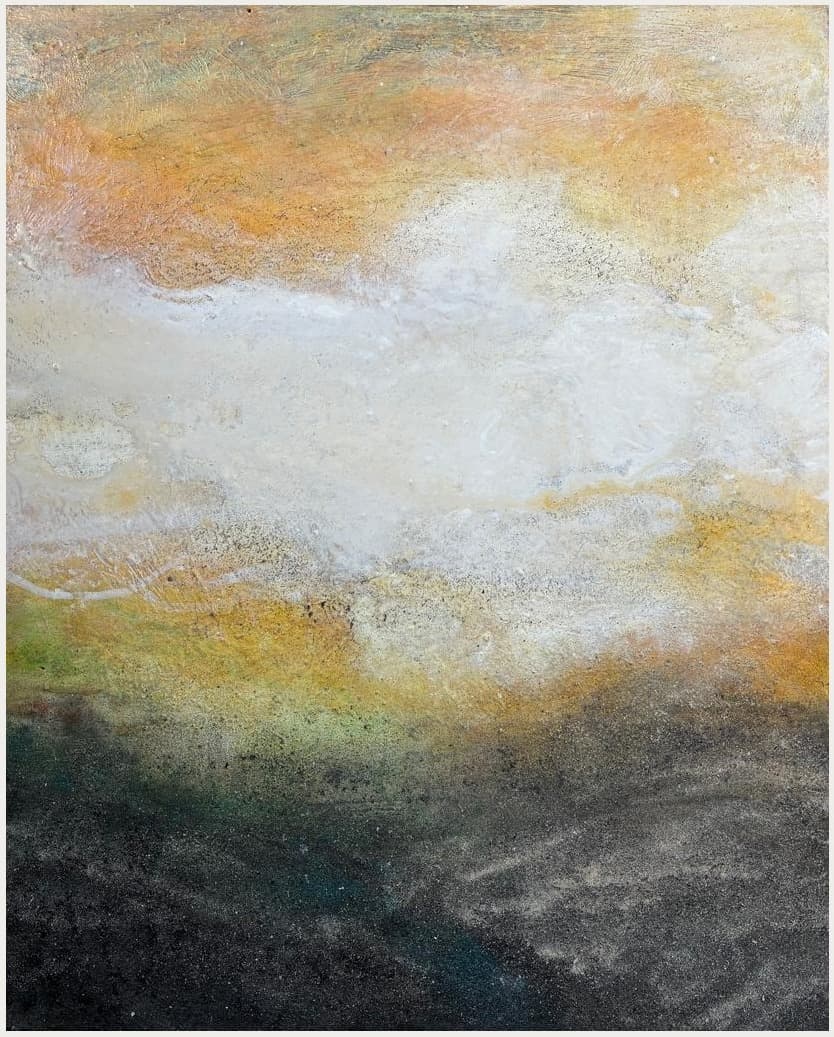
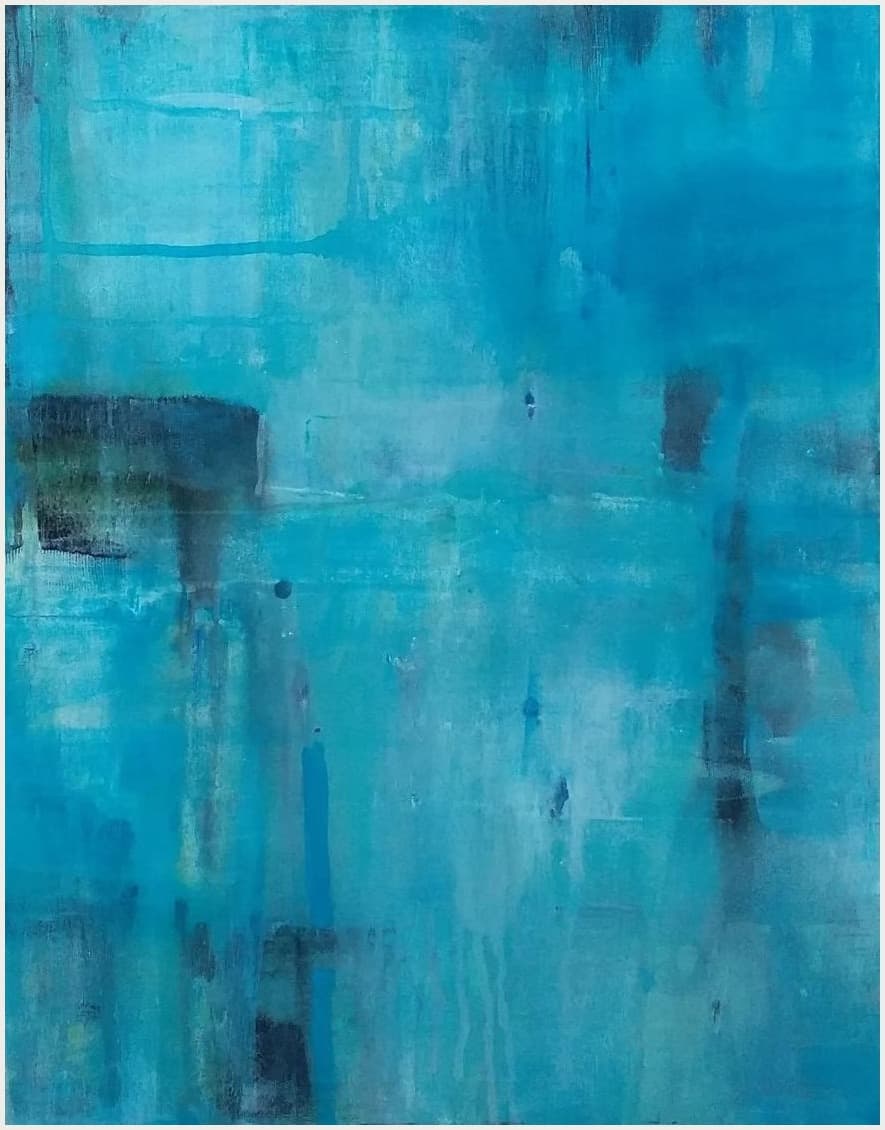
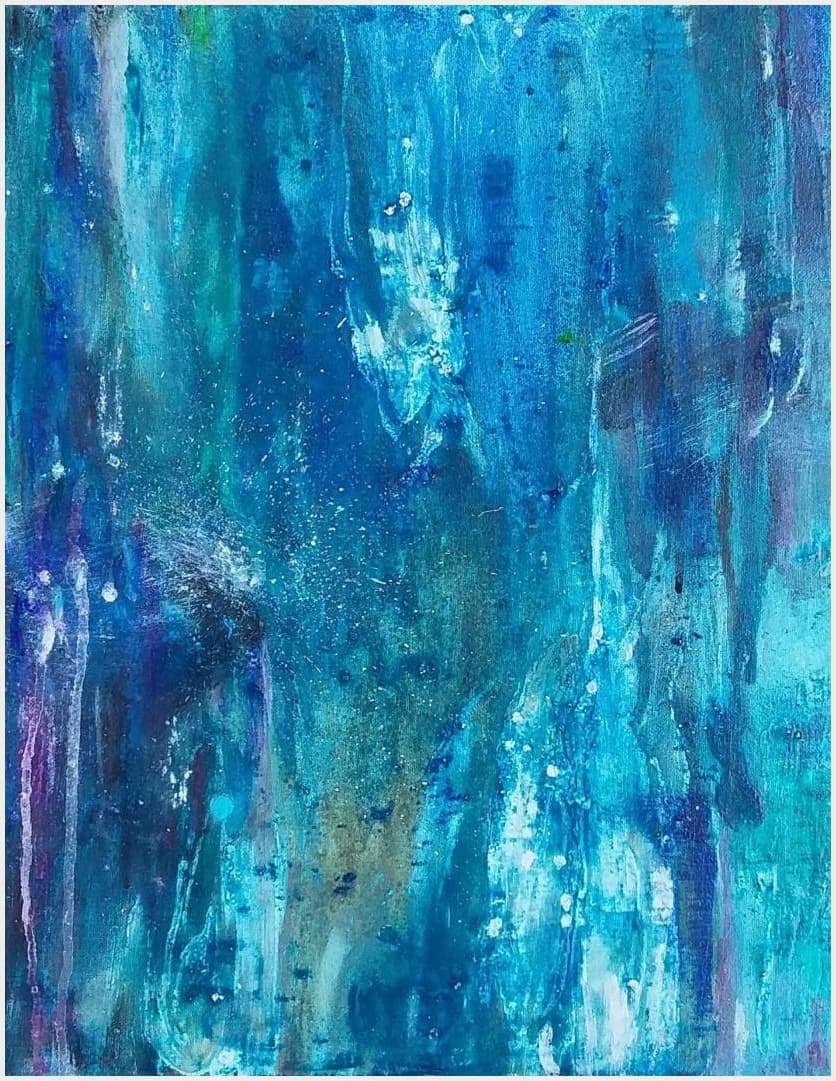
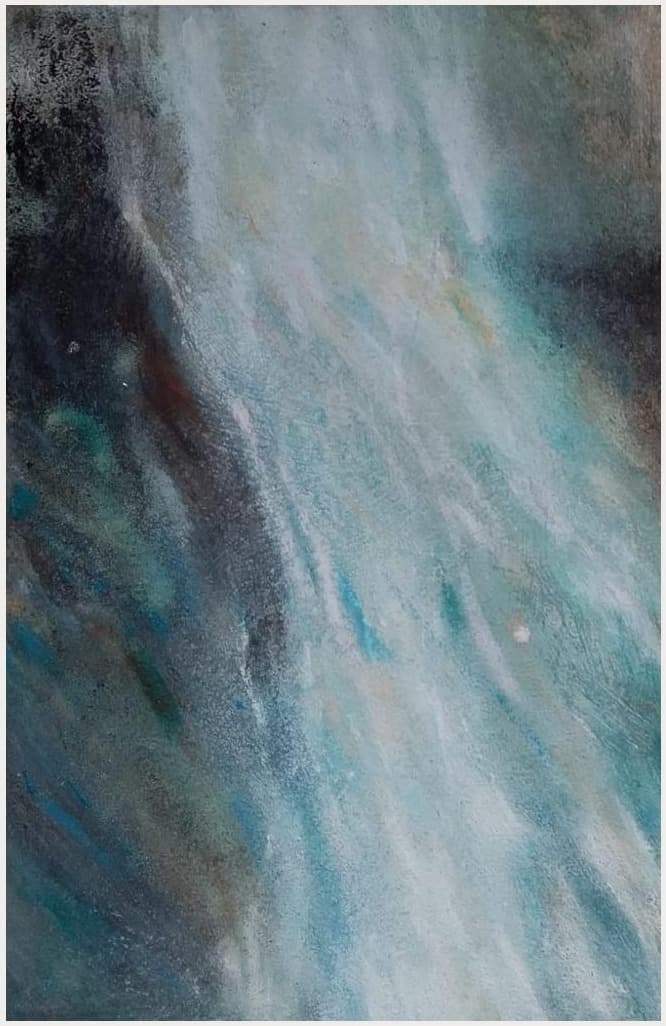
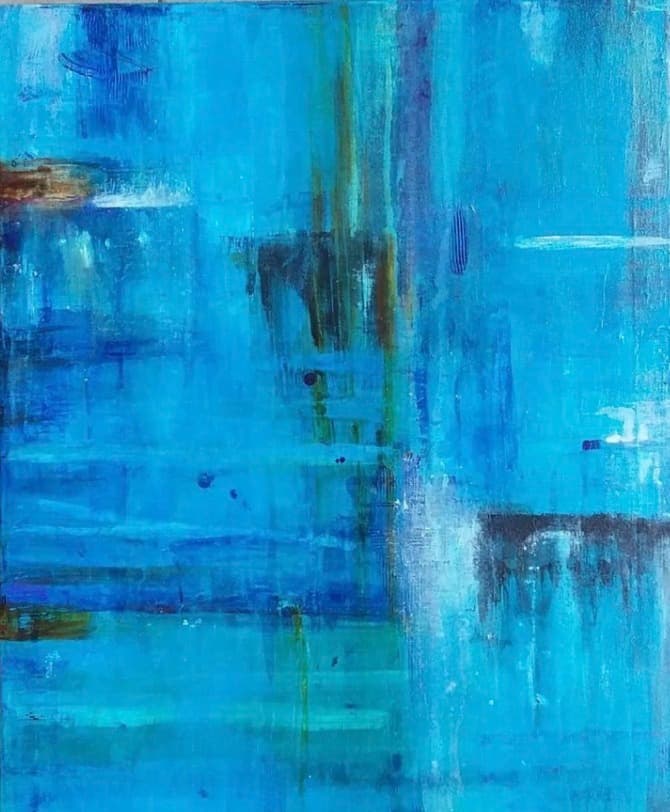
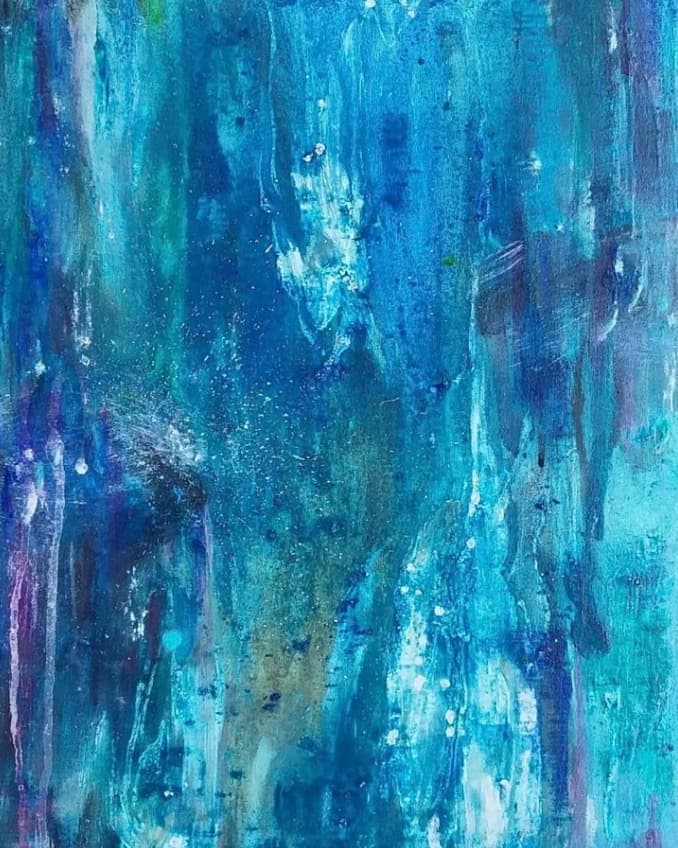
The collection is organized into four interconnected series, each exploring a different dimension of the relationship between color, place, and memory — from intimate works on paper to large-scale canvas.
Explorations of color as geography — where hue becomes landscape and saturation defines altitude. Each work maps a territory that exists only in pigment.
Color Field · Lyrical AbstractionExplore seriesInvestigations into edges, frontiers, and the liminal spaces where opposing forces meet. These works examine the tension between color fields — where they clash, merge, and negotiate.
Lyrical Abstraction · Abstract ExpressionismExplore seriesA meditative series drawn from the chromatic vocabulary of the Indo-Pacific waters. Deep ceruleans, volcanic indigos, and translucent aquamarines create an immersive experience of depth and light.
Color Field · Frankenthaler / Sam Francis lineageExplore seriesThe newest and most ambitious works in the collection. Nine large-scale canvases — including three diptychs — capturing the raw meteorological energy of the Mauritian storm season in heavy impasto and layered texture.
Neo-Expressionist Impasto · The SublimeExplore series“Working in the lineage of Lyrical Abstraction — but from a vantage point 10,000 miles from the movement’s New York and Paris origins — Julia brings a new chromatography to one of contemporary painting’s most enduring conversations. Her works on paper recall the luminous transparency of Sam Francis; her large-scale canvases carry the meteorological weight of Turner and the material intensity of Kiefer. What anchors both is a single geography: the Indian Ocean, as seen from Mauritius.”
No major figure in Lyrical Abstraction or Color Field ever claimed the Indian Ocean as their visual territory. Frankenthaler was Connecticut; Sam Francis was Pacific California; Rothko was New York. Julia paints in Mauritian light — equatorial sun on volcanic soil, cyclone sky, coral lagoon — a palette and meteorology that has never been central to this tradition.
The Indian Ocean is emerging as one of the most important conceptual geographies in contemporary art — shaped by climate urgency and the long-overdue recognition of postcolonial plural identity. Julia arrives before that discourse is fully codified in the Western art market.
“She is not painting about Mauritius. She is painting asMauritius.”
On location — the act of making, in Mauritian light.
“I don’t illustrate the island. I let it paint through me.”
Tamarin Bay, Mauritius · 2026The works in this collection emerge from a profound personal renaissance on the island of Mauritius. Fleeing chronic illness in Europe, Julia found healing in the monsoon light, the coral lagoons of Point d'Azur, and the raw volcanic energy of the Indian Ocean. Each piece explores the boundary between sheer survival and creative rebirth.
Working primarily with acrylics on archival paper—reminiscent of the days she ground her own pigments from saffron, island earth, and burned wood—Julia builds layers of translucent washes that create depth impossible to reproduce digitally. Every original carries the texture of the hand, the discipline of alla prima, and the weight of intention.
The Indo-Pacific region—whether it's the silhouette of Coin de Mire or the naked strata of the Seven Coloured Earth—provides her chromatic vocabulary. These are not merely landscapes, but translations of lived island experience into pure color and light.
Online Gallery
Julia Art
Atelier Julia
Budapest, Hungary
Book Fair & Exhibition
Frankfurt, Germany
Caudan Waterfront Gallery
Port Louis, Mauritius
Hibiscus Gallery
Grand Bay, Mauritius
Selected Works Exhibition
Vienna, Austria
National Library Gallery
Port Louis, Mauritius
Magyar Nemzeti Galéria
Budapest, Hungary
“The Chromatic Territories series brought an emotional depth to our Umhlanga project that no European import could match. Our client had honeymooned in Mauritius — when she saw the painting, she cried. That's what great art procurement looks like.”
The Source & The Reflection
Every painting begins twice: once in the act of seeing, and again in the language that tries to hold what was seen. Julia Andrasy’s canvases are born from a journey — not merely across an ocean to Mauritius, but inward, through the ancient dialogue between experience and understanding, colour and meaning, the hand that paints and the mind that asks why.
What follows is that dialogue made visible. On one side, the novel — the raw encounter, the artist’s eye absorbing a world of seven-coloured earth, coral lagoons, cyclones, and sacred light. On the other, the accumulated wisdom of those who have thought most deeply about what it means to see, to create, and to render the transient permanent: Walcott on the sea as history, Rilke on attention as devotion, Ruskin on sight as prophecy, Gauguin on the courage to stay.
Together, these scrolls form the philosophical bedrock beneath every brushstroke in the gallery above — the lived experience and the learned tradition, moving in parallel, neither complete without the other.
← The Novel
Seven Coloured Earth — Julia’s journey through Mauritius. The raw material of vision: landscape, encounter, solitude, and the stubborn act of making paint from earth and saffron when no art shop exists. This is where the paintings are born.
The Critique →
Voices from the traditions of literary criticism, art history, and poetics — placing Julia’s work alongside Monet’s haystacks, Baudelaire’s voyages, and Walcott’s island memory. The frame through which the paintings speak.
A travel guide in a story — Mauritius, Indian Ocean
by Julia Andrasy
"The novel is about the adventures of a European tourist in Mauritius, Indian Ocean. Her personal experiences are closely tied to historical and religious events of a tropical and multicultural island. Narrative parts about nature, people, life and religions are atmospheric, compact, and covered with a refined poetry." — Thomas Worm, Journalist, Berlin
A sudden cold with mist and fog set in over Hungary at the beginning of October. Determined to escape the harsh winter, Julia feverishly searched travel magazines for affordable accommodation in Southern Europe. She found short-term offers only, luxurious and expensive, and she had almost given up when a simple ad in a German journal caught her attention. It said: "seeking companion to spend winter in paradise." She immediately dialed.
"Harald Feldman," a man answered, his voice thin.
"Hello! This is Julia Andrasy from Budapest. May I have a word with you regarding your ad?"
"Oh, yes," he said, surprised. "Where is this paradise?"
"In the Indian Ocean, east of Madagascar," he answered in a growing animated voice, "it's called Mauritius."
"Southern Hemisphere! Isn't everything upside down there?" she asked eagerly, "the summer, the winter, the entire constellation, and…"
"Yes," Harald interrupted enthusiastically, "the summer has just started there and it will last until April next year. Isn't that wonderful?"
"A tropical summer might be too hot for me."
"No, no," he quickly said, "in the Southern Tropics the climate is mild, temperatures average 28°C and the volcanic island is protected by coral reefs, which means calm, warm lagoons to swim in."
"Have you been there before?"
"No, but a friend of mine has and he loved it. He has a travel agency and he is offering me the same villa where he spent his last vacation." Harald then described the villa. There were six apartments, each one fully furnished, and with kitchen, bathroom and veranda. "The village is charming," he continued, "the white sandy beaches are gorgeous, the tropical fruit delicious, and the natives very friendly."
"May I ask you a personal question," Julia said, "why are you looking for a companion?"
"I plan to stay for six months and I thought it would be good to have somebody from the same culture to talk to. Don't worry, there is nothing else. I have bad health," he sighed. "I am forty-five and I cannot work anymore. I had to give up my business, and my wife left me. I cannot survive winter in Germany, as I have arthritis, rheumatism and Chronic Fatigue Syndrome. Do you understand?" "Yes, yes," she said hurriedly to end his complaints. "I have similar problems, and I am forty-three. We seem compactable. How much money would I need?"
"My friend said the food is cheap and an apartment in the villa costs seven Euro per day. You won't find anything under twenty Euro in the Mediterranean."
"I know. I have already looked at that and I can't afford any." "Why don't you come with me to Mauritius? You can have your own apartment and me as your neighbour. I think it would work well, but you have to decide as soon as possible because I fly in three days."
African region, tropical climate, mosquitoes, maybe malaria, all ran through Julia's mind and what about the natives? I won't understand their language.
She called the Mauritian Consulate and found out that there was no malaria, no yellow fever, or any other dangers in Mauritius. The official language was English.
During dinner with her family she discussed the idea of a trip to Mauritius.
"Take a chance and go," her brother, Jànos suggested. "I cannot see you suffer all winter. I will buy your plane ticket."
"We want to go to Africa too!" Jànos' three daughters all yelled at once.
"You need to go to school," their mother rebutted.
"I don't go to school," five year-old Anna raised her voice triumphantly, "I go to Africa with Julia." She quickly got off her chair and began to run around the table singing a Hungarian ditty about Africa. Oh, te mesebeli Afrika, nem kell oda sok ruha, csak egy fügefa levèl.
During the night Anna slipped into her aunt's bed. "Julia," she whispered, "you can put me in the big suitcase and take me with you. Mother would not notice."
"You would not be able to breathe in the suitcase and would soon die."
"We could drill a hole, or two," Anna continued her musings. "No, I need the suitcase for my clothes."
"But you don't need clothes in Africa," she argued, and she sang the song all over again. It ran thus: in fabled Africa, there is no need for lots of cloth, only for a fig leaf.
Anna fell asleep and Julia stared at the ceiling. She had interrupted Harald when he spoke about his illnesses, in fact she was worse off than him.
When she turned fourty, a serious spine injury forced her to give up her career as a reputable art painter. At her brother's house her nieces kept her busy teaching them to paint and telling them stories.
That night, watching Anna sleeping by her side, Julia made her decision. 'I want to be a better teacher for these children. I will go to Mauritius. Sea air, sunshine and swimming will do me good. I wish I were already there,' she sighed.
She called Harald the next day and asked him to make reservations for her in the same villa in Mauritius.
There was not much time for travel preparations. 12-year Edith, Julia's eldest niece encouraged her. "You always teach us that our first impressions of a new world or a person are the best and certainly without prejudice," she said self-assured.
"Wow, you are a good pupil," Julia laughed. "Come and help me to pack."
They chose a small travel bag for summer dresses, bikinis, beach slippers, a straw hat and a few other necessary items.
Two days later Julia took a short flight from Budapest to Frankfurt to meet Harald Feldman at the check-in counter of Air Mauritius. She recognized him at once. He was a tall, extremely thin person with a pale face and dark rings under his eyes. He stood a little further away from the counter with two huge suitcases and a mountain bike. Julia smiled and went to say "hello" and saw that he was pleased. "Let's check in together," he said, "your tiny bag will prevent me from paying extra charges."
At the gate Julia noticed that Harald behaved strangely. He could not sit and wait. He kept jumping up and running to buy this or that and to make telephone calls. During the 12 hour flight he was engrossed in his CD's; both earphones plugged into his ears, and his woollen hat pulled over. From time to time, he shouted at her in an extremely loud voice, asking her to arrange special requests from the stewards. 'I have my doubts about whether this is perfect companionship,' Julia thought.
Her attention turned to the flight attendants. They didn't look particularly African, nor Indian, Asian or white, 'perhaps a mix of everything,' she thought. They spoke to each other in a very strange language which she could not identify.
During the night she became bad migraine headache. There were moments when she thought she would die before she ever caught sight of this paradise island. When morning dawned some passengers pushed up the small window shutters allowing columns of light into the cabin. Soon breakfast was served and she started to feel better. She saw a pale violet sky with weightless snow-white clouds, and then during a sharp left bank of the airplane the deep blue of the ocean. Her heart was beating fast and her mind was clear and alive.
"In thirty minutes we will land," she said to Harald.
"I need another cup of coffee," he said nervously, "but tell them I need a really strong one."
Julia asked a steward and he returned with a small cup of espresso. Harald sipped it until the airplane landed.
In a spacious airport hall uniformed employees led the passengers to the Passport and Immigration counters. The Immigration officer gave them a one-month visa, in spite of Harald's plausible arguments. "You have to apply at the Immigration Office in Port Louis for a longer stay," the officer said in an exotic accent.
At the exit Julia and Harald found a taxi driver, a Muslim man, holding up a sheet of paper with their names. "Hurry," he said, and ran ahead to a van, and loaded their luggage. They climbed into the back. The man opened the windows, turned on the radio and drove off. It was left side traffic. 'Once this island must have been a British colony,' Julia thought.
The air was hot and humid. She felt sweat trickle over her body and run down her chest and back. She hurried to take off her leather jacket and sweater and glanced at her companion. Harald was sitting still and motionless in his winter coat and woollen hat. His face showed a kind of resignation. Heat, fumes and smoke came from outside. She looked out the window and spotted sap-green plants growing in long rows. In some places the plants were slightly burnt filling the area with dark smog. Julia was puzzled.
During the hour drive from the South East coast to the North of the island the taxi passed villages, thickets and modern cities. In one of the cities Julia saw a Catholic Church standing opposite a Hindu temple and a Mosque. On the streets Indian women in saris, Muslims, Chinese and Africans walked side by side. The car radio was playing continuous music without any commentary, hot Reggae followed by shrill Indian songs, melancholic French chanson and Madonna's latest hit!
She saw that the vegetation was equally exciting: pine-like trees, tropical plants, European flowers, coconut palms, papaya, mango and banana. The soil turned from yellow to ochre, brown and in some places red. Sharp peaks of strange-shaped mountains loomed in the distance, as if designed for a stage backdrop.
"It feels like being on several continents at the same time," Julia said with excitement, "Africa, India, Asia and Europe all seem to meet here, on this small island." She turned to her companion; "isn't that something Harald?" There was no answer.
In Frankfurt, Harald had shown Julia photographs of the "Villa Happy Days," the hotel he had booked. The pictures showed a two-story house with a large living room, a kitchen and bedrooms. When they arrived at the hotel, neither of them were given the apartments that were featured in the photos. Instead they were shown into tiny, shabby apartments upstairs. The flat cement roof, heated from the sun provided an indoor temperature of 33°C and this lasted through the night. Around the villa there was a thicket, dumping grounds, burnt fields and hungry stray dogs that barked and prowled all night.
Julia felt cheated and Harald was clearly furious. At midnight he woke her up by shouting through the window. "Julia! I want to talk to you." She heard that he was drunk and she kept silent, but Harald did not give up. "Julia, let's fly back together and go somewhere else. This is crap."
"No!" she replied. "I need more time to make a judgment. I cannot afford another plane ticket to another warm place. I will stay here and try to make the best of it."
"How?" He sneered.
"I will look for another apartment, which is not a hot oven like this. I saw many signs for rent in the village. Consider that idea."
Harald murmured something under his breath and went back to his apartment, slamming the door behind him. The following two days he vanished. It seemed to Julia that with or without her, Harald was determined not to stay on the island. On the third day she saw him briefly when the van came to pick him up and take him to the airport. She found lots of things left in front of her door. Had he felt guilty or had he lightened his load? He had left beach mats, an air mattress, a flash light, an old radio and a plastic bag full of basic medicine and first aid stuff. 'This could be useful,' Julia thought, 'but I am still here on an unknown island, possibly not a paradise, and further more, instead of a perfect companion, I am alone.'
After Harald left, she went to the beach and she found a tiny inlet with white deck chairs and large parasols. No one was there and she lay down on a padded chair. Soon a dark skinned boy in a white shirt with huge red flower-patterns appeared to tell her that the chairs were meant for the hotel guests only. "Hibiscus Hotel," he said and she recognized the hibiscus flowers on his shirt.
"You can come to our hotel restaurant," he told her very kindly. "Sounds great, do you have breakfast?"
"Sure, come over," he said and led her across the beach and up to the restaurant. "You can sit at this front table which has the best ocean view."
"Very nice of you," Julia smiled pleasantly, "and it is charming here."
"Coffee or tea?" the boy asked. "Tea please," she said
"Welcome," another waiter said as he approached Julia, "you are our only client at the moment. All the hotel guests are still sleeping." He winked behind the restaurant. "Would you like us to turn the music up?"
"Yes, it sounds lovely. What is it?"
"Seggae, it is very popular on the island, a mixture of Sega and Reggae," he explained.
Her breakfast was brought by a third waiter. He placed a pot of black tea on her table, a basket with baguette and croissants, butter, jam and scrambled eggs on a plate. A minute later the second waiter arrived with a bowl of fresh fruit. It was beautifully arranged; long melon pieces and banana, topped with pineapple rings and mango cubes.
"Bon appetit," he said and went back to the bar.
Julia greedily started to eat. For a moment her thoughts were drawn back to her family. 'My brother would be happy to see me sitting at a seaside restaurant with an ocean breeze, eating tropical fruit instead of lying in bed and shivering from pain.'
When Julia finished breakfast all the young waiters returned to her table. After a chat with them she paid her bill. The luxury breakfast had a high price, but she felt it was worth it.
"What is next to Hibiscus Hotel?" Julia asked the waiter. "Hibiscus Beach," he said. "Just go further south, about hundred meters on that narrow road and you will see it."
Hibiscus Beach was a marvellous lagoon with azure blue water. The coarse sand lane extended down steeply towards the water's edge. Julia took off her dress to go into the sea. The crystal clear waters immediately became deep. She could see coral flowers on the bottom and a myriad of fish coloured red, yellow, turquoise, streaked and dotted, like in an aquarium. She lay on her back, stretched out on the water's surface. It was the first time in years that she did not suffer back pain. As she watched the stream of clouds running across the huge sky a feeling of happiness overwhelmed her.
A young Muslim couple, Nadia and Nizam, were the caretakers of the "Villa Happy Days." They lived at the back of the villa in a small apartment. Nizam was short and slim, and Nadia fairly matronly, although she had no children. As an Indian-Muslim, she wore long and colourful dresses with baggy pants. She took Julia shopping.
There was one grocery shop in the village of Pereybere: Stephen Boutique. The shop's sign was hand painted above the red entrance. Stephen was a middle-aged Chinese man who ran his shop with his wife and his hunchbacked elderly brother. When Julia looked around the shop, she thought she would not find what she needed, but whatever she asked for was drawn forth from somewhere behind and below the shelves and put on the broad wooden counter: baguette, butter, Coca Cola, tooth paste and a telephone card. Close to the shop, a street vendor was selling fruit and vegetables from his van.
Vendors drove along the streets on mopeds using different horn sounds to entice people out of their houses to buy. Early each morning the fish seller came with heavy plastic baskets full of fish hanging on the front of his moped, and a wooden box with the scale fastened on the back. The pastry seller passed by in the afternoons, taking greasy pancakes in his oily fingers from old stained bags.
Julia was glad to be able to prepare her own food in spite of the primitive kitchen. It consisted of a stone board propped against the bathroom wall in the hallway, with a sink and a small gas cooker. A few cooking utensils were piled up at the corner of the board. The refrigerator, a plastic table and two chairs stood against the other wall. The end of the hallway was divided into a bedroom, not much bigger than the bed, but with a window and a glass door to the balcony. Heavy burglar-bars were installed at every window.
Towards evening pale pink lizards ran on the walls and ceilings and made Julia scared. She soon realized that they were afraid of her presence and rushed to hide themselves behind furniture. Nadia explained that they hunted insects and mosquitoes.
"But what if one falls on me from the ceiling during the night while I'm asleep?" Julia asked desperately and shuddered at the thought.
"That never happens," Nadia said and laughed. After that, Julia looked at her lizard family very thankfully. Their call "chek-chek-chek" in the night became familiar to her.
Julia's first weekend on the island went by and she became completely integrated into Nadia's family. Nadia received visitors, a cousin, named Jasmine and her husband Feroz. Jasmine did not speak any English but was very fond of a European woman's company. She wanted Julia to eat all her meals with them, and when Julia fell sick from the spicy food Jasmine prepared a separate dish for her. She spent an entire evening painting her new friend's hands and feet with henna in beautiful ornamental patterns. "Women in India practice this custom for weddings, but Mauritian Indians also do it just for fun," Nadia explained. At times Julia escaped upstairs to have some peace, but Jasmine soon found her and took her back downstairs. Julia was confused and did not understand Jasmine's behaviour but she could not be angry with her either. Jasmine gazed at her with curious, sincere eyes, ready to serve and do anything the European woman wished for. Jasmine rummaged in her wardrobe and dressed Julia up in white silk pyjamas with a sleeveless, flower-pattered dress. It seemed like a fancy Indian outfit, and turned out to be a great relief for Julia's sunburned arms and legs that had never before experienced the power and intensity of the tropical sun.
Her new friends took her by bus to Grand Bay, the most well known village in the North. The main road was narrow with high basalt walls on both sides and no sidewalk for pedestrians. People walked casually on the road, side by side, and drivers honked angrily. Cars rushed past pedestrian's shoulders, missing them by inches. Small bus stop signs dangled on the walls, without any schedule. People stood at the stop under the murderous sun. The bus driver drove at a ferocious speed as if he were fleeing from a flood or fire. Branches of bougainvillea growing over the wall slashed and broke on open windows. Julia heaved a sigh of relief when Nadia waved at her to get off the bus.
They strolled along the busy main street, passing elegant villas, luxurious hotels and restaurants. Behind a labyrinth of fancy boutiques they turned into a narrow street with small houses and crooked huts. At a wooden table, two Muslim women turned thin pancakes on hotplates and filled them with green, brown, yellow and red sauce out of tiny bowls. "Roti," Feroz said, while Jasmine lined up to buy some.
"What are the sauces?" Julia asked one of the Muslim women. "Lentil, bean, pumpkin and chilli," she answered.
"Try," Feroz said, and took one pancake out of Jasmine's hand. "This is without chilli." One bite was enough for Julia to realize that a roti, even without additional chilli was spicy.
They soon arrived at "Super U," a French supermarket. Inside it was bright, clean and heavenly cool with air conditioning to welcome shoppers. Shelves were filled with an abundance of imported food: the finest French Camembert cheese and red wine, South African fruit, Australian beef, Italian pasta, Spanish ham, Viennese ice cream, all you could wish for at high prices.
"How can you afford to shop here?" Julia asked Nadia.
"We can't," she said. "We eat rice with fish and Mauritian vegetables."
That's what I will do too, Julia thought. Nevertheless she bought five sorbets to refresh themselves, and chicken, basmati rice and lettuce to take home for lunch. At home they cooked together and the two men assisted.
"Are all Mauritian men as helpful as these two?" Julia asked. "Of course," Nadia said, "you should marry a Mauritian." Julia recognized a sudden flash in Feroz's eyes.
The next day they took her to sight-see around Port Louis, the capital city of the island. They rode the same kind of "crazy bus" from Pereybere to Grand Bay and there changed to an express bus. After a few stops, it turned onto a wide road which ran between fields of the same high green plants that she had first seen coming from the airport.
"What is this?" she asked, pointing out of the window. "Sugar cane."
"Oh," she exclaimed, "so that was the smoke! They burn the sticks after the harvest!"
"No," Nadia said, "before the harvest. The leaves are burnt first, and then they don't need to cut them off."
Strange, Julia thought, and looked at the plantation out of the window. The road was lined with high plants with brownish and acid-green leaves, a grass-like flower sat on top. The next field had half-grown cane plants, the stems a delicate pink and violet-blue, the leaves light green.
After a half hour drive they arrived in Port Louis at a huge bus station with long lines of vehicles. Between honking cars, vans and trucks, they could hardly cross the road. In front of small shops, hawkers milled around with tooth brushes, batteries, or whatever in their hand, shouting loudly to offer their wares. They were especially persistent in running to Julia, a foreigner. Nadia and Jasmine took her by the hand and entered a big bazaar. Various items were for sale; ready-made garments, materials per meter, shoes, cosmetics, plastic dishes and porcelain, electronic articles and religious objects.
"Here you can buy everything cheaply," Nadia whispered to Julia. "Please find me a pair of white cotton socks," Julia asked.
Nadia glanced down at Julia's feet. They were red and swollen. Although her straw hat protected her face, the silk outfit her arms and legs, her poor feet were in open sandals and were badly sunburnt. At that moment Julia thought about her nieces and telling them that the nursery rhyme with the fig leaf for Africa was not wholly true for a European with white skin. Nadia found a pair of white socks that Julia immediately bought and put on. She stepped out into the sunshine relieved and fully protected. Nadia used a simple umbrella against the sun as many native women did, but Jasmine walked bare headed, her black hair braided into a long plait.
"This is the Central Market," Nadia said to Julia, entering a crowded street. Along the narrow street stalls stretched, stacked high with luscious tropical fruits, such as mangoes, papayas, bananas and pineapples. Other stalls had piles of vegetables: deeply orange-shaded carrots, giant, yellow cucumbers, frizzy lettuce, purple eggplants, red beets, cabbage, and many local vegetables that were unknown to Julia.
"Madame, ananas," a seller called and held out an artistically peeled pineapple to Julia. Julia's mouth watered with the sweet smell.
"How much?" she asked the seller. "Twenty," he said in English.
"Give me five," she said and handed him a hundred rupee-note. "You like pineapple, don't you?" She turned to her friends.
"Yes, especially Jasmine," Feroz said. At the next stall Nadia bought bananas, Feroz mangoes, while Jasmine purchased oranges. They ate the fruits all the way through the market. On both sides of the street small shops sold rice, dried seafood, mobile telephones, Chinese textiles, and a lot of cheap goods.
"Take care!" Feroz held Julia back by her arm. A man passed by in front of her with a huge pork leg on his shoulder. "See, they're carrying meat to the market stalls. Do you want to see that part of the market?"
"Yes."
She saw a long white building with narrow doors to each section labelled: pork, beef, chicken and mutton. Inside the meat was laid out on white tiled tables. The strong smell forced the group to return to the street.
In some areas of the market the smell of fresh spices filled the air, green and red chilli, thyme, parsley, watercress, myrrh and mint. At a small stall dried medicinal herbs lay, tied in bunches. Each bunch was labelled for treating different illnesses and pains. Julia picked up a bunch of herbs, but Jasmine tapped her shoulder to follow Feroz, who was leaving the Central Market. Passing through a wrought iron gate, he waited for a moment to show Julia an old building on the other side of the road: "POST OFFICE AD 1868" was carved and painted white on the dark gray facade. 'This is the oldest post office on the island,' he explained. At the traffic light they crossed the busy road to the harbour.
"Do you see the ocean liners far out?" Feroz asked Julia. She stopped and took a deep breath.
"I never thought they were that large," she said. "Just like in the movies."
"We are at the Caudan Waterfront. This is the place to see in Port Louis," Feroz continued his explanations to her.
They strolled along a modern building complex with luxurious shopping centres. At a book store Julia lingered. She then visited an art gallery filled with commercial pictures, probably for tourists. 'Art in Mauritius is not like in Europe,' the French owner agreed with her. Most places in the complex were packed to capacity with well dressed Mauritian families, curious tourists, local youths and businessmen.
"What a lively scene," Julia said, "and so many coffee shops and restaurants. Let us have lunch here."
"At the end of the pier, close to the water," Feroz winked at her, "there is a food plaza with self-service restaurants. They offer Creole, Indian and Chinese specialties, but also pizzas and hamburgers."
"What will you have?" Julia asked.
"We will eat fried fish patties, but you can take a look first."
Jasmine ushered Julia around the stands. She saw an abundance of food: chicken, lamb and seafood, all smelling intensely of chilli. Julia queued up at a sandwich bar for a cheese sandwich and French fries. The others had gathered at a long wooden table under a canvas parasol. Nizam bought water and Coke and Feroz, a French newspaper.
"Can you get me one in English please?" Julia asked him.
"We only have French daily newspapers, but once a week you can get the News on Sunday. That is in English."
"I don't understand," she said, "you say the official language in Mauritius is English, but everybody speaks Creole. The radio broadcasts in French, Creole and Hindi, and the newspapers are printed in French. All I can see in English are street names and traffic signs."
"Well," Feroz said and leant back.
"And it is ridiculous to drive on the left hand side, obviously a remnant of the British period, but the distances are given in kilometres!" Julia continued to complain.
"Well," Feroz said again, "the kilometres and many other things were kept from a French period, which was before the British. I have noticed how many mixed things we have here. Look at the girls," he pointed to Jasmine and Nadia, "they have no idea what you are talking about."
"OK, but how come your wife and Nizam and so many other people do not speak the official language of their own country? This is unbelievable! How did they finish school?"
"Well," Feroz started to calm Julia. "Let me tell you the simple truth. Sooner or later you will find out anyway," he sighed. "Nizam never went to school and Jasmine just sat on the school bench sometimes."
"Are you telling me that there are illiterate people in Mauritius, even young ones? Isn't school compulsory for every child?" Julia looked at him astonished.
"No, it isn't. In poor families children have to work with their parents in the sugar cane fields or fishing areas."
"What about the population on the island, and the different religions?" Julia asked, thinking it was the right time and the right person to talk to about these delicate matters.
"About 60% of the Mauritian population are of Indian origin, they are Hindus and Muslims, some 30% are Christians of African origin, and white Mauritian of European origin. Chinese belong to the minority."
"Wow, was that from the statistical records? It sounded very official."
"I was expecting you to ask that," Feroz said and laughed, "you are a very curious tourist."
"I know. So what about languages in this multicultural country? I can hear only Creole," Julia said, "everywhere."
"All Mauritian speak Creole," Feroz answered, "regardless of their ethnic origin. It is a language that the islanders developed among themselves through their history and it is a mixture of French dialects and diverse African languages with very simple grammar. You could learn it very quickly."
"I would love to. Let me go back to the book store to buy an English-Creole dictionary," she said enthusiastically.
"You won't find any, Creole is only a spoken language."
The girls said something and he suddenly stopped his conversation with Julia. Obviously the others were bored and felt excluded.
"Let us return to the city's main square," Nadia said. "We have to use the subway."
On the city square, a monument of a man standing in the middle of a traffic island took Julia's attention. The statue's long and curly wig, along with a frilled shirt and frockcoat signified it was of French origin, 18th century. Julia walked over to read the name on the high rostrum. It said: Mahé de Labourdonnais.
"Who was he?" she asked and waved at Feroz to come over to translate the French inscription for her.
"French governor," he answered and quickly walked to Jasmine, who was buying pineapples, thin pieces in a small plastic bag with lots of chilli sauce.
Julia lay down on the grass to sketch the statue. She could see a roll, plans of Port Louis, in the statue's hand. He might have been the founder of the capital city, she thought, and from her frog-like-perspective she drew the statue of the French governor with a haughty look.
Behind the statue, a wide avenue opened up. It was lined with modern skyscrapers, and tall royal palms. At the end of the avenue stood the old, French-style Government House.
The group turned right and entered a shady park. "This is the Jardin de la Compagnie," Nadia pointed out. The garden was an oasis with giant banyan trees, bottle palms, flowerbeds, pagodas and many small statues of former Mauritian notables. The scent of orchids and cane flowers kept away the smell of diesel and gasoline from the busy roads.
"Phew! Let us take a rest on a bench," Julia pleaded with her friends.
"Oh, yes, yes!" Nadia agreed, "let us have some refreshments first." They went across to some sellers. Julia's attention was on a man who was cutting green coconuts with a long knife and pouring the water into plastic glasses. She asked for five glasses of coconut water. Nadia bought banana pastries and Jasmine fetched puffy cream cakes. They all enjoyed the feast.
"That was my first taste of coconut water," Julia said happily. "Do you like it?" Nadia smiled at her.
"It tastes sweet and light. I am going to get another one, would anybody else like some?"
"No, thanks," they all laughed, "we have had enough."
While waiting for her coconut water, Julia saw a yellow building that was the Natural History Museum.
"Let us go to the Museum, please," she said as she returned with her second glass of coconut water.
"We can," said Feroz, "the entrance is free." He stood up and the others followed him.
Although the Museum only had four exhibition rooms, the atmosphere was charming. The large showcases contained stuffed specimen of different tropical birds. Collections of exotic butterflies were displayed on the walls. Corals, shells and sea stars lay out in glass cases. Fish and bigger marine animals had been carefully prepared and repainted. Coloured plaster models of turtles lay on rostrums, while sharks hung from the ceiling. The most important exhibit in a separate glass box was the reconstruction of the extinct Dodo. It was a curious looking large bird.
"The Dodo is the symbol of Mauritius," Feroz said and turned to Julia, "look, it is even on the rupee." He took a note out of his pocket and held it up against the light.
"That was our first time in the Museum," Nadia said while they walked down the steps out of the building. "We liked it, Jasmine and I."
Nizam looked at his watch and told the others to walk back to the bus station.
Back at the Central Market, Julia bought fruit and vegetables and a bunch of dried herbs for migraine headaches. At the bazaar Jasmine bought fabric to sew a new dress for herself and Nadia, red henna for hand paintings. The two men carried the heavy plastic bags. To Julia's surprise plastic bags were used in abundance on the island and carelessly thrown away everywhere.
"How do you like Port Louis?" Julia's friends asked her back at home.
"Oh, it is full of exotic surprises, but the fumes gave me a headache."
"Try your herbs," Nadia said, "I will prepare them for you."
"Of course, thank you." Julia took the herbs out of a black plastic bag to give them to Nadia. She saw a thin whitish-green cover of fungus on the leaves. "Forget about it," she said with a sigh, "I don't know if it would take away my headache, but it would give me intestinal fungus." Nadia took the bunch and started to wipe off the leaves. "It is from the moist air," she said.
"No, thanks, I will go upstairs to lie down," said Julia.
Next morning Nadia told Julia that Jasmine's husband had wanted her as his second wife, and take her to their home in the south.
"Vini Julia, vini," Jasmine took her hands in hers.
"No," Julia said and looked at Feroz. Again she saw that sudden flash in his eyes. Did Feroz want her, or her money, or was Jasmine lonely? All this ran through her mind, or was it that Muslims do not leave a single woman alone?
"No hurry," said Feroz, "we will come again to Pereybere. You can think about it."
At the bus stop, when the bus approached, Julia embraced Jasmine. "You are my sister," she told her, "sister, you understand?" "Sister, sister, bye-bye sister," Jasmine shouted out of the bus-window, while the driver honked and closed the doors. The bus left and Julia never saw the couple again.
Walking north along the beach and passing a peninsula, Julia found a lagoon with a special volcanic rock-island. It rose steeply out of the water upon the reef. The ocean drew flashing white lines of waves around it. The entire lagoon looked as if it was painted with intense living colours. Dark-green casuarina trees embraced the bay, the white trunks threw emerald shadows on the yellow sand. The water lapped the shore, the waves turning from aqua-green into red-violet and cobalt blue. A helio-turquoise flashed inside the reef, and a blue-violet turned into manganese behind. The deepest ultramarine blue lined the horizon. Above the rock white clouds banked, echoing the horizontal water line.
It was breath-taking. 'God must have painted each stroke with a different colour when he created the Indian Ocean,' Julia thought. She did not have that colour-choice. All she had was a mini watercolour box, a brush, and a small sketch pad that she could put in her pocket. 'In case I feel like drawing,' she had thought back at home. After seeing this magical lagoon, she was burning with a desire to paint it. Her painting kit lasted for a week. She went to various art and craft stores in Port Louis but found nothing.
She tried to remember how to make paint using natural materials, as painters did before synthetic pigments were available. When she was a student, her art history classes included some lectures on historical painting techniques and paint materials. In ancient times producing paints were studio secrets that the masters passed on to their apprentices, and therefore very few were published. She remembered reading with horror. Besides plants, earth and minerals, animal and human material had been used: evaporated cows blood, roasted snails, pressed cochenille lice, the secretion of the cuttlefish, and roots either decomposed in urine or cooked in urine. 'What ever it needs, I will make paint,' Julia thought.
On the island, she found an abundance of organic pigments. She made yellow from saffron, red from chilli powder, violet from red beet, black from burned wood, and many different shades of ochre and reddish-brown from pure earth collected from different places. Since she had no Gum Arabic, the binding medium of water colours, she mixed the pigments with thickened sugar water and poured each colour into separate compartments of an ice cube tray. The paints dried and hardened after just a few hours in the sun. It was the perfect painting box to put in the straw basket she bought to carry all her painting supplies to the lagoon, her studio. She thought God would be proud of her spontaneous ideas, she was!
There were others blissfully happy with Julia's organic paints. While the paints became pitted with holes, Julia realised that the tiny pieces of excrement that the lizards dropped turned red and violet. Obviously the lizards fed at night and especially enjoyed the red chilli!
Blue was the only primary colour she couldn't create. The Royal blue school ink when thinned with water could cause blotchy spots that deeply stained the paper. To paint the Indian Ocean she needed a palette of shades of blue.
Once she met two fishermen scaling fish in the lagoon. The scales had exactly the blue she wanted so badly, a brilliant cobalt-turquoise. It was the same shade of the shimmering early morning sea at the coral reef. She took a handful of scales home and put them in alcohol and vinegar, but they failed to dissolve. When she pulverized the scales, they lost their colour as soon as they dried. To paint the horizon, Julia needed ultramarine blue. Ultramarine was the blue of Antique, used by Egyptian tomb painters and anonymous altar painters of the Middle Ages, as well as by famous Italian Renaissance artists to paint sky and sea. Ultramarine was the most desired and most expensive colour medium throughout the centuries. Historically, the pigment had been extracted from the semiprecious stone Lapis-Lazuli, and as a consequence was applied in very small quantities.
'Where could I get Lapis-Lazuli, to make ultramarine, and what about all the other shades of blue?' Julia pondered. The island's capital city gave her the answer. In China town, she found traditional Chinese rub stones in azure-blue. In the bazaars she discovered bottled liquid Indigo used to dye cloth. At Caudan Waterfront, in the book store, she obtained Paris blue and cobalt blue pencils, which were water soluble, and finally in the French art gallery a tube of real ultramarine.
Watercolour paper was available at the art stores, but was almost ten times more expensive than in Europe and Julia did not buy any. She painted on the cheapest sketching pad and with determined ambition, sketched "alla prima." She was forced to do this because the thin paper didn't allow for a second layer or for any change. She had only one chance to place the right colour and the right dilution. Months later she received real watercolour paper, thick and rough, and she painted them with many layers using glazing, flowing and wet-on-wet techniques. When she compared the two methods, she realized that the ones on thin paper without the different art techniques were more expressive. They had the secret of purity.
The bay, where Julia chose to paint, was called "Point d'Azur." Whoever gave it that name was right, she thought. Blue was the spirit of the lagoon. The volcanic rock, called "Coin de Mire" became her main motif, and painting her most important activity in the morning. It was a ritual, a hymn to God, in the process of becoming one with nature. She did not feel well all day long if she did not paint in the early morning.
Point d'Azur was not a place for tourists but for the natives. Fishermen came to fish and children passed on their way to school. Julia felt their shy looks and could read their thoughts; what is she doing here? After the children left for school and the fishermen went to sea, she had peace to paint and dream.
The children were the first to draw nearer, and curiously look at what she was doing. Later on the fishermen would greet her with a "bonjour."
One day, an elderly fisherman asked her to paint the license number on his boat.
"How much money?" he asked.
"No money, but a fish," she said and saw the fisherman's dark weather-beaten face break into a broad smile.
The following two weeks she painted license numbers, dolphins and other signs on different boats and was given delicious fish as payment. They cleaned the fish for her at the beach.
"You can come to fish with us," Jean-Michel, the youngest one told her.
"Thanks, I really appreciate your offer, but I would get sea sick," Julia explained to him. She knew they stayed out on the sea six hours or more to come back at noon when it would be too hot for her.
Julia had painted numerous pictures of the Coin de Mire at different times of the day when she saw the figure of a woman. Her proud head was held up high as she lay on the surface of the water, leaning on her arms. The clouds were her playmates as they danced around her, crowning her as if she was a princess.
"What have you seen since your birth from liquid fire, shattering the ocean and sky?" Julia asked her one morning.
"I have seen much," she started hesitantly. Her soft voice suffused upon the slow waves. "For a long time there was peace all around me. I watched the island forming and the vegetation growing. Wind and birds brought life and change, the sun ripened fruits, the hurricanes and cyclones took what was not strong enough," she paused.
"One day, a ship sailed around the island and more came later. Men landed and used the island as shelter and for food supplies on their way to the East. The first settlers with blond hair brought women and children, pigs and dogs and blacks in chains to work for them. Their huge ships left loaded with ebony wood, which protected the island against the cyclones. They didn't care about that, just like they didn't care about exterminating birds and animals. When they had had enough of the island, they left and nobody but the pirates found their way back. The pirates came with black flagged ships, bringing monkeys and glossy treasures. Some of the treasures are still hidden.
For centuries, I watched thousands of ships arriving flying different flags, sailors speaking different languages, fighting against each other, turning sea and land into battlefields. Fires and smoke shrouded the horizon. The victors brought new workers from the East giving them false promises. They believed they would only need to turn over a rock and would find gold. Indeed, they had to lift heavy rocks to turn the volcanic terrain into fields of sugar cane, but they never found gold. Many did not survive the long voyage, the dead and the dying were thrown overboard, their dreams ending on the ocean floor. Dozens of ships were wrecked and sunk by storms." She sighed. "At my feet on the deepest ocean bed, there is a cemetery grown over and over with coral flowers."
On a Friday morning Julia noticed two white clouds floating above Coin de Mire. They looked like two perfect wings. She hurried to paint that unique appearance before it changed and the clouds dispersed. As the clouds vanished and as she stood up to leave, she found a little plastic angel with white wings in front of her feet in the sand. It was a Barbie toy, probably lost by a child. She took it home.
At that time she lived close to the public beach at the Hotel Paradizo, which turned out to be hell in many ways. The Muslim caretaker had given her a small apartment on the ground floor with one tiny window. "Only for two days," he told her, "after that you can move upstairs to a nice, airy apartment." Tourists were leaving daily, but the caretaker always found excuses not to let her move upstairs. At night when she couldn't endure anymore of the hot and sticky air inside, she slept rolled up on the small bench outside, at the back of her apartment, even though mosquitoes bit her. The back door could not be locked from outside but there was a high basalt wall around the garden. She was sure nobody ever would put foot in this corner… until that Friday night.
She awoke and sensed someone near her. There was no sound but an eerie feeling, and as she opened her eyes she saw a dark male figure beside her. He was so close she could have touched him. She knew she should scream and shout but nothing came out of her throat. 'Try something else,' she told herself and with a deep breath she gave a strange, long hiss. The man took his hand off the door handle as he turned to look into the darkened corner at a heap of something he obviously did not expect, and he simply ran away. His steps on the grass were quiet and his clothing black as night. Had he wanted to go in or was he coming out? Was he alone or were there others? Julia had heard from some tourists that they had been robbed at night while they slept.
The door was slightly open and she ran straight into the kitchen without turning on a light. She took the biggest knife from the board and pulled aside the shower curtain, opened the closet, peered under the bed. Nobody! Her things were untouched. The green phosphorous light of her alarm clock showed five to midnight.
The next day, Julia walked around the village looking for another apartment. 'Not under a flat cement roof, not on the west side, not on the ground floor,' she told herself, 'I want windows facing east, where the wind comes from, but it must be cheap.' After two days searching she found the Hotel La Perdrix, at the end of a side walk. It was a long white building, with verandas and balconies facing east and with a good, insulated roof. The studio-apartment on the second floor, which was shown to her, was tiny and simply furnished, but a comfortable bed at the east-window and a mosquito net persuaded Julia to take it.
The owner was an elderly Indian man, Mr. Nepaul. He lived at his hotel, taking care of everything. He kept daily routine and got up early each morning to exercise at the beach and then to fetch fresh baguette from Stephen. He hung half a loaf in a plastic bag on Julia's door handle, but never on any other door. Julia thought it was the artist-bread. At 8 o'clock when the cleaning woman arrived, Mr. Nepaul left to catch the express bus to Port Louis.
The cleaning woman was Indian too, her face was deeply wrinkled, and her grey hair was tied at her neck. She spoke Hindi only. Julia called her "Nani" as the children of the neighboring villa did. Each week Julia gave her a twenty-five rupee note, the smallest paper money. She first kissed Julia and then the money.
Mr. Nepaul returned at noon carrying heavy bags of shopping. He worked all day long as if he was ageless. He washed bed sheets and towels, cut hedges, watered flowers, and swept the yard. In the evening he sat in the garden to chat with his guests, some of whom returned to his hotel every year for their holidays. Whenever Julia was sick with a migraine, headache or back pain, Mr. Nepaul took care of her just as a father would. He cooked her lunch and cut coconuts to serve her fresh coconut water. She gave him a watercolor painting and he pinned the picture on his living room wall and proudly showed it to his visitors.
Early morning clouds towered above the Coin de Mire and moved with the wind. Silhouetted behind, as if a dark curtain had been dropped, it started to rain. Mighty powers formed a rainbow above the rock. When the rain reached the shore Julia ran to find shelter beneath a low growing tree with light-green leaves. A jogger arrived at the same time. He was a slim Mauritian-Indian, around forty.
"Hi," Julia said quickly, before he talked to her in French. "It seems we found the best tree. It is like an umbrella, isn't it? No rain drops are coming through the leaves."
"Yes," he said, and he broke off a small twig with inflorescent white flowers and gave it to her. "Do you know this tree?"
"No," Julia said, "what a lovely, sweet smell and smooth leaves." "It is called 'bois veloutier' because of its soft, velvet-like leaves. It only grows in the salt water of the coastal area," he explained. "My name is Alain," he added. "Where are you from?"
"I am from Hungary, my name is Julia," she said and shook his hand.
"I have never met anybody from Hungary before."
"Oh," Julia said and laughed. "Most people don't know about my country, but you seem to know."
"I am a teacher," he said.
"Great! Can you tell me where I can find a library in Mauritius? I would like to learn more about the flora and fauna, especially the flowers and birds."
"The National Library is in Port Louis. It is located behind the Telecom Tower in the Fon-Sing Building," he said and paused. "Actually I can take you there when I go to work, to make sure you will find it," he added and blinked at her from behind his glasses.
What a nice intelligent man, Julia thought, after the rain stopped and they separated.
Early next morning, Alain picked her up at the bus stop in Pereybere and they drove to Port Louis. Getting through a terrible traffic jam, he passed the Jardin de la Compagnie and stopped in front of a Chinese store and dropped her off.
Julia found the library on the second floor of the building. She had to fill out a form to receive a library card and to have access to the reading hall, relieved that they didn't mind that she was a foreigner.
The hall was spacious with rows of tables and chairs. She sat down close to a fan. A librarian in a red sari came to assist her. She made a note and left for another room. Soon she returned with books and placed them on the table in front of Julia.
"You can read the books here, but you may not take them out," she explained.
Over a period of time Julia learned to enjoy this special service, instead of searching through computers and long bookshelves, the right books were brought to her table. She could go out for lunch and come back to continue to read as the books remained on her table.
Later on, Julia discovered a small library in Grand Bay next to the Police Station. It was a wooden house in the Victorian colonial style situated in a beautiful garden. "In the 19th century it was Grand Bay's elementary school," the librarian explained to her. She became a member and was able to take books home to read. She read about the island's geography, geology, history, fauna and flora and tried to identify trees by comparing her sketches or pressed leaves with examples in books.
Her flower-studies started in Alain's garden. One day after sunset he picked her up at the public beach and drove her to his house. In front of a white bungalow two tall Indian almond trees grew, the branches interwoven and high provided shade for the house, as a hat on a man, Julia was impressed. The garden lay behind the house, it was large and wild.
Alain proudly showed her his garden, placing flowers into her hands and telling her their names. From the ends of a branch he picked a cluster. It had 5-petalled, white flowers with a yellow centre.
"Smell," he said smiling.
"I know this flower. I used to pick them up from the ground to take home for the intense scent. It is the famous Ylang-Ylang flower, the one pictured on post cards."
"Oh no, Hungarian lady," he said. "You are wrong. This one is michelia and that one is frangipani," he said and went over to a shrub to pick some other white flowers. Julia gazed at them, "but they are identical, even the smell," she said but then hesitated. "Wait a minute, maybe a little bit different. But what is Ylang-Ylang?"
"Quite different," he said amused. "Ylang-Ylang is a tall tree with glossy leaves and pendant flowers of a greenish-yellow colour. I will show you a picture of the tree and the flower in my flora-book. Don't be sad," he said recognizing her disappointment, "when you go to the central plateau, you will see plantations of Ylang-Ylang."
On the east side of the garden plenty of yellow and orange strelizia grew shoulder high. "Come and lie down on the grass," Alain said, "and look at the flower-heads." She examined the strelizia flower closely. The six petals reminded her of its origin, the lily-family, but there was a seventh petal in a very different colour, a brilliant purple. The flower grew out of a thick ruby red steam. "To me they look like exotic birds sticking out their long beaks and lifting their wings to take off," she suddenly said.
"That's right." Alain smiled and sat up in the grass. "The strelizia is also called the bird of paradise plant. I love my Garden of Eden!"
"Well, where is the apple tree?"
"Oh, that I do not have, but I have a pomegranate tree and a mango tree, both full of fruits. I will give you some to take home. Come and see my anthurium," he said eagerly. The anthurium flowers ranged from yellow and light green to violet, pink and deep red. "Once cut anthurium can last up to three weeks. They were shipped over to the French King."
Alain served dinner in the kitchen, rice and steamed vegetables. "I am a strict vegetarian," he explained to her. After dinner they went to the sitting room and to his study. Julia wondered about the modern furnishing.
Using his books and his computer, Alain enjoyed giving Julia some information on the flora and showed her a picture of the famous Ylang-Ylang flower. Suddenly he moved closer. Julia protested. "No, I can see the hand of a woman in this house! A European woman, I think."
"Yes, I am married… I have a French wife… but she is in France for one more month."
"Ah," Julia raised her voice and pushed his hands away. "I should be a one-month girlfriend then? I thought you were different, but you are the same, just like all those beach guys."
"No, I am different! I told you that I have a wife. I do not lie, why don't you want me?"
"Why? When your wife is back you will pass in front of me with her and you will not even greet me."
"Well, yes, no… I do not know, but can we stay friends?"
"Yes, if you promise you will stay a friend when your wife is back."
"Sure, of course," he said.
Alain often met Julia in the cafeteria for dinner and he helped her with her studies, but later on when his wife returned he ignored her.
In Mauritius along the road side creepers grew. They had the most varied and intense colours. Bougainvillea hedges blossomed in yellow, purple, magenta, violet and red. Along the top of garden fences, branches leaned against each other and young buds burst open in a riot of colours. The allamanda had funnel-shaped flowers in the brightest, sunniest yellow. It flowered in abundance on woody scrambling shrubs and stood out against the dark green foliage. When Julia first saw Hindu women collecting allamanda flower cups for their religious offerings and leaving the green leaves, it saddened her. She didn't know that the following day the bush would be filled with new golden flowers.
The scarlet flamboyant trees started to flower in November while the violet-indigo jacarandas flowered between October and December. Hibiscus, oleander, jasmine, lilies and tropical orchids were common and blossomed in gardens all year round.
Often Julia cut bougainvillea to put in a vase because they remained fresh for many days. Hibiscus she cut only once. Towards evening, the hibiscus flowers closed as they did outside and were dead the next morning. Julia found the "lys blanc," a white lily, to be the best flower to put in a vase. The plant was robust with thick stems and large bright green leaves. Julia cut the long flower stem that had up to 30 buds to put in a water bottle on the floor. Every evening for a week 2 flowers opened, and a sweet smell filled her apartment.
It was not easy to identify birds. There were plenty and Julia learnt their names and habits through patient bird watching.
At the beach, tiny sparrows, small pigeons and turtle doves walked proudly, keeping an eye out for tourists who dropped bread crumbs. The red-fody, with scarlet-red body and black wings was eye catching. It flew onto cafeteria tables to pick leftovers from plates, but never shared with any other birds. The red-fody fought like a warrior. It took Julia time to realize that only the males had the red colour while the females were gray. Mauritian called the red-fody "cardinal." Julia thought it was a perfect name. The banana-fodies with strident yellow bodies were as plenty and as beautiful as the cardinals. Once, she saw a pair of fodies fighting with a chameleon that tried to get close to their nest, bound to the upper part of a palm front. The birds made a big scene, flying in circles over the chameleon's head, trying to pick on him. The chameleon moved back and forth, changed colours and for a while hid itself on the trunk of the tree, but nothing helped. After hours of trying the chameleon gave up and left.
The black bulbul perched high on the branches, its head capped with erect feathers which were raised when the bird was excited. The red-whiskered bulbuls had scarlet whiskers and their tails flashed the same red when they flew. The male bulbuls sang high pitched trills during mating season. The Indian mynah was a comical bird with pitch-black plumage in contrast to its strident sulphur-yellow beak and feet. The call of the mynahs was very shrill. The first prize for the most harmonious call went to the yellow-fronted canaries. They lived on casuarinas which provided them with nutrient seeds. The little paradise fly-catchers sipped the nectar from hibiscus flowers.
Julia's first introduction to tropical birds went as far back as the day she arrived. She was sitting on the public beach under the shady trees when something tapped her head and a bird nest fell at her feet. She looked up and saw nests hanging at the very end of the thinnest branches with the opening facing the ground. The fallen bird nest was the first interesting object she took home and hung on her window bar. She could not stop admiring the beautiful construction and skilful weaving technique as well as the soft inside-lining. Obviously the female village weaver was of a different opinion when she tested the stability of the new nest made by the male bird. She rejected it and it was dropped! She certainly did not choose him as the father of her children. A man who could not build a good house was worthless. 'Perhaps I could have had a house and a family by now,' Julia thought, 'if I had treated my boyfriends as these little birds do.'
The underwater life around Mauritius was fascinating, whilst swimming and snorkelling Julia saw a marine garden. In the fine rigid coral beds blue and yellow spotted parrot fish fed on polyps. She met the orange big-eyed fish, the blue-striped snappers, the gray cleaners and different species of angel and butterfly fish. On the sea bed she saw sea stars, sea cucumber, and the crown starfish with red thorns.
In nooks and crannies, octopus was found in abundance. At noon fishermen emerged from the sea with snorkelling equipment. They walked away with dozens of octopus on a fishing line thread through the large heads. They speared the octopus with a barbed two-pronged spear.
Julia learnt that activities such as scuba diving and sometimes even swimming could be dangerous in the Indian Ocean. She once saw a fatal accident at Pereybere's public beach. A young German woman died shortly after she was bitten by a poisonous sea creature. On the same day, an elderly French tourist was taken to the hospital after he was stung on the chest by a jelly fish. He barely survived.
"Do these things happen often?" she asked Jean-Michel. "No, no, very seldom," he answered.
"But just recently I met a dangerous water creature," Julia explained, "when I went into the water I stepped on something, it moved away. It looked as if a round piece of the sea bed had been swept away and I felt a light electric shock on my leg."
"That was just a ray," Jean-Michel smiled, "it is not really dangerous."
"Please tell me what is really dangerous?"
"A number of species are," he said, "including fish, clam and snail. All these can sting, bite or have deadly poisonous barbs. The lagoons can be dangerous after rainstorms and tides. Watch out for sea urchins, for the cleverly camouflaged and exceptionally poisonous stone fish. The fire coral, which is not a true coral but a jelly fish, has a powerful sting if touched. Any creature that does not move when you approach will have some other means of defence, so be careful."
"What do I do if I get bitten?"
"You must cut the wound immediately and let it bleed. There is no antidote."
"Why did no one help that German woman?"
"We wanted to cut the wound on her leg, but her husband would not let us. He wanted the doctors, but that took too long."
"If something happens to me please don't hesitate to cut." "Don't worry I will, but as I told you it happens very seldom." Once, after a heavy rainfall, Julia was walking on the water's edge when she recognized something in the shallows that looked like a cock. The animal had long feathers standing up like that of a conceited cock, but it had the body of a fish. It was striped and dotted in ochre and brown and it had a wide muzzle and big eyes with heavy eyelids. Julia stood close to the fish, but it did not move. She remembered Jean-Michel's words. She waited until a fisherman passed by with his boat and asked him to come ashore and take a look. "Rascasse," he said, "do not touch." He took his spear, pierced the fish's head through an eye, and held it up. "Look at the spike on the end of the back fins, it is poisonous." Julia saw that the long spotted feather-like fins ended in transparent spikes. "You can take it home, the poison is gone," he said, "it is the most delicious meat to eat."
Julia took it home in a plastic bag and put it in her kitchen sink in water. The fish was still alive, still very calm. She made a drawing and a photo of it but decided to take it back to the fisherman. Later, Julia saw an illustration of the fish in a book and learnt that it was called "lion fish."
One day James, a Mauritian friend of hers took Julia to visit Pamplemouss, the famous botanical gardens. It was close to Port Louis and they rode the local bus. At the beautiful, old cast iron entrance gate Julia stopped for a moment.
"What a moist and heavily scented air," she said breathing deeply.
"Enjoy it," James said, and he left her to wander in any direction she wanted.
First they walked along shady avenues with an astonishing variety of palm trees; delicate bamboo palms, decorative raffia, Christmas palms with red fruits, stubby bottle palms with bottle-shaped stems, coconut and date palms. Beside endemic tropical trees like wild pepper, rubber tree, camphor, baobab and eucalyptus, there were many peculiar tree species like a marmalade-box tree and a bread-tree. On long stems of a sausage-tree brown, sausage-shaped fruits hung, and on the upper branches of an octopus-tree red flowers in clusters radiated out as the tentacles of an octopus. "Let us take a rest," Julia said after a long walk, "my back is sore. This garden has bread and sausage trees! Why don't we have a sausage sandwich?" Julia said teasingly to James.
"Never do that. The fruits of the sausage-tree are toxic, though some people use it as medicine," he said, "but wait, I'll show you a fruit you can eat." He went over to a tree and Julia saw him collecting something from under the tree. He returned with both hands full of brownish pods. Julia glanced curiously at them.
"This is tamarind," he said smiling, "we normally eat tamarind when we have a cold, pain, diarrhoea, or any kind of sickness. Indians use it in their cooking too." He opened a pod to show her how to take out the yellow-brown fruits. They were soft with a strange acid taste. "They are also good to prevent illnesses," James said, and they ate them all.
They went to see the wide water ponds where different water lilies were. Most impressive were the "Victoria Amazonica" water lilies. The young leaves emerged like wrinkled balls to unfold into a classic tea-tray shape up to one meter in diameter. The flowers opened in white and violet blooms.
They took time to watch a tortoise family. "The baby could be twenty years old," James said, "it might be able to see what we cannot right now, the flowering of the talipot palm tree which occurs once every hundred years, as legend has it. The truth is that a talipot-tree flowers once in its life span when it is about seventy years old and then dies after flowering. I have never seen one flowering."
Religious events and festivals in Mauritius reflected the cultural heritage of an ethnological mix embracing three continents. The Hindu and the Tamil festivals were holidays for every citizen as well as the Chinese Spring festival, the Muslim Eid-Ul-Fitr, Christmas and New Years Day.
The first religious event Julia experienced was Ganga Snaan. One early morning at the Point d'Azur she found three Indian women taking a ritual bath in the sea. After bathing, they prepared offerings on betel leaves. A banana, a hibiscus flower, a money bill and coconut pieces stacked with incense were placed on the leaves. Before they floated the laden leaves on the sea water they lit the incense. Julia was quietly sketching when the youngest woman came shyly up to her and handed her a leaf with coconut pieces and cookies. "Please eat," she said and rushed back to the others. Later Julia read about Ganga Snaan and about the popular belief that the longer the camphor or the incense burnt on the betel leaves, the sooner the wishes would be granted. One amusing and fun celebration Julia accidentally ran into was Holi. On that day Hindus threw handfuls of coloured powder at each other on the streets.
The most splendid Hindu festival was Divali, celebrated on a moonless night, the darkest of the year. "When nature has made the night the darkest and man has made it the brightest," the Hindu say, "Light is a symbol of victory, the power of knowledge over the darkness of ignorance."
On Divali evening, numerous small clay-lamps called "diyas" are arranged in rows along walls, in courtyards and verandas. Children are busy pouring oil into them and cutting wicks, the right length ready to light at sundown. Mr. Nepaul placed diyas on both sides of each apartment door, and Julia's Hindu neighbours drove her to see some beautifully decorated temples and private houses. It was as if the whole island was gleaming with light. At home delicious home-made cakes were served, and Mahatma Gandhi's profound thoughts were quoted: "when man's mind is filled with the light of Heaven, all obstacles in his path fade away."
Tamil festivals took place all through the year and Tamil Hindus were characterised by rigorous abstinence and penance. Besides fasting and pilgrimage, various ceremonies took place including piercing, fire walking and sword climbing.
The neighbouring villa of La Perdrix had a Tamil caretaker family. Father and mother were short and very dark skinned. Vanesri, the 14 year old daughter had long black hair, huge almond eyes, and a fragile body. Sometimes after school she came over to Julia to practice her English. One day, Vanesri mentioned that a Tamil festival, called "Kathee Pousai" would be held on the coming Sunday.
"Men will climb a ladder made of knives," she said, "it will be in Mont Choisy."
"The sword climbing!" Julia said excitedly. "I have seen a photo in a book, one hundred and one swords to climb."
"Not so many, but very high," Vanesri said.
On Sunday morning Julia took an early bus to Mont Choisy. She got off at the end of the public beach. A colourful group of Tamil women made offerings in front of a statue of a six-armed goddess. As Julia approached the women smiled at her and waved invitingly. The youngest woman gave her some allamanda flowers to make her own offerings. "What does this statue symbolise?" Julia asked her.
"Durga-Ma, the universal mother," she said and hurried to other small statues. Julia had read about Durga-Ma. She was the great battle queen, wielding weapons in all her hands to annihilate evil. She placed the flowers at the statue's feet and drew her hand over the flames of burning oil on betel leaves, just as the Tamil women did. With them, Julia then walked along a narrow road, to the festival.
The decorated temple stood in an open green field. It looked as if a round brooch of precious stones had been placed on a soft green velvet scarf. Transparent orange and red cloths had been stretched all around the temple fence. Neem bouquets hung at intervals with delicate palm shoots cut in V-shapes. The temple was old, with clay walls and a rusty corrugated iron roof, but skilfully decorated with ruby-red and sulphur-yellow saris.
The sword ladder rose up to a vertigo-inducing height. The top was fastened with ropes to the temple-roof on one side and to a giant banyan tree on the other side. A third rope ran diagonally to the earth. It was unusually narrow, the two sides wrapped with neem-leaves and anthurium flowers. Horizontal dark brown swords were tied as rungs, with the blades facing up. She counted thirty-three swords.
People gathered around the temple wearing their finest clothes, women in red and orange saris, men in white. At the gate they dropped money into a donation box and in return took saffron-powdered rice grains. Skilfully the women tied the grains into a knot in a corner of their sari.
"What are the grains for?" Julia asked the woman she came with. "To put it in your wardrobe, as a house blessing," she explained.
"Take off your shoes, we are going to enter the temple yard."
At the temple porch incense burned and offerings piled up on a table. Each person placed something on the table and touched the bell hanging above. Julia followed the women through two decorated rooms. At the door of the third room, a temple guard stopped her. He won't let me in, she thought, being a foreigner, though I wear a brand new orange sari. "Madam," the guard addressed her, "are you vegetarian?"
"Yes, I am," she answered. The guard stepped aside and she entered the third room. In semi-darkness the black statue of Kali stood with shiny golden eyes. Garlands, flowers and religious requisites were all around. A priest chanted loudly while attending to the newcomers. Women carried silver trays of offerings. The priest took the money bills from the trays and smeared sacred ash on every passing person's forehead. Having no tray, Julia put money into the priest's hand. He turned to a table and after a few seconds he placed a loaded betel leaf in Julia's hands and smeared sacred ash on her forehead. Out in the sunlight Julia saw a banana, a pear and an allamanda flower on her betel leaf. They were all spread with sacred ash.
"You can eat now the fruit. It is for your good health," an elderly woman told her. She ate the pear and the banana, but put the betel leaf and the allamanda flower with the sacred ash into her handkerchief to take home.
At ten o'clock a procession of a dozen men in pink loin cloths approached the temple. Two musicians escorted the group, beating small drums. Before entering the temple, the men circled the building three times, shaking and dancing in what seemed to be a trance.
"These devotees will observe Kathee Pousai as penance for sins, or they will ask for good health," the woman explained to Julia. "My son does it for his sick father. He is the one with pierced tongue." She pointed out her son, just before he entered the temple. After praying in the temple, the devotees made their way to the sword ladder. An elderly priest was the first to step on the "Kathees," or swords. A jug of saffron water was poured over his head before he put a barefoot on the lowest sword. Slowly, with both arms clinging around the decorated ladder, he stepped from one sword to the next. He descended the ladder from the fourth sword. His first attendant took over with the power and concentration of his youth. Each of his steps was accompanied by loud prayers and exclamations from the gathering. With her head held back and looking at the hot sun, all Julia could see was a man rising up to the sky. When he reached the last sword he ripped off the flower-wreath, on an arch above the ladder, and scattered it downwards. He did the same with the limes from his waist satchel. Chaos broke out in the audience. People jumped up and ran to catch anything falling from the top of the sword ladder, especially the limes. You stay healthy if you eat such a lime, a man told Julia.
The second penitent reached about three quarters of the way up the ladder and blessed the believers with limes. The next two climbers reached about midway. The fifth one, an old man, only reached a quarter of the way up and this became the norm for the next five penitents to toss down limes. All the time the musicians beat their drums and the folk prayed loudly. The tension was high, higher than at a circus during a dangerous show of trapeze-artists. These "ladder-artists" were sons, husbands, relatives, or friends of the audience. After the last man descended, they took the lower swords and held them up high as they danced their way into the temple. The first penitent let Julia touch his sword. It was razor sharp. She was amazed and wondered how their feet had not been cut.
On the east side of the temple food was served on banana leaves. Just as Julia lined up there was a sudden motion. She saw a goat's head rolling on the grass. The body collapsed and the blood gushed out. A strong man picked up the goat's head and flung it to the front of the incense table. Assistants dragged the body of the goat out of the temple yard. Immediately the next goat was brought in. Four goats fell, each with one single clean cut. After the goats cocks were brought. In front of the incense table goats and chicken heads lay, mixed and bleeding. 'These are offerings to the goddess to propitiate her and appease her divine anger,' Julia was told.
The most popular Tamil festival was Thaipoosam Cavadee. A cavadee was a small pavilion made of sculptured flat pieces of wood and bamboo sticks. The stretched arches were richly decorated with flowers and religious objects. The cavadees were prepared by the devotees on the eve of the festival. In the early morning after a bath in the sea, the devotees changed into saffron cloths and priests drove the needles into their tongues. Their upper bodies bristled with silver needles and hooks on which limes were suspended. After 10 days of fasting on vegetarian food and daily prayers with offerings in the temple, "during which the faithful must be pure in their thoughts, their words and their acts," the penitents were strong enough to take the needles without any pain. When the piercing ceremony had been completed, penitents took their cavadees across their back as a yoke and the procession started their way to the temple of their community. Loudly praying relatives in white clothing walked with the men to wipe their sweat, to give them strength and to help if necessary. The women in saffron-dyed sari walked in the front of the procession, carrying bowls of milk on their heads.
Julia took part in the Cavadee ceremony at the Mariamen temple, north of Pereybere. After the women devotees had entered the temple, the men placed their cavadees around the temple wall and they lined up in front of a priest. Julia could closely watch him removing the long needles with one quick movement. No one showed the slightest sign of pain and not a single drop of blood had been shed. The women devotees went amongst the crowd with their brass bowls of milk. The blessed milk was shared drop by drop between many and was quickly drunk. Then a two hours ceremony of chanting and singing was dedicated to God Muruga.
The legend of cavadee said that a man, called Idumban was asked by his guru to go to Mount Kailash and to come back with the two neighbouring mountains. Idumban detached the two peaks, tied them to the ends of a pole which he placed on his shoulders and started his journey back to earth. God Muruga, who was the second son of Shiva, the God of youth and war, and who rode a peacock, wanted to reward Idumban for his faith and spiritual strengths, but the meeting went wrong. On his way, Idumban was overcome with pride at the thought of his own strength and began to think of himself greater than his guru. Thus God Muruga punished him with death. However, with the prayers of his relatives, the appeased God brought him back to life and announced that all those who were willing to carry the cavadee up to his temple would be graced with his blessing.
There were many Catholic Churches in Mauritius. Cap Malheureux church stood by the seaside. The small, red-roofed church had a bell tower, a blue ocean backdrop with Coin de Mire in sight. Inside the church Julia felt as if she was back home in Europe. The whole inventory, the wooden pews, the crucifix with Jesus, the statue of Mary in her blue robe, the Fourteen Stations of the Cross hanging on the walls, it was all the same. The only difference was the clam shell instead of a marble front containing the holy water.
At Sunday-mass, Julia met the Father. He greeted his people in front of the church and kindly patted the children's heads. He was a remarkable person, slim, ever-young looking, a smile on his face. She could see he was a priest in complete harmony with his calling. His house and church was open to anybody seeking an audience. Julia once was badly hurt by a friend and in despair she called the Father. He gave her an appointment within the hour. "Just stay where you are," he said, "I will come to pick you up." After a while he arrived on a bicycle explaining that his car would not start. He listened to all she had to say. His smile never faded and he repeated the advice: "let it go."
Though a cyclone was forecast to reach the island that day, the lagoon was calm in the morning. The sea was grey with a chalk white wave running along the reef. Fishermen pulled their boats out of the water onto the safety of the beach and fastened them with ropes to strong filao trees.
The cyclone had not changed direction in the afternoon, and headed straight for the island. It was expected to pass at midnight. Authorities announced a warning class 4 and the radio gave out a list of shelters where people who lived in huts or timber framed houses could gather.
Julia was sitting on her balcony enjoying the fresh air, when the Eastern sky became a brilliant red-violet shade and a strong wind whipped over the green sugarcane fields behind La Perdrix bending the plants. The tops almost reached the ground. The crown of the coconut tree in front of her balcony whirled around like a ballerina and a strong branch with sharp leaves swept across the balcony lashing her back. She hurried inside and closed the door. The wind knocked heavily on doors and windows and forced itself through slits like an intruder who tolerated no obstacle. The electricity went out. The small bathroom window banged rhythmically. She could not close it because the latch was partly broken. She found paper, tissue and wood to stuff into the slit, but whatever she tried to do it was ripped out immediately, as if another hand was pulling it from the other side. The noise was deafening and the roof creaked as if it would fly off at any moment. She had to see what was going on outside, and she unlocked the balcony door. With great difficulty, she pushed it, but then in a second the handle slipped out of her hand and the door flew open, crashing against the wall. It slammed back and hit her forehead. All she could see during those few seconds of darkness was the silver silhouette of the coconut palm, trembling and shaking. Even the darkness seemed to be moved by the storm like a threatening mass. She lay down on the bed, the day cover was wet. Water was dripping through the window slits and puddles appeared under the door. She stuffed towels between the door and the threshold, using the blade of a knife.
At midnight the wind seemed to change direction. There was more rattling on the west-side door and windows though she could not really tell what direction the storm was coming from. Wind and water seemed to come from all directions with incessant and increasing fury. Julia started to fear that the night would never end. With her flash light, she found sedatives in her medical kit and took one to get a little sleep. When she woke the storm still roared.
It sounded as if mighty hands were rubbing the outside walls with rough sandpaper. It felt as if an inexhaustible power razed the house to its foundations, lifting, rocking and moving it. Was the house flying in the air like the white bird La Perdrix or was it rocking on the sea like Noah's Ark? She wondered.
Morning came but the darkness remained and the noise raged on, penetrating and painful. Suddenly her landlord shouted and pushed her door open. As she saw his silhouette and daylight breaking through the open door she burst into tears.
"What are you crying for?" he asked curtly, "you don't even have water inside! Downstairs, they have water up to the mattress." The door slammed behind him and darkness returned. Julia ran to the door but could not open it. It was noon and she could hear that the storm was dying down.
Hours later she was able to open the door and step outside. The wind lashed her face and she held onto the rails with both hands. She stared at an unknown landscape. The west side, once surrounded by a lush green thicket, was bare except for a few stripped trees with peeled trunks. No leaves, no flowers, no bird nests. Houses that she had not seen before were exposed. Far away on the pale horizon, she saw the famous Pieter Both Peak of the mountain chains that stretched east of Port Louis.
Her next door neighbours, a Mauritian couple, were sweeping water out of their apartment. They called out to her. "Julia, have you heard the news? The centre of the cyclone passed 50 km north of Cap Malheureux. We were lucky." Julia went into her apartment to open the balcony door. The east side looked even worse. The tallest coconut palm, which stood in front of her balcony, lay on the ground torn out of the earth. The second tallest one stood bent close to the earth but still held by a few roots. All other palm trees were bent towards the west.
Late in the afternoon the wind subsided and Julia dared to leave the house. Everywhere branches and garbage lay. The air was thick with moisture. People walked slowly through pathways as if in a procession. On their faces, expressions of relief that the storm was over, but flabbergasted at such damage. Only the children were active, collecting fallen coconuts.
The public beach was the worst hit. It looked as if a Giant had walked through and trampled down whatever was under his feet. The two highest and probably oldest filao trees lay across the park, stretched out like two corpses. The yellowish soil soaked with water smelt fresh and looked like a gaping wound. The park was a pile of rubble: aluminium roof trims from the cafeteria, corrugated iron, an electricity pole and torn wires lay under broken branches. A torrent of water splashed over the beach steps. All manner of debris floated to and fro: brown planktons, branches, dead birds amidst rusty fishing equipment and plastic bottles overrun by violet-green planktons from the deep sea. It seemed to Julia that the ocean had vomited out all the indigestible matter that had weighed down its stomach for a long time in order to rise up against sinful, human environmental pollution.
She made her way back to the main road where she met James. She hugged him.
"You are trembling," he said holding her arms.
"I have never seen anything like this in my whole life."
"We have had worse ones, this one just lasted longer," he said.
La Perdrix was without electricity and water for 8 days. Because of the power outage, Mr. Nepaul could not pump the water up to the cistern on the roof to provide the house.
"Cook and eat everything that is in your refrigerator because after cyclones temperatures rise very high," he advised her.
The main road had been cleared quickly. The thick trunks of trees that lay across the road were sawn into small pieces and taken away; branches and garbage were temporarily pushed to the side of the road to make a passage for the traffic.
On the second day the vegetable seller arrived with his van containing potato, onion, carrot and red beet, only those vegetables which grew under the soil. "Everything else is gone with the wind," he said, "it will take three to four months before I have other Mauritian vegetables, but the Government is planning to import vegetables and fruit from South Africa. Of course they will cost a lot more."
On the third day the bus service began again. Julia was curious and went to Grand Bay. The landscape all around was the same; bare trees bent in the same direction and garbage everywhere. On the big bay, fishing boats lay ashore bound to filao trees. Ironically some boats had been smashed by the same trees on which they had been tied to for safety.
The early morning wind carried smoke across the lagoon and towards the Coin de Mire. Four weeks after the cyclone, gardeners were still removing piles of debris whilst nature had already recovered. The trees were full of new green shoots, and flowers had sprung into blossom as if nothing had ever happened. Julia was determined to travel around the island. In Pereybere as in Grand Bay, there were plenty of travel agencies offering day-tours. All the brochures started with factory visits and shopping, followed by a few stops at nature's wonders and sights. She often heard tourists complaining about spending half a day in factory shops, but being rushed through beautiful bird park and nature reserve. Another possibility was to rent a car and go where ever she wanted, but to drive on the left side of the road was something she had never done before and the crazy traffic frightened her.
The shrine of the French Roman Catholic priest, Pere Laval, was her first tour. It was the Lourdes of the Indian Ocean. She took the bus to Port Louis and then a taxi. The driver drove slowly and carefully along the bazaars and up to the motorway. Soon they arrived in a valley in a steep mountain range and stopped at a coast iron gate. The taxi driver offered to wait for an hour and then take her back, she agreed.
As Julia headed to the entrance, a girl in a white dress ran to her and pressed a small bouquet into her hand. The girl nodded and smiled at her as if she was telling her "this is what you will need inside. Believe me and take it." Julia gave her some money and the girl ran to a bazaar and returned with a candle. The candle was a simple white, household candle but the flowers were lovely, a tiny red anthurium, a wild rose and some blue flowers wrapped in folded green leaves in a very special way. Julia happily passed through the gate.
In the spacious garden a Mausoleum took her interest. It was a quadrate building made of basalt and with open doors on all four sides. Inside, on a black tomb stone, a glass coffin stood containing the effigy of Pere Laval. On top of the coffin bouquets and candles were piled, identical to Julia's. All around the tomb on iron rods candles burnt, illuminating the face of an old woman. She muttered a prayer, her hands stroked the tomb stone, her head and her face. She repeated this movement until it became a flowing act. After a while she stopped, took her bouquet and candles off the coffin and left. Now they are consecrated to take home, Julia believed. She took her place at the tomb stone which had been rubbed by pilgrims in the hope of miracle cures.
Behind the shrine, in a small Museum, Pere Laval's liturgical robes, letters and photographs were exhibited. Pere Laval came to Mauritius in 1841 at the age of thirty-eight. Slavery had recently been abolished but neither the freed slaves nor their former masters had adapted to the new situation. He devoted himself to the moral and spiritual uplifting of the slaves. In the beginning, he was hated by both whites and blacks, but after thirteen years of tenacious effort he was accepted, admired and loved by all. When he died in 1864, thousands of Mauritian carried his coffin to Sainte Croix. He was beatified in 1979 by Pope John Paul II.
The third building in the garden was the Holy Cross Church. To Julia's surprise it was a modern building in the style of the famous French architect, Le Corbusier. The old church made of brick was destroyed by Cyclone Carole in 1960, an inscription said. Julia lingered a while in the park, sketching the valley with the mountain peaks, the shrine and the church. On the street she found her taxi driver talking to a man at a bazaar. The seller started to show her his souvenirs. Just to stop him, Julia bought a rosary. She noticed a line of people at a shed under a branched tamarind tree.
"What is going on there?" she asked her driver. "A healer."
"I have to take a look. Is that alright?" "Of course," he answered.
She walked along the line to the healer, a bent old woman. Her long gray hair was bound back, though tousled at her ears, and her face was wrinkled. She wore blouse and skirt with an apron around her waist. She stood barefooted in red mud under a shabby shed covered with corrugated iron. Gaps between the sheets and rusty holes allowed rainwater to run inside. The old woman and her environment were in harmony. There was nothing strange, nothing unnatural or mysterious about her. People stepped in front of her one by one and she stroked their bodies, or put her hands on babies' heads. Julia went back to her driver.
"Would you please wait for me until I have seen the healer?" "You will not be able to communicate with her," he said smiling, "she is a tatchi. I will accompany you." She knew "tatchi" meant an old woman, an aunt, or a grandmother, but a good-hearted, wise one. "You have to buy a needle from this man before you go," the driver said. For a rupee she received a small piece of newspaper pierced with a simple sewing needle. As she lined up, two Indian women turned back and glanced at her. She talked to them, and they politely explained to her that the old woman was a good healer. "She took away my daughters coughing," the one said, "and my sister's headaches," the other one added. "Do you know her name?" Julia asked.
"No," they said. "We are now close to her, we must stop talking." The women's treatment was short, and it was Julia's turn, but tatchi shook herself and stepped aside. 'She will not take me,' she thought, but then saw tatchi's eyes following the long line behind her. She heaved a long sigh and staggered for a second. She looked tired and weak. 'She will collapse, she can not see anyone else, she will finish for today,' Julia thought, but in a minute tatchi was back at her place. Stable and strong, she looked questioningly into Julia's eyes. The driver quickly translated about her migraine headaches and back pain. Tatchi took her needle and stroked her head a few times as if she was combing her hair. Julia was amazed that it didn't hurt. Her strokes were gentle, short, quick movements. In the same manner she went down Julia's shoulders, arms and hips, then her chest, stomach and to her knees. At last she stroked her back and legs down to the heels. Julia felt she treated her much longer than any other client. Finally she gave the needle to the driver.
"How much should I pay her?" Julia asked her driver.
"Just give her some money, whatever you think is appropriate," he said. She took some notes out of her pocket and placed them in tatchi's hand. Tatchi did not look down, she just put it in her apron pocket.
During the drive back to Port Louis, the driver explained that Julia had to come back for two more treatments, on Friday and then next Tuesday.
"Every client has to go for three treatments," he said, "here is your needle. You need to take it with you each time, and after the third time you pierce it into a leaf of a tree."
That makes sense, Julia thought, to give the symbolically collected pain to a tree to deal with it, and lead it down to Mother Earth. "I will pierce it right into a leaf of that tamarind tree at tatchi's place," she said and turned to him, "would you drive me again?"
"With pleasure," he said and gave her his business card. "Do you know about ayurveda?" he suddenly asked.
"Yes, it is one of the oldest holistic healing systems, developed in India."
"Have you ever tried?"
"No, ayurvedic treatments in Europe are very expensive."
"You can have it for free in Mauritius," he said smiling and explained, "the Ayurvedic Clinic in Pamplemouss opened its doors a few years ago. It is a department of the SSRN Hospital, which offers free healthcare for everybody, free consultations by physicians, check-ups and medication. Do you want to go?"
"But I am not a Mauritian citizen," Julia protested. "That does not matter."
Fifteen minutes later he drove through a small entrance gate beside the SSRN Hospital. The road wended into a shady garden which looked with its red earth and diversity of trees like an extension of the Botanical garden close by. Old styled, low houses lined both sides of the road. On the last house an inscription read: Ayurvedic Clinic. At a tiny reception window Julia was registered. Inside a nurse measured her vital signs, then sent her outside to sit and wait with other patients, people from all walks of life. His door open, the Indian doctor one by one let his patients step in front of his small desk. Julia could hear that most ailments were related to obesity and diabetes, skin problems like psoriasis and vitiligo, and other chronic disorders.
As it was Julia's turn the doctor switched to English to ask about her complaints, earlier illnesses, and lab records. He gave her prescriptions and in a very friendly manner explained to her that ayurveda was a system of medicine to balance the 3 bodily humors, named doshas. Through a window which said "Pharmacy" her medication was handled to her: bottles of mixtures, pills, powders and oil, enough for 3 months.
Back in Pereybere, at the Internet café Julia googled the name of her medicines: Ushirasav, Abhayarishta, Gokshuradi Guggul, Sutshekhar Ras, Reguliv and Maha Narayan Oil. All were herbal preparations of plants, flowers, stems and fruits. The mixtures were for kidney cleansing and digestion, the pills for detoxification of the liver and for headaches, the oil for external use to rub on joints. Most of the medicine that she received was to address Vata imbalances. After reading about the 3 doshas she definitely knew she was a Vata type. How did the doctor know it in such a short time? She decided that in the future she will come to understand her illnesses, her weaknesses of body and mind and deepen her knowledge in ayurveda, in "the science of life."
When the driver took her to tatchi the second time, she asked him whether he would take her on an island trip.
"Where do you want to go?"
"South-West, but no factory visits. I am very keen to see the coloured earth at Chamarel."
"No problem. I can pick you up at 9 in the morning and we will be back at 6 pm."
So happened, that Julia went for a day trip with a competent driver, who turned out to be an excellent and informative guide. His name was Kesaven. Driving on a motorway from Port Louis, which climbed continually, his first stop was "Trou aux Cerfs," an extinct volcanic crater. The basin like rim of the volcanic crater was bordered by wooden barriers and Julia could look down to the bottom. It was a bare reddish area. In the distance, a mountain chain rose with jagged peaks that ran like sea waves and were painted in deep blue, contrasting with the pale blue-violet sky. Between the deep crater and the mountain chain, a peaceful town stretched like a band.
"That is Curepipe, the highest of the plateau towns," Kesaven explained and drove through the town. Imposing colonial buildings and houses, the sugar barons had built were evident. The damp climate had given them an ageing, mildewed quality. In the centre the Town Hall, a bus station and a market hall circled the statue of Paul and Virginie. "Every visitor to the island meets these two lovers," Julia laughed, "be it as a restaurant or an illustration on a writing pad or printing on a bed sheet."
"Curepipe was a haven for the upper classes," Kesaven explained, "in summer when it got too hot at the coast they came here. It can rain without warning at any time. You should never come without an umbrella."
"Well, even without an umbrella, I would like you to stop somewhere to buy something to eat."
"I know a nice French patisserie very close. Would you like that?"
"Yes, it sounds wonderful."
He turned and drove along streets lined with shops and boutiques. The patisserie was charming, with small iron tables and chairs. In glass counters chocolate and lemon cake, coconut cookies and banana pastries were displayed. Julia bought a bag full, enough for the whole day. As she got back into the car, heavy rain drops pattered on the front window. Kesaven drove up roads that curved and twisted and climbed through a tropical, evergreen, mountain forest.
"Where are we now?" she asked Kesaven.
"This is the Black River Gorges National Park," he said and handed her a map. "We are on the roof of Mauritius."
Indeed, she could see a sign on the map, Piton de la Rivière Noire, 828.
"Is this peak 828 meters above sea level?" she asked astonished, "I never thought it possible on such a small island."
"In paradise you have everything," said Kesaven.
The nature reserve was picturesque, mysterious, and varied with deep valleys, green hills and spectacular view points with thundering waterfalls. It was a moist forest through which rivers and gorges ran. The air was fresh with scents. Kesaven stopped at numerous viewpoints. He showed her the ravinala tree. It was a banana plant with a fibrous trunk, the leaves large and distichal, arranged in a fan shape. "This tree is able to store rainwater in its leaves for a long time. It is also called the traveler's tree. Since you are a traveler you should drink some drops," he said and took his knife to pierce a thick sprout. A short water jet came out. "What other surprises do you have?" Julia asked him and laughed.
"Now I will take you to the sacred lake of the Hindus, to Grand Bassin," he announced with a festive voice.
"You are Hindu, aren't you?"
"Yes. We Hindus come to Grand Bassin each year for Maha Shivaratree celebrations. It will take place in five days."
"Like pilgrims in India go to River Gangas?" Julia asked. "What a pity I leave Mauritius a day before."
"Never mind," he said. "The lake can not cater for five hundred thousand people on one day, so any day this week devotees make their trip, you will see." Indeed, turning on the road to Grand Bassin, Kesaven had to slow down as they past groups of young men in white cloths carrying decorated frames.
"They carry canwars," he explained, "and if they come from the North they might have marched all night."
Compared to cavadees, canwars appeared to be light and four to six boys carried one canwar. Some were designed like domed temples or artistic masterpieces of fairy palaces decorated with paper streamers, small multicoloured tinkling bells and countless tiny round mirrors flashing lights. Another group carried a blue statue.
"What is the statue?"
"Lord Shiva." The answer came unmistakably and without any explanation.
All Julia knew about Shiva was that he was portrayed as the Destroyer in the Hindu triad, along with Brahma the Creator, and Vishnu the Preserver, and that he had a third eye to emit fire if opened. But why was he blue, she pondered. "What is the legend?" she finally turned to Kesaven.
"The legend goes that during a battle between Gods and Demons, Shiva was chosen to swallow deadly poison from the sea to save the Universe from total destruction. In the process, the poison caused his throat to turn blue. This is how he came to be known as 'Nilkanth,' the blue-throated God. That explains his dark complexion. During Maha Shivaratree celebrations, the devotees will collect holy water from the lake to pour over Shiva's statue to cool his neck and soothe his pain."
"What about Hindus who can't make their way on foot?"
"They come by bus or car. You will see them in red clothing. Those at home fast during the day and keep a long vigil at night. In all temples of the island bells are rung, sacred texts are chanted and traditional offerings are made."
"What exactly are traditional offerings?"
"The five foods of immortality; milk, clarified butter, curd, honey and sugar," he said.
He stopped at a temple and escorted her down the steps to see the crater-lake, set like a flashing mirror amidst the rolling green hills. At the shore women and men made offerings. In the water decaying offerings floated. All around the lake, a footpath led to many small temples.
"You can walk round the holy lake. I will wait for you in the car," Kesaven said and left her alone.
'He is tired of answering my questions,' Julia considered, 'I will go to the library and read about the legends and symbols.' She took her sandals off and placed them on the step beside the others, and held her feet under running tap water as she had seen a Hindu family do. Following the family, Julia entered the spacious temple. Inside life-sized painted figures stood. In the last room she found men and women lining up apart in front of priests to receive sacred ash on their forehead. She knew she could join the line of women. "You've got the sacred ash," Kesaven said, looking surprised at Julia's forehead and started the car to leave.
"Now you will see the seven coloured earth," he announced as he drove into a park-like area. "You will have the most perfect view," he said smiling and let her to a path that ran downhill.
Brochures described the seven coloured earth as a moon landscape, rugged and without vegetation. The 7 colours were believed to be the result of uneven cooling of molten rock and metallic oxidation. Julia could not think of a moon-landscape at all when she caught sight of a huge, bare, smooth and contoured, multi-coloured earth valley surrounded by lavish green vegetation. She thought of Mother Earth: unveiled, undressed, completely naked and sun tanning herself. It was the Mauritian Venus, erotic and full of allure. This pure earth piece was the refined essence of the island. She radiated greatness, freedom and unequalled nobility. There was a small coffee bar cleverly tucked into the hill. Solid wooden tables surrounded the trees and high bar chairs were placed around them. Julia took a drink. She went into the tiny souvenir shop and bought a glass tube filled with 7 different coloured soil layers.
"Was it what you expected?" Kesaven asked her in the car.
"It was more than that, and I have this little glass tube of colours as a future reminder. Actually I have 7 empty film boxes in my bag," she said and took one out, "I thought I would be able to collect some original pigments to paint with, but it wasn't possible. The area is protected and you can't step in."
"Not anymore, but when I was a school boy we used to run and jump on it," he said. "I suggest I show you the view at Le Morne next, and then take you to Casela Bird Park, which I am sure you will enjoy."
Le Morne Brabant is a clear-cut mountain at the South West corner of the island 550 meters high. "It was the hiding place for runaway slaves during the colonial time, where a dreadful tragedy occurred," Kesaven explained to Julia. "When slavery was abolished policemen were sent up the mountain to announce freedom to them. They thought they had been discovered and they panicked and jumped into the sea. Now mangrove trees are planted in the shallow water to serve as a good breeding ground for sea creatures."
Kesaven drove through a small village with idyllic scenes. Creole women with children were washing clothes in a stream. Dirty clothes were piled in buckets, whilst clean clothes lay on white plastic spread on the grass. Women and children were wearing clothes of eye-catching colours. From a distance the group looked like a thousand butterfly wings fluttering on the green grass.
Casela Bird Park was the second highlight of Julia's journey. It was a wonder world hosting 1500 birds of 140 species from almost every tropical region of the earth, including the nearly extinct Mauritian pink pigeon. She had already seen a stuffed pink pigeon in the museum and now in a spacious cage she could see this unique bird. The pink pigeon was large and elegant and drowsed basking in the sunshine. The chest and belly were delicate pink the small head was white and sat on a long neck. Its plumage was brownish-red on the back. Beside mischievous birds, the park also had monkeys, Bengal tigers and giant tortoises which gave it the character of a Zoo. Heavenly cool and shady areas hosted unusual ducks, ibises, ostriches, and kangaroos. Ponds were full of fish. Magnificent collections of orchids scented the air. Up at the highest point of the park, the view from all directions was panoramic. There was a valley with java deer and a sugarcane field stretched down to the Indian Ocean. To the west, clouds reaching volcano peaks filled the horizon.
"I have never had a client who stayed in the Bird Park as long as you," Kesaven said. "We will arrive back home late." Indeed it was already dark when he dropped her off. "Do not forget your last treatment tomorrow," he reminded her. "Actually you look as if you won't need it anymore."
"I have no back pain at the moment, but I do not want to miss the third treatment. Please pick me up at 10 a.m."
After her last treatment at tatchi, Julia stayed in Port Louis to shop. For her nieces she found colourful pareos, printed with birds, shells, fish and fruit. For the adults she bought coral jewels, exotic spices and a few packets of the unique Mauritian black vanilla tea.
Next morning Kesaven took her to the airport. At the terminal Julia said goodbye to him but he just smiled. "Have a safe flight and call me to pick you up when you return, I am sure you will be back," he said and drove away. He had said the same thing that Mr. Nepaul had after a last photo taken with him in front of La Perdrix. 'Do most tourists come back again and again to Mauritius?' She wondered.
When the airplane took off, she looked out to see a deep blue ocean and white waves encircling a green island. 'I have to come back again,' she told herself, 'to see the other half of the island: the raw East-Coast, the wild South, the tempestuous sea at Gris-Gris, the sanctuary island of Ile aux Aigrettes. I must add new colour shades to my palette.'
Placing Seven Coloured Earth within the traditions of travel writing, plein air painting, and island poetics
"The novel is about the adventures of a European tourist in Mauritius, Indian Ocean. Her personal experiences are closely tied to historical and religious events of a tropical and multicultural island. Narrative parts about nature, people, life and religions are atmospheric, compact, and covered with a refined poetry."
Seven Coloured Earth belongs to a lineage of artist-voyage narratives that stretches from Delacroix's North African journals through Gauguin's Noa Noa to Patrick Leigh Fermor's Mediterranean wanderings. In each, the journey is not mere backdrop but catalyst — the foreign landscape cracks open the artist's perception, making the familiar technique inadequate and forcing invention. Julia's improvised pigments — saffron yellow, chilli red, burned-wood black — recall the material resourcefulness of cave painters at Lascaux, collapsing millennia into a single creative impulse: when the world demands to be painted, the painter finds a way. This tradition recognises that the artist does not merely visit a place but is transformed by it. Delacroix returned from Morocco with a palette permanently altered; Gauguin never came back at all. Julia, characteristically, finds a middle path: she returns to Europe, but she is no longer the same painter who left. The seven colours of Chamarel have entered her bloodstream — literally, as pigment she mixed and applied, and figuratively, as a permanent expansion of her chromatic vocabulary. The novel documents this transformation with the patience of a naturalist recording metamorphosis.
What distinguishes this novel from conventional travel writing is its ekphrastic engine. The prose does not merely describe landscapes — it paints them. When Julia encounters the lagoon at Point d'Azur, the text itself becomes a watercolour: "the waves turning from aqua-green into red-violet and cobalt blue. A helio-turquoise flashed inside the reef." This is writing that thinks in pigment, that structures sentences the way a painter layers washes. The result is a rare hybrid: a novel that teaches the reader to see as a painter sees — not objects, but relations of light and colour. The ekphrastic tradition in literature reaches back to Homer's description of Achilles' shield in the Iliad — a passage where the poet attempts to translate the visual into the verbal, to make the reader see what exists only as an image. Keats performed a similar act with his Grecian urn, Auden with Brueghel's Icarus, and Ashbery with Parmigianino's self-portrait. But these poets described artworks that already existed. Julia's ekphrasis is different: she describes the world that will become an artwork, the scene before it is frozen on paper. Her prose is not a response to painting but a preparation for it — the seeing that precedes the brushstroke. This inverted ekphrasis — where language anticipates rather than responds to image — gives Seven Coloured Earth its peculiar energy. Every descriptive passage vibrates with latent art. The reader knows that the "dark-green casuarina trees" embracing the bay, the "white trunks" throwing "emerald shadows on the yellow sand," are not merely landscape but future paintings assembling themselves in the artist's eye. The prose becomes a kind of underpainting, the preliminary sketch over which the final work will be laid.
Mauritius itself becomes a character in this novel — an island where Hindu temples face Catholic churches across the street, where Creole, French, Hindi, and English weave through daily conversation, where roti sellers and French patisseries coexist in the same village. Julia does not observe this multicultural reality from a distance; she is absorbed into it. She eats Jasmine's spicy food until she falls ill, has her hands painted with henna, receives sacred ash at Tamil temples. The novel's genius is that it never exoticizes — it simply records, with the painter's trained eye, what is there. This refusal to exoticize is itself a literary achievement of considerable importance. The history of European travel writing about tropical islands is rife with projections — from Defoe's Robinson Crusoe to Melville's Typee to the entire genre of "paradise literature" that reduces complex societies to settings for Western adventure. Julia's narrative resists this tradition at every turn. When she discovers that Nizam never went to school, that Jasmine can barely read, she does not frame this as picturesque poverty but as a systemic failure that angers her. When Feroz proposes that she become his second wife, she does not treat it as exotic comedy but navigates it with the directness of a woman who has lived enough life to know her own boundaries. The Creole language itself becomes a metaphor for the novel's method. Creole is, as Feroz explains, "a language that the islanders developed among themselves through their history... a mixture of French dialects and diverse African languages with very simple grammar." Seven Coloured Earth is itself a kind of literary Creole — a narrative that mixes the conventions of travel writing, memoir, art criticism, nature journalism, and philosophical meditation into a form that has "very simple grammar" but carries the weight of multiple traditions. Like Creole, it was developed not in an academy but in the field, through necessity, by someone who needed to communicate across boundaries.
There is a deep structure to Seven Coloured Earth that aligns it with the oldest form of narrative in human civilisation: the pilgrimage. Julia's journey follows the classic arc — departure from a world of suffering (the Hungarian winter, her physical pain, her abandoned career), passage through trials (the disastrous villa, Harald's abandonment, the night intruder, the cyclone), and arrival at transformation (the sacred lake at Grand Bassin, the seven coloured earth at Chamarel, the tatchi's healing touch). This is the pattern of Dante's Commedia, of Chaucer's Canterbury Tales, of Bashō's Narrow Road to the Deep North. But Julia's pilgrimage is distinctly modern in that it is secular and syncretic. She participates in Hindu festivals, receives Catholic counsel, undergoes ayurvedic treatment, and submits to the healing of a tatchi who belongs to no organised religion at all. Her spiritual openness is not eclectic dilettantism but a painter's instinct: she understands that truth, like colour, cannot be reduced to a single hue. The seven colours of the Chamarel earth — volcanic, metallic, irreducible — become the novel's final image precisely because they represent this plurality. The earth is not one colour pretending to be many; it is genuinely, geologically, seven colours at once. So is Mauritius. So, the novel suggests, is the human soul when it stops defending its borders. The healing narrative that runs through the novel — from Julia's initial spine injury through the migraine headaches to the tatchi's three treatments and the ayurvedic clinic — mirrors the spiritual journey. Pain is not sentimentalized or used for dramatic effect; it is simply a constant companion that the island, with its sun and sea and accumulated wisdoms (Western medicine having failed), gradually alleviates. The tatchi's instruction to pierce the needle into a tree leaf — "to give the symbolically collected pain to a tree to deal with it, and lead it down to Mother Earth" — is the novel's quiet theology: suffering is not overcome but transferred to a larger body, absorbed by the earth that also absorbs colour, history, and the dead coral of ancient reefs.
Julia's aloneness — abrupt, unplanned, total — places her in a specific literary tradition of women who travel alone and discover, in the stripped-down encounter with an unfamiliar world, capacities they did not know they possessed. Robyn Davidson crossing the Australian outback with camels in Tracks; Cheryl Strayed walking the Pacific Crest Trail in Wild; Isak Dinesen managing a coffee farm in Out of Africa. In each case, the solitude is not sought as romantic retreat but imposed by circumstance, and the woman must decide daily whether to stay or flee. Julia's decision to stay — "I need more time to make a judgment. I cannot afford another plane ticket to another warm place. I will stay here and try to make the best of it" — is the hinge of the entire novel. It is not heroic; it is pragmatic. She stays because she cannot afford to leave. And yet from this prosaic necessity flows everything: the lagoon paintings, the friendships with fishermen, the flower studies, the pilgrimage to the sacred lake. The novel quietly demonstrates that the greatest art often arises not from privilege and choice but from constraint and the refusal to surrender. Her brother's gift of the plane ticket is the novel's founding act of generosity, and it ripples outward through every subsequent exchange — the fisherman's gift of fish for painted boat numbers, Mr. Nepaul's artist-bread, the tatchi's healing touch, the coconut water from the greenmarket. Julia enters a gift economy that operates parallel to and often in defiance of the commercial world. She cannot afford watercolour paper, so she paints on cheap sketch pads and discovers the "secret of purity." She cannot buy pigments, so she makes them from saffron and earth and discovers a palette no art shop could have sold her. Limitation becomes the engine of originality — a lesson the commercial art world, with its unlimited supply of synthetic pigments, has largely forgotten.
Julia's practice at Point d'Azur — painting the same motif at different times of day, watching how light transforms the volcanic rock of Coin de Mire — places her squarely in the lineage of Monet's haystacks and Cézanne's Mont Sainte-Victoire. But where the Impressionists had paint shops on every Parisian corner, Julia must manufacture her own materials. This necessity transforms plein air painting from bourgeois leisure into something more primal: a confrontation between the human desire to capture beauty and the physical reality of making marks on surfaces. Her organic paints — their impermanence, their vulnerability to lizards — become metaphors for the transience she is trying to arrest. The Impressionist revolution, it is sometimes forgotten, was itself born from material constraint. When the tin paint tube was invented in the 1840s, it freed painters from the studio for the first time — they could carry pre-mixed colours into the countryside. Before that, painting outdoors required an apprentice to grind pigments and an easel the size of a writing desk. The tube of paint democratised landscape painting. Julia's situation in Mauritius inverts this history: she has no tubes, no art shops, no pre-mixed anything. She must return to the pre-industrial condition of painting, where every colour is a substance wrested from the physical world — and in doing so, she recovers something the Impressionists lost in their abundance. What she recovers is the intimacy between pigment and place. When Julia paints the lagoon with colours made from the island's own earth, saffron, and chilli, the painting literally contains the landscape it depicts. This is not representation but participation. The yellow in her painting is the same saffron sold in the markets she walks through; the red is the same chilli that burns Jasmine's roti. The painting does not stand apart from the world it portrays — it is continuous with it, materially entangled. This is closer to Aboriginal Australian sand painting or Tibetan mandala construction than to Western easel painting: art as an extension of place rather than a comment upon it.
Julia's quest for ultramarine is the novel's most quietly profound passage. Blue — the colour of distance, of sky, of the infinite — has always been the most elusive pigment. The ancient Egyptians ground lapis lazuli; medieval monks hoarded it like gold; Yves Klein patented his own International Klein Blue. Julia's hunt through Port Louis — Chinese rub stones, bottled indigo from the bazaars, water-soluble pencils from a bookstore, a single tube of ultramarine from a French gallery — compresses the entire history of blue pigment into one woman's afternoon errands. It is both comic and sacred, a shopping list that doubles as art history. The history of blue pigment is, in microcosm, the history of global trade and human aspiration. Lapis lazuli came from mines in what is now Afghanistan, was traded along the Silk Road, and reached European painters who ground it into the most precious pigment in their arsenals — ultramarine, literally "beyond the sea." It was reserved for the robes of the Virgin Mary, a colour so expensive that patrons specified in contracts exactly how much ultramarine a painter could use. When the synthetic version was invented in 1826 by Jean-Baptiste Guimet, the price of blue collapsed, and suddenly any painter could have ultramarine by the tube. But Julia cannot. In Mauritius, she is thrown back into the pre-Guimet world where blue is rare and precious and must be hunted. Her search takes her through the entire cultural geography of Port Louis — Chinatown, the bazaars, the Caudan Waterfront, the French gallery — and in each location she finds a different blue with a different cultural origin. The Chinese rub stones carry the azure of ink painting; the indigo carries the deep blue of textile dyeing traditions from India; the water-soluble pencils carry the synthetic precision of European industry; the tube of ultramarine carries four centuries of Western art history. Her palette, by the time she assembles it, is as multicultural as Mauritius itself. She paints the Indian Ocean with colours sourced from five civilisations. This quest also illuminates the philosophical problem at the heart of colour theory: is blue a property of the world or a construction of the mind? The fishermen's scales that Julia tries to dissolve are "a brilliant cobalt-turquoise" when wet and alive but lose their colour when dried. The blue exists only in the living scale, in the interplay of light and structure that physics calls "structural colour." Julia cannot extract it because it is not a substance but a relationship — between light, surface, and the eye that perceives them. The same is true, the novel implies, of the lagoon's blues: they are not in the water but in the act of seeing. And this is why painting, not photography, is the art form adequate to the Indian Ocean — because painting preserves not the objective colour but the subjective experience of colour, the relationship between eye and world that constitutes seeing.
The revelation that her thin-paper, alla prima sketches were "more expressive" than the later, technically superior watercolours on proper paper contains a truth that art schools spend years trying to teach: spontaneity cannot be improved upon. First marks carry conviction. This is the lesson of Zen calligraphy, of Matisse's cut-outs, of Basquiat's raw canvases. Julia discovers it not through theory but through poverty — she paints on cheap paper because she cannot afford better, and the constraint becomes a gift. "They had the secret of purity," she writes. It is possibly the most important sentence in the novel. The alla prima technique — painting in a single session, wet-on-wet, without underpainting or revision — was elevated to a philosophy by the Venetian painters of the sixteenth century, particularly Titian in his late works, where broad, seemingly careless brushstrokes replaced the meticulous glazing of his earlier career. Giorgio Vasari, the first art historian, was appalled; he thought Titian had lost his skill. In fact, Titian had discovered what Julia discovers four centuries later: that the marks made under pressure, without the possibility of correction, carry a vitality that no amount of revision can produce. The alla prima sketch is, in this sense, more like a performance than a composition — it happens once, in real time, and its imperfections are inseparable from its life. Julia's thin paper enforces this discipline absolutely. A second layer would buckle the paper; a correction would blur the first mark into mud. She has, as she says, "only one chance to place the right colour and the right dilution." This is the condition of the calligrapher, the jazz musician, the surgeon — one chance, total concentration, the acceptance that the result will be imperfect but alive. When she later receives proper watercolour paper and uses "many layers using glazing, flowing and wet-on-wet techniques," she produces work that is technically superior but expressively inferior. The lesson is clear, and it applies far beyond painting: mastery is not the accumulation of technique but the willingness to risk everything on each moment. This principle — what the Japanese call ichi-go ichi-e, "one time, one meeting" — connects Julia's painting to a philosophical tradition that stretches from Heraclitus ("you cannot step into the same river twice") to Kierkegaard ("life can only be understood backwards; but it must be lived forwards") to the contemporary mindfulness movement. The alla prima watercolour is a meditation practice that happens to produce an artifact. Its value lies not in the finished image but in the quality of attention that produced it — the painter's total presence before the lagoon, the complete surrender to the moment of seeing.
"The greatest thing a human soul ever does in this world is to see something, and tell what it saw in a plain way. Hundreds of people can talk for one who can think, but thousands can think for one who can see. To see clearly is poetry, prophecy, and religion, all in one."
Ruskin's declaration that seeing is "poetry, prophecy, and religion, all in one" is the closest single sentence to the philosophy that animates Seven Coloured Earth. For Ruskin, the painter's task was not decorative but moral: to see the world correctly was to participate in its divine order, and to communicate that vision was an act of spiritual generosity. He championed Turner precisely because Turner's late paintings — those delirious explosions of light and colour that bewildered his contemporaries — were, in Ruskin's view, the most truthful representations of nature ever made. Not the most accurate, but the most truthful: they captured the experience of seeing a sunset or a storm at sea, which is always more overwhelming, more saturated, more chaotic than any photograph could suggest. Julia paints in Turner's wake without knowing it. Her lagoon watercolours, with their "helio-turquoise" and "manganese" blues, their "aqua-green into red-violet," pursue the same goal: not to copy the lagoon but to transmit the experience of seeing it. When she writes that "God must have painted each stroke with a different colour when he created the Indian Ocean," she is not merely being pious — she is making a Ruskinian claim about the identity of seeing and worship. To attend to the world with the full force of one's perception is, in this view, a form of prayer. Ruskin also insisted that great art required great moral character — a claim that has fallen out of fashion but which Julia's story quietly reinvigorates. Her paintings emerge not from talent alone but from courage (staying on the island alone), generosity (painting boat numbers for free), humility (learning from fishermen and healers), and patient suffering (migraines, back pain, loneliness). The paintings are good because the painter is good — not in a moralistic sense, but in the sense that she has earned her vision through lived experience, through what Rilke would call "the difficult."
The Western tradition of landscape painting developed its chromatic vocabulary in the grey-green-brown latitudes of Northern Europe. Constable's Suffolk, Corot's Barbizon, the Barbizon School's forests — these are landscapes of subdued colour, where the drama lies in the play of cloud shadow on meadow, of mist over still water. The Impressionists expanded this palette southward: Monet's Mediterranean paintings, Renoir's Algerian landscapes, and especially Cézanne's Provençal hillsides introduced warmer hues — the ochres, the lavenders, the sun-bleached whites that define the French South. But even Cézanne, painting in the blazing light of Aix-en-Provence, never confronted the chromatic intensity of the tropics. Julia's palette at Point d'Azur represents a further expansion — into the Indo-Pacific colour range, which is to Northern European landscape painting what gamelan music is to the string quartet: an entirely different harmonic system. The blues alone — "aqua-green," "cobalt blue," "helio-turquoise," "ultramarine," "blue-violet," "manganese" — constitute a vocabulary that has no precedent in European landscape painting. Constable had one blue (the sky); Monet had perhaps three (sky, water, shadow); Julia has seven or eight, each as distinct and necessary as a note in a scale. This chromatic richness reflects a geological and oceanographic reality. The lagoons of Mauritius produce their extraordinary blues through the interaction of sunlight with shallow coral sand, deep oceanic water, and volcanic rock — a combination that exists nowhere in Europe. The greens are equally unprecedented: the "sap-green" of sugar cane, the "emerald shadows" of casuarina trunks, the "acid-green" of young cane leaves create a green vocabulary as nuanced as the Japanese language's famous twenty-seven words for green. The reds range from the volcanic soil's "ochre" and "reddish-brown" through the "scarlet" of flamboyant trees to the "ruby red" of strelitzia stems. And the yellows — the "sunniest yellow" of allamanda, the "strident sulphur-yellow" of banana-fodies, the "greenish-yellow" of ylang-ylang — are the intense, saturated yellows that European painters associated with van Gogh's Arles, but here occurring naturally, casually, everywhere. To paint this palette with materials sourced from the landscape itself — saffron for yellow, chilli for red, earth for ochre — is to create a closed circuit between seeing and making, between the colour observed and the colour applied. Julia's paintings are not representations of Mauritius; they are Mauritius reorganised into rectangles.
"I have escaped everything that is artificial, conventional, customary. I am entering into the truth, into nature. Having the certainty of a succession of days like this one, equally free and beautiful, peace descends on me. I develop normally and no longer have such vain preoccupations."
The parallel with Gauguin is irresistible but must be handled carefully. Both artists flee Europe for a tropical island; both seek in the tropics a palette unavailable in northern latitudes; both find that the act of painting abroad transforms not just their art but their identity. But Julia is no Gauguin. She does not mythologize the natives or project fantasies onto them. She sits at their tables, eats their food, accepts their hospitality and its complications — including a marriage proposal — with directness and humour. Her Mauritius is no "primitive paradise" but a complex society with illiteracy, cyclones, and night intruders. What she shares with Gauguin is rarer than exoticism: the courage to stay when the villa is a disaster, the companion has fled, and the paradise is revealed as real — which is to say, imperfect, and therefore worth painting. Gauguin's Tahitian paintings, for all their brilliance, have been justly criticised for their colonial gaze — the objectification of Polynesian women, the erasure of colonial power dynamics, the construction of a fantasy "primitive" that served European desires more than Tahitian reality. Julia avoids every one of these traps, not through theoretical sophistication but through the simple fact of her vulnerability. She is not a wealthy Parisian fleeing the vulgarity of the Salon; she is a disabled woman from Budapest who cannot afford a Mediterranean holiday. She does not arrive with an entourage but alone, abandoned by her companion within days. She does not hire models but paints fishermen's boats in exchange for the day's catch. She does not live in an artist's colony but in a concrete hotel with burglar bars and a landlord who brings her baguette. This vulnerability is the novel's ethical foundation. Julia cannot exoticize Mauritius because she depends on it — for food, shelter, healing, companionship, the very pigments with which she paints. Her relationship to the island is not that of the tourist to the attraction but that of the creature to the habitat. She is embedded, entangled, at risk. And this embeddedness produces a kind of art that Gauguin, for all his genius, could never achieve: art that participates in rather than appropriates its subject. The contrast extends to their departures. Gauguin died in the Marquesas, increasingly isolated, ill, and embittered. Julia leaves Mauritius healthy, with paintings and friendships intact, and the certain knowledge that she will return. Her driver Kesaven knows it; Mr. Nepaul knows it; even the reader knows it. The novel ends not with tragedy but with promise — the promise that the encounter between artist and island was genuine, reciprocal, and renewable. This is the ethical artist's relationship to place: not possession but communion.
"What I dream of is an art of balance, of purity and serenity, devoid of troubling or depressing subject matter, an art which could be for every mental worker, for the businessman as well as the man of letters, for example, a soothing, calming influence on the mind, something like a good armchair which provides relaxation from physical fatigue."
Matisse's dream of an art of "balance, purity and serenity" finds an unexpected heir in Julia's lagoon watercolours. Both artists use colour not to describe the world but to evoke an emotional state — what Matisse called "expression." When Julia writes that the lagoon appeared "as if it was painted with intense living colours," she is seeing the way Matisse saw: not local colour (the water is blue, the sand is yellow) but expressive colour (the water is joy, the sand is warmth, the shadows are mystery). The Fauvist revolution of 1905 — when Matisse, Derain, and Vlaminck exhibited paintings of such violent colour that a critic called them les fauves, "the wild beasts" — was precisely the liberation Julia achieves in Mauritius. Before the tropics, European landscape painting had been bound by plausible colour: skies were blue, grass was green, shadows were grey. The Fauves broke these rules, painting trees in orange, skies in purple, faces in green. They did not invent these colours; they discovered them by looking at the world without the filter of convention. In the intense light of the Mediterranean, shadows really do turn purple, and green light really does reflect onto faces from surrounding foliage. Julia's Indo-Pacific experience pushes even further than the Fauves. In the tropics, the "unnatural" colours that shocked Parisian audiences in 1905 are simply the natural palette. The lagoon really does shift from "aqua-green into red-violet and cobalt blue." The volcanic rock really is silhouetted against a "pale violet sky." The strelitzia really does have a "brilliant purple" seventh petal emerging from a "ruby red" stem. Julia does not need to be a wild beast; nature is wild enough. Her task is the opposite of the Fauves': not to exaggerate colour but to faithfully record a reality that already exceeds European norms of chromatic possibility. This produces a distinctive aesthetic that might be called "tropical realism" — painting that looks exaggerated to European eyes but is, in fact, meticulously observed. It is the aesthetic of Gabriel García Márquez's fiction, where events that seem magically real are simply Colombian reality reported accurately. Julia's watercolours are magical realism in pigment: they show you what is there, and what is there is astonishing. The viewer's disbelief is a measure not of the painter's exaggeration but of the viewer's limited experience of what the world actually looks like when you leave the grey-green latitudes behind.
Julia's decision to paint the volcanic rock of Coin de Mire repeatedly, at different times of day and in different weather, places her in one of the most fertile traditions in Western art: the serial motif. Monet's haystack series (1890-91) is the canonical example — thirty paintings of the same subject, distinguished only by the changing light. But the tradition extends to Cézanne's sixty-odd paintings of Mont Sainte-Victoire, Hokusai's thirty-six views of Mount Fuji, Warhol's repeated Marilyns and soup cans, and Morandi's endless bottles. The serial motif is, at bottom, a philosophical technique. By holding the subject constant and varying only the conditions of seeing, the artist demonstrates that perception — not the object — is the true subject of painting. The haystack does not change; the light changes, and with it the haystack's appearance, and with that the painter's emotional response. Monet painted haystacks not because he was interested in agriculture but because he was interested in light — and a haystack, being immobile, golden, and rough-textured, was the perfect surface on which to study light's transformations. Coin de Mire serves Julia as the haystack served Monet: a stable form against which to measure the Indian Ocean's restless play of colour. The rock is volcanic, dark, massive — an anchor for the eye amidst the shimmer. Julia sees a woman in its shape: "Her proud head was held up high as she lay on the surface of the water, leaning on her arms." This anthropomorphising transforms the motif from geological specimen to companion, a presence that is always there when Julia arrives at dawn with her straw basket and improvised paints. The Coin de Mire becomes her teacher, her mirror, her patient model. She paints it as one paints a face one loves — repeatedly, obsessively, never quite capturing it, always compelled to try again. The serial motif also functions as a meditation practice. The repetition empties the mind of novelty-seeking and opens it to subtle perception. By the twentieth painting of Coin de Mire, Julia is no longer "painting a rock" — she is attending to gradations of blue, to the exact angle at which white cloud meets dark basalt, to the way morning mist softens the rock's edges while noon sun sharpens them. This is the painter's equivalent of the meditator's concentration on breath: the same object, encountered again and again, reveals depths that novelty conceals. As Flaubert said of style, "the more you look at a thing, the more different it becomes."
Julia's meticulous flower studies — the ylang-ylang confusion, the strelitzia's bird-like posture, the hibiscus that closes at evening and dies by morning — belong to a tradition that stretches from the Dutch Golden Age's botanical paintings through Redouté's roses to Georgia O'Keeffe's magnified petals. In each case, the artist's attention to a single flower produces not mere illustration but revelation: the flower, seen with sufficient intensity, becomes a portal to larger questions about beauty, mortality, and the structure of the natural world. The Dutch tradition of flower painting, particularly the work of Rachel Ruysch and Jan van Huysum, was often read as a vanitas — a meditation on the transience of earthly beauty. The flowers in their paintings were shown at the peak of bloom, already beginning to wilt, often accompanied by insects that signal decay. Julia's observation that the hibiscus "closed as they did outside and were dead the next morning" contains the same vanitas sensibility, but without the moralising overlay of Dutch Protestantism. For Julia, the hibiscus's death is not a sermon but a fact — one that makes the living flower more precious and the act of painting it more urgent. O'Keeffe famously said: "Nobody sees a flower really; it is so small. We haven't time, and to see takes time — like to have a friend takes time." Julia's flower studies are acts of friendship in this sense. She spends hours in Alain's garden, holding flowers, smelling them, comparing them, learning their names in both French and Creole. She discovers that the michelia, the frangipani, and the ylang-ylang — three white flowers with similar scents — are entirely distinct plants, and that her initial confusion is the confusion of every visitor who has not yet learned to see. The lesson is botanical but also metaphysical: the world contains far more variety than our categories suggest, and the act of distinguishing is itself a form of understanding.
"Where are your monuments, your battles, your martyrs? Where is your tribal memory? Sirs, in that grey vault. The sea. The sea has locked them up. The sea is History."
When the Coin de Mire speaks to Julia of ships arriving "flying different flags, sailors speaking different languages, fighting against each other," of workers brought from the East with false promises, of the dead thrown overboard whose "dreams ending on the ocean floor" — the novel enters Walcott's territory. The sea around Mauritius, like the sea around St. Lucia, is a liquid archive. Julia's act of painting this sea is an act of witnessing: she captures on paper what the island remembers in its coral bones. Walcott's great insight was that for island peoples, the sea is not a boundary but a text — a dense, layered, constantly rewritten record of everything that has happened. Slave ships and sugar traders, pirates and pilgrims, cyclones and coral growth — all are inscribed in the water's patterns, its depths, its beaches of shell and bone. When Julia finds a plastic angel with white wings at her feet on the beach, she has found a fragment of this text: a Barbie toy, probably lost by a child, but also — in the context of the novel's layered symbolism — a tiny emissary from the world of kitsch and commerce that washes up against every island's shores. The Coin de Mire's monologue — that sustained passage of prose poetry where the rock speaks to Julia of centuries of colonial violence — is the novel's most formally ambitious passage. It draws on the tradition of prosopopoeia, the literary device of giving voice to inanimate objects, which stretches from the shields and swords of Homer through Blake's "clod and the pebble" to Ponge's parti pris des choses. But Julia's prosopopoeia is specifically Walcottian: it gives voice to a landscape that has been silenced by colonial history, allowing the rock to testify to what it has witnessed. "At my feet on the deepest ocean bed, there is a cemetery grown over and over with coral flowers." This is Walcott's sea as history, geologically materialised: the dead of the Middle Passage, the drowned workers, the wrecked ships, all absorbed into the reef and transformed, over centuries, into the very coral that creates the lagoon's blues. Julia paints these blues. In painting them, she is — without knowing it — painting history. Every stroke of ultramarine carries the freight of the sea's memory. This is what makes her paintings more than skillful watercolours: they are, in the Walcottian sense, acts of historical witness performed through colour.
"My child, my sister, Think of the rapture Of living together there! Of loving at will, Of loving till death, In the land that is like you! There, all is order and beauty, Luxury, peace and pleasure."
Baudelaire's dream of escape — to a land of "order and beauty, luxury, peace and pleasure" — is the same impulse that drives Julia to answer Harald's advertisement. But where Baudelaire's voyage remains imaginary, Julia's is concrete and disillusioning: the "Villa Happy Days" is a hot oven, the companion a neurotic who flees within days, the paradise conceals poverty and illiteracy. Yet Julia stays. And in staying, she discovers something Baudelaire never could from his Parisian desk: that beauty is not found in perfection but in engagement, in the daily ritual of painting at dawn, in the exchange of art for fish, in the kindness of Mr. Nepaul and his artist-bread. Baudelaire is the patron saint of the modern artist's restlessness — the longing for elsewhere, the conviction that beauty exists in some unreachable place, the aestheticisation of wanderlust. His "anywhere out of the world" became the motto of two centuries of artistic escape, from Rimbaud's Aden to Hemingway's Paris to the Beats' Morocco. But this tradition, for all its richness, has a fatal flaw: it locates beauty in the destination rather than in the quality of attention brought to any place. The somewhere else is always more beautiful than the here, which means the here is never enough. Julia breaks this cycle. She does not find Baudelaire's "order and beauty" in Mauritius — she finds disorder, discomfort, danger, and complexity. But she also finds something Baudelaire's aestheticism could never provide: the experience of being fully present in a place, not as a tourist consuming beauty but as a person embedded in a community, painting what is in front of her because that is what she has. Her mornings at the lagoon are not Baudelaire's "luxury, peace and pleasure" — they are cold dawns, sore back, improvised paints, and the nagging awareness that the cheap paper won't survive a second wash. And yet these mornings produce the paintings. The beauty arises not from the perfection of the setting but from the integrity of the encounter. This is, finally, the novel's implicit critique of the entire tradition of paradise literature: that paradise is not a place but a practice. Julia finds paradise not in Mauritius but in the act of painting Mauritius — not in possession but in attention, not in arrival but in return. When Kesaven tells her "I am sure you will be back," he is confirming that she has understood this: paradise is not where you go but how you go there. It is a quality of seeing, not a property of landscape. And this is why Julia must return — not because the island is beautiful, but because her seeing has become inseparable from it.
"If your daily life seems poor, do not blame it; blame yourself, tell yourself that you are not poet enough to call forth its riches; for to the creator there is no poverty and no poor indifferent place."
Julia embodies Rilke's injunction completely. Before her, Pereybere is a sleepy village with stray dogs and flat-roofed villas; in her eyes, it becomes a stage for colour, ritual, and human connection. She does not merely endure her circumstances — she transforms them. Her primitive kitchen is a workshop; the lagoon is her studio; a fisherman's boat is a canvas. This is the Rilkean act of attention: making the ordinary radiant through the sheer intensity of one's looking. Painting, for Julia, is not a career or a hobby. It is — as Rilke said of poetry — "a way of life." Rilke's Letters to a Young Poet constitute perhaps the most famous instruction manual for the creative life ever written. His central command — "You must change your life" — is usually read as an exhortation to artistic commitment. But in context, it is more radical: it is a command to see differently, to let the encounter with beauty (in his case, the archaic torso of Apollo) shatter the comfortable arrangements of the mind and force a new way of being. Julia experiences this shattering at Point d'Azur: the lagoon's beauty is not merely pleasing but overwhelming, transformative, life-altering. She does not admire the view; she is remade by it. She goes from a retired painter with a spine injury to an artist who manufactures pigments from earth and food, who paints in the open air despite pain, who exchanges art for fish and friendship. Rilke also wrote, in the Duino Elegies, "Beauty is nothing but the beginning of terror, which we still are just able to endure." This captures perfectly the ambivalent quality of Julia's tropical experience. The lagoon is beautiful, but the beauty is inseparable from danger: poisonous stone fish, fire coral, jelly fish that kill. The cyclone is terrifying, but its aftermath reveals a beauty — trees stripped bare, then sprouting green within weeks — that is inseparable from the terror that preceded it. The night intruder is a moment of "eerie" dread, but it leads Julia to a better apartment and the protective kindness of Mr. Nepaul. Throughout the novel, beauty and terror are intertwined, not as opposites but as aspects of the same intensity — the intensity that Rilke called "the difficult" and that constitutes, in his view, the raw material of all genuine art.
The novel's title — Seven Coloured Earth — points to the geological wonder at Chamarel, but it also describes Julia's entire spiritual arc. She arrives colourless, depleted, in pain. Over months of painting, she assembles a palette — literally, from saffron and earth and chilli — that mirrors her inner restoration. Each colour she creates is an act of healing. The seven colours of Chamarel's exposed volcanic earth, with their reds and ochres and violets, are the island's own palette, revealed. When Julia holds up her glass tube of seven coloured soils at the end, she holds a reliquary — proof that the earth itself is an artist, and that to see its work clearly is to be made whole. The identification of colour with spiritual states has a long history in both Eastern and Western traditions. In Hinduism, the seven chakras are associated with specific colours — red, orange, yellow, green, blue, indigo, violet — forming a rainbow that maps the body's energy centres from base to crown. In Christianity, the colours of the liturgical year — purple for Lent, white for Easter, green for Ordinary Time — mark the soul's passage through suffering, resurrection, and growth. In Sufism, the mystic's journey towards divine light is described as a passage through coloured veils. In all these traditions, colour is not decorative but diagnostic: it reveals the state of the soul. Julia's progression from colourlessness (the grey Hungarian winter, the depleted body, the abandoned career) through the gradual accumulation of colours (saffron yellow, chilli red, earth ochre, ultramarine, malachite green) to the final encounter with the seven coloured earth at Chamarel follows the chakra's rainbow exactly. She arrives at the base — survival, physical need, the colour red (the red earth, the red sunburn, the red chilli that makes her ill). She progresses through the warm colours of relationship and self-assertion (the golden saffron, the orange flamboyant trees, the yellow allamanda of the Hindu offerings). She reaches the greens and blues of observation and communication (the emerald shadows of the casuarinas, the seven blues of the lagoon, the indigo from the bazaars). And she arrives, at Chamarel, at the violet — the colour of transformation and spiritual vision, the exposed volcanic earth that reveals the island's deepest truth. Whether this colour-arc is intentional or emergent — whether Julia the character or Julia Andrasy the author designed it — is irrelevant. The pattern is there, as patterns are always there in genuine art: not imposed but discovered, like the fossil in the rock, like the seven colours in the cooling lava.
Seven Coloured Earth is, finally, a novel that behaves like a painting. It has no conventional plot — no crime to solve, no romance to consummate, no villain to overcome. Instead, it accumulates impressions: the taste of coconut water, the sound of a gecko's "chek-chek-chek," the violet shadow of a casuarina trunk on yellow sand. Each chapter is a wash laid over the last, building depth through transparency. The reader finishes the book as one finishes viewing a watercolour — not with the satisfaction of a story concluded, but with the lingering sensation of having seen, for a moment, through someone else's eyes. And those eyes saw colour everywhere. This structural analogy between prose and painting is not merely metaphorical; it is methodological. Watercolour is a medium of transparency: each layer is visible through the layers above it, and the white of the paper glows through even the darkest wash. Julia's prose operates identically. The early chapters — Paradise Island, Natives and Towns — establish the white page: the basic facts of arrival, geography, cultural orientation. Subsequent chapters lay coloured washes over this ground: the Painted Lagoon adds the artistic practice, Flora and Fauna Studies adds the natural history, Religious Events and Festivals adds the spiritual dimension, the Tropical Cyclone adds the sublime terror. Each new chapter does not replace what came before but is transparently laid on top of it, and the reader sees through to the earlier layers at every point. This is why the novel does not build to a climax in the conventional sense. A watercolour cannot be made to climax; it can only be made to glow. The "climax" of Seven Coloured Earth is not an event but a quality of light — the moment when all the layers are present simultaneously and the novel, like a finished watercolour, seems to shimmer with its own accumulated seeing. The seven coloured earth at Chamarel is not a plot point but a motif that completes the painting's composition, providing the final colour note that brings the whole into balance.
"The artist is the origin of the work. The work is the origin of the artist. Neither is without the other. Nevertheless, neither is the sole support of the other. In themselves and in their interrelations, artist and work are each of them by virtue of a third thing which is prior to both, namely that which also gives artist and art work their names — art."
Heidegger's concept of "dwelling" — the idea that human beings do not merely occupy space but inhabit it, that authentic existence requires a rootedness in place that goes beyond physical presence — illuminates Julia's relationship to Mauritius in ways that the language of tourism cannot. Julia does not visit Mauritius; she dwells there. She learns its languages (or tries to), eats its food (painful though this sometimes is), participates in its rituals, submits to its healers, and makes art from its very soil. Her dwelling is not comfortable — the flat cement roofs, the burglar bars, the mosquitoes — but it is genuine. She is, in Heidegger's sense, "in the world" rather than passing through it. The notion that "the artist is the origin of the work" and "the work is the origin of the artist" describes exactly the feedback loop that the novel documents. Julia arrives in Mauritius as a retired painter; the act of painting the lagoon makes her a painter again; the paintings demand more painting; the practice transforms the painter; the transformed painter produces different, deeper work. Neither Julia nor her paintings can be understood in isolation — they are, as Heidegger says, each the origin of the other, and both are originated by something prior: the encounter with the island, the act of seeing, the necessity of art. This circularity is not a defect in Heidegger's argument but its point. Art does not come from artists; artists come from art. The creative impulse — what Heidegger calls "the setting-to-work of truth" — precedes any individual artist, and what the artist does is not create ex nihilo but serve as a conduit for a truth that is already pressing to be expressed. Julia does not choose to paint the lagoon; the lagoon demands to be painted. She does not invent her pigments; the island provides them. She does not compose her motif; Coin de Mire offers itself as the stable centre around which the shifting blues organise themselves. The artist's task is not creation but attention — the disciplined openness to what is already there, waiting to be seen and set to work.
Julia's organic paints — vulnerable to lizards, to humidity, to the simple passage of time — embody the Japanese aesthetic of wabi-sabi: the beauty of the imperfect, impermanent, and incomplete. Her ice-cube-tray painting box, with its compartments of dried saffron and chilli and earth, is the antithesis of the industrial paint set — it is handmade, site-specific, and perishable. The paints will fade, the sugar-water binder will attract insects, the thin paper will yellow. And yet — or therefore — the paintings made with these materials carry a quality of presence that no synthetic pigment can achieve. Wabi-sabi arose from the Buddhist recognition that all things are transient, that perfection is an illusion, and that beauty resides precisely in the marks that time and use leave on surfaces — the patina on bronze, the crack in the tea bowl, the moss on the stone. Leonard Koren, who wrote the definitive English-language study of wabi-sabi, describes it as "the beauty of things imperfect, impermanent, and incomplete... the beauty of things modest and humble... the beauty of things unconventional." Julia's painting practice — modest materials, humble setting, unconventional technique — is wabi-sabi avant la lettre. The lizards that eat her chilli-red pigment and leave violet droppings are the perfect wabi-sabi detail: nature intervening in the art-making process, reminding the artist that she does not control the materials but collaborates with them. A synthetic cadmium red would sit inert in its tube, obedient and permanent. Julia's chilli red is alive — it attracts lizards, it fades in sunlight, it smells of the kitchen. It is, in every sense, a living colour, and the paintings made with it are living paintings, continuous with the ecosystem that produced them. This continuity between art and ecosystem is precisely what industrial civilisation has severed. When a painter buys cadmium red from an art supply store, there is no relationship between the pigment and the landscape being painted — the cadmium was mined in South Korea, processed in a German chemical plant, shipped to a warehouse, and sold in a tube. Julia's chilli red was bought from a street vendor five hundred metres from the lagoon she is painting. Her saffron yellow was purchased in the same Central Market where she ate pineapple with Nadia and Jasmine. Her ultramarine was found in a gallery on the Caudan Waterfront where she also bought books about the island's history. Every pigment on her palette has a story, a provenance, a human connection — and these stories are woven into the paintings as surely as the pigment itself.
Lewis Hyde, in his essential study The Gift: Creativity and the Artist in the Modern World, argues that art operates according to a gift economy rather than a market economy. The work of art is not a commodity to be bought and sold but a gift to be given and received, and its value increases — rather than decreases — with circulation. Julia's Mauritian practice is a perfect illustration of Hyde's thesis. She paints license numbers on fishermen's boats and receives fish in return. She gives Mr. Nepaul a watercolour and he pins it on his living room wall. She receives sacred ash at temples and allamanda flowers from women she has never met. She is given coconut water by sellers at the market and medicine by doctors at the ayurvedic clinic — for free. She receives the tatchi's healing touch and paid "whatever she thought was appropriate." In every case, the exchange is governed not by price but by relationship: the value of the transaction lies not in the equivalence of the objects exchanged but in the bond established between giver and receiver. This gift economy extends to the novel itself. Seven Coloured Earth is, in Hyde's terms, a gift: it gives the reader a way of seeing Mauritius that no guidebook provides, a way of understanding painting that no art textbook teaches, and a way of thinking about travel that no Instagram post can convey. The reader who finishes the novel sees differently — sees colour more acutely, attends to flowers more carefully, listens to the sound of the sea with greater patience. This changed perception is the novel's gift, and like all true gifts, it creates an obligation: the obligation to look, to pay attention, to resist the commodification of experience that makes us blind. Julia's glass tube of seven coloured soils — her final Mauritian acquisition — is the perfect emblem of this gift economy. It is a souvenir, yes, but more than that: it is a reliquary, a container of sacred material, a reminder that the earth offers its beauty freely to anyone willing to look. The seven colours were not manufactured or designed; they were revealed by geological time, by millions of years of volcanic cooling and metallic oxidation. They are the earth's gift, patient and inexhaustible, waiting for the painter who will see them and translate them into watercolour — who will give them, in turn, to the world.
"Colour is a power which directly influences the soul. Colour is the keyboard, the eyes are the hammers, the soul is the piano with many strings. The artist is the hand which plays, touching one key or another purposively, to cause vibrations in the soul."
Kandinsky's metaphor of colour as keyboard and soul as piano could serve as an epigraph to Julia's entire lagoon practice. When she paints the seven or eight distinct blues of the Indian Ocean, she is, in Kandinsky's terms, playing a chord — a simultaneous sounding of notes that produces a harmony more complex than any individual colour could achieve. The "aqua-green" is the bass note; the "cobalt blue" is the mid-range; the "helio-turquoise" is the shimmer at the top. Together they produce not a representation of the sea but a vibration in the viewer's soul that corresponds to the vibration Julia felt when she first saw Point d'Azur. Kandinsky's theory of colour-music — the idea that specific colours correspond to specific sounds and emotional states — was not merely metaphorical. He experienced genuine synesthesia, hearing music when he saw colour and seeing colour when he heard music. His paintings were structured like musical compositions, with themes, variations, and crescendos expressed through the interaction of coloured forms. While Julia does not claim synesthetic experience, her prose consistently links colour to emotion and sensation in ways that suggest a similar sensitivity. The lagoon is not merely blue; it is breath-taking. The strelitzia is not merely purple; it looks "like exotic birds sticking out their long beaks and lifting their wings to take off." The cyclone's sky is not merely red; it is a "brilliant red-violet shade" that triggers flight. In each case, colour is not a property of the object but a vibration transmitted from the world through the eye to the soul. This understanding of colour as spiritual transmission — shared by Kandinsky, Klee, Mondrian, and the entire tradition of abstract art — provides the theoretical grounding for Julia's insistence that painting is "a ritual, a hymn to God, in the process of becoming one with nature." For Julia, as for Kandinsky, colour is not decoration but devotion. To paint the lagoon is not to make a picture of the lagoon but to enter into a vibratory relationship with the lagoon's colours — and through them, with the cosmic energy that produced them. This is why Julia felt unwell "all day long if she did not paint in the early morning." The painting was not a hobby but a spiritual practice, as necessary to her well-being as the tatchi's healing or the ayurvedic medicine. It was, in Kandinsky's language, a way of keeping the soul's strings in tune.
The cyclone chapter — "Tropical Cyclone" — is the novel's encounter with the sublime, that aesthetic category which Edmund Burke defined in 1757 as the experience of terror mixed with pleasure, of vastness that overwhelms the mind and leaves it, paradoxically, exhilarated. Julia's account of the storm — the deafening noise, the darkness, the sense that "mighty hands were rubbing the outside walls with rough sandpaper," the question of whether the house was "flying in the air like the white bird La Perdrix or rocking on the sea like Noah's Ark" — meets every criterion of the Burkean sublime: obscurity, power, vastness, infinity, and terror. But the novel's treatment of the sublime extends beyond Burke into the territory of Kant, who distinguished between the "mathematical sublime" (the experience of vastness that exceeds the imagination's capacity to grasp it) and the "dynamical sublime" (the experience of power that exceeds the body's capacity to resist it). The cyclone provides both: it is immeasurably vast (Julia cannot tell which direction it comes from; it seems to come "from all directions") and immeasurably powerful (it tears coconut palms from the earth, strips trees bare, and lifts corrugated iron roofs). Julia is reduced to her bed, sedated, unable even to open her door. She is, in Kant's formulation, in the presence of a power that could annihilate her — and this awareness of her own finitude is, paradoxically, the condition for a heightened appreciation of her own existence. What makes the novel's sublime distinctive is its aftermath. Romantic painters — Turner, Caspar David Friedrich, John Martin — tended to represent the sublime as a permanent condition, freezing the moment of terror in paint. Julia's novel, by contrast, moves through the sublime into recovery. "Four weeks after the cyclone, gardeners were still removing piles of debris whilst nature had already recovered. The trees were full of new green shoots, and flowers had sprung into blossom as if nothing had ever happened." This is the tropical sublime: not the frozen terror of the Northern Romantic but the cycle of destruction and regeneration that defines life in the cyclone belt. The sublime is not a destination but a passage — a passage through terror to a new and deeper appreciation of the ordinary. The hibiscus that blooms the morning after the cyclone is more beautiful than any hibiscus that bloomed before, because the painter has now seen what the hibiscus can survive.
The novel ends with Julia in the airplane, looking down at "a deep blue ocean and white waves encircling a green island," already planning her return. She has not finished painting Mauritius — she has seen only the North, and "the raw East-Coast, the wild South, the tempestuous sea at Gris-Gris, the sanctuary island of Ile aux Aigrettes" remain unexplored. The novel is, in this sense, deliberately incomplete — a painting that stops before the corner is filled, an essay that breaks off mid-argument, a symphony that ends on a chord that demands resolution. This incompleteness is not a flaw but a structural principle. The Japanese aesthetic concept of ma — the pregnant pause, the empty space, the interval between notes — teaches that what is left unsaid can be more eloquent than what is spoken. The white space in a sumi-e painting is not absence but presence: it is the silence that gives the brushstroke its meaning. Julia's unvisited South Coast, her unfinished palette, her promise to return — these are the ma of the novel, the spaces that the reader's imagination fills with its own colours. Marcel Proust, writing about memory and art in In Search of Lost Time, argued that the true paradise is the paradise we have lost — that the act of remembering transforms experience into art more effectively than the experience itself. Julia is already remembering Mauritius while the airplane takes off, already transforming the lived experience into the material of future paintings and, implicitly, of this novel. The glass tube of seven coloured soils in her luggage is both a souvenir and a paintbox — a portable Mauritius that she will carry back to Europe and from which, in the grey days of the Hungarian winter, she will extract new paintings, new chapters, new colours. The novel thus performs its own theme: it is itself a glass tube of seven coloured soils, a compressed essence of an island that the reader can carry away and unfold in their own imagination. To read Seven Coloured Earth is to receive a palette — to learn to see cobalt-turquoise in the fisherman's scales, sacred ash in the priest's hand, the seven colours of the earth in the cooling lava. And to learn to see is, as Ruskin promised, "poetry, prophecy, and religion, all in one."
"The Orient was almost a European invention, and had been since antiquity a place of romance, exotic beings, haunting memories and landscapes, remarkable experiences."
Edward Said's devastating critique of Western representations of the East — that "the Orient" was not a place but a European projection, a screen onto which colonial powers projected fantasies of exoticism, sensuality, and primitiveness — provides the essential framework for understanding what Julia does not do in Mauritius. Said argued that nearly all Western art, literature, and scholarship about the non-Western world was contaminated by this projective logic: the East existed as a mirror in which the West admired its own superiority. Julia's novel, consciously or not, dismantles this apparatus at every turn. She does not arrive in Mauritius with a theory of what it should be. She arrives ill, alone, and broke. Her first response to the island is not romantic appreciation but physical discomfort — the heat is unbearable, the villa is a "hot oven," the food makes her sick. This is not the Orient as place of romance; it is the tropics as physical ordeal. And from this honest registration of difficulty, everything genuine follows. When Julia describes the Central Market of Port Louis, she does not aestheticize it into an "exotic bazaar." She notes the specific prices of saffron, the confusion of fish names in Creole versus French, the practical challenge of finding art supplies in a country that has no art supply stores. When she describes Hindu festivals, she does not perform the Western tourist's condescending reverence for "ancient traditions." She participates, receives sacred ash, eats the food, and then goes home to paint — treating religious experience not as spectacle but as part of the texture of daily life. This matter-of-factness is Julia's inadvertent postcolonial achievement. By refusing to make Mauritius exotic — by treating it as simply the place where she lives and works — she restores to the island the ordinariness that colonial representation always denied it. Mauritius in Julia's prose is not "the tropics" or "paradise" or "the Orient." It is a specific place with specific people, specific food, specific light, and specific problems. It is, in other words, real — and this reality is precisely what Said argued Orientalism could never allow. The counter-gaze is also present in the Mauritians' responses to Julia. Feroz, Jasmine, Kesaven, Mr. Nepaul, the fishermen — they are not passive subjects of the Western gaze. They look back. They evaluate Julia as she evaluates them. Feroz proposes marriage; Jasmine teaches her to cook; Mr. Nepaul brings her bread and monitors her safety; the fishermen commission her to paint their boats. In each case, the "native" is an agent, not an object — a person with desires, judgments, and purposes of their own. This reciprocity of gaze is what distinguishes Julia's Mauritius from every colonial fantasy ever written about a tropical island.
The literary theorist Édouard Glissant, writing from the neighbouring island of Martinique, developed the concept of créolisation — the idea that Caribbean and Indian Ocean cultures are not degraded versions of their source cultures (African, Indian, European) but genuinely new formations, richer and more complex than any of their ingredients. Glissant's créolisation is not the "melting pot" of American mythology, where differences dissolve into homogeneity. It is an "opacity" — a respectful coexistence of irreducible differences that produces something unprecedented. Julia's painting practice in Mauritius is a perfect instance of créolisation. Her palette is European (watercolour technique learned in Budapest), her pigments are Indian Ocean (saffron, chilli, volcanic earth), her motifs are Mauritian (lagoons, volcanic rock, tropical flowers), and her spiritual framework is syncretic (Hindu festivals, Catholic kindness, traditional healing, ayurvedic medicine). No single tradition claims her work. It exists in the space between traditions — the "relation" that Glissant considered the fundamental condition of island consciousness. Her painting box — an ice-cube tray — is the emblem of this créolisation. It is a domestic European object repurposed for artistic use in a tropical context, filled with substances sourced from multiple cultural traditions. The saffron is Indian; the chilli is probably South American in origin, brought to Mauritius by Portuguese traders; the earth pigments are volcanic, purely Mauritian; the Chinese rub stones are East Asian; the indigo is pan-tropical. The painting box is, in miniature, the island itself: a small container holding the residue of global exchange, transformed by one person's creative necessity into something that has never existed before. Glissant would recognise Julia's practice as what he called "a poetics of relation" — an art form that does not seek purity or authenticity but embraces contamination, mixture, and the productive confusion of borders. Julia's watercolours are not "European paintings of a tropical subject" or "tropical paintings by a European." They are something for which we do not yet have a critical vocabulary — Creole paintings, perhaps, made with Creole pigments in a Creole language of colour that borrows from every tradition it touches.
An entire chapter of the novel could be written about food — not as a subject but as a structural principle. Julia's relationship to Mauritian food follows the same arc as her relationship to the island itself: initial refusal (the spices make her ill), gradual adaptation (she learns to eat Jasmine's cooking), and eventual incorporation (she makes pigments from the same ingredients that go into the food). The boundary between eating and painting dissolves: the saffron that colours her watercolours also colours the rice at Hindu festivals; the chilli that burns her tongue also provides the red for her sunset studies. This dissolution of the boundary between nutrition and art has deep roots in human culture. The earliest pigments — ochre, charcoal, plant extracts — were often the same substances used in cooking and medicine. The Latin word "temperare," from which we get "tempera" (a painting medium), means "to mix in due proportion" — the same skill required of the cook. To temper paint and to temper a sauce are, etymologically and practically, the same action: the careful combining of ingredients to produce something greater than the sum of its parts. Julia's kitchen-studio — the space where she both eats and paints, where food ingredients become art materials and art materials sit next to dinner — is a return to this ancient unity. It is also a space of hospitality, which the philosopher Jacques Derrida identified as the fundamental ethical act: the welcoming of the stranger, the offering of food and shelter, the acceptance of the other into one's home. Julia is both guest and host in Mauritius. She receives hospitality from Jasmine, Mr. Nepaul, the market sellers, the ayurvedic doctors; she gives hospitality through her art — painting boat numbers, giving watercolours, teaching children in Alain's garden. The gift economy is, at bottom, an economy of hospitality: a system of exchange governed not by price but by the mutual obligation to feed, shelter, and care for one another. Mr. Nepaul's "artist-bread" — the baguette he brings Julia every morning — is the novel's most concentrated symbol of this hospitality. It is bread for an artist, bread that sustains art-making, bread that the landlord gives freely because he understands that the painter is doing something necessary and that the least he can do is ensure she is fed. It is the bread of communion, of companionship (the word "companion" comes from the Latin com-panis, "one who shares bread"), of the ancient understanding that to break bread with someone is to enter into a relationship of mutual care. That a Mauritian landlord should spontaneously provide this to a Hungarian painter is the novel's quiet testament to the universality of human generosity — a generosity that operates below and prior to all differences of culture, religion, language, and race.
"Treat nature by the cylinder, the sphere, the cone, everything brought into proper perspective so that each side of an object or a plane is directed towards a central point. Lines parallel to the horizon give breadth... lines perpendicular to this horizon give depth. But nature for us men is more depth than surface, whence the need to introduce into our light vibrations, represented by the reds and yellows, a sufficient amount of blueness to give the feel of air."
The philosopher Maurice Merleau-Ponty, in his famous essay "Cézanne's Doubt," argued that Cézanne's greatness lay precisely in his uncertainty — his lifelong struggle to reconcile what the eye sees with what the mind knows, to paint not objects but the "lived perspective" of embodied perception. Cézanne's apples tremble on their cloth not because he couldn't draw but because he was painting the act of seeing them — the way the eye moves across surfaces, the way depth emerges from colour rather than from linear perspective, the way a table edge bends because we see it from multiple angles simultaneously. Julia's watercolours, made under tropical light at the edge of a lagoon, face the same perceptual challenge that Cézanne confronted in his Provençal studio — but with an inverted emotional register. Where Cézanne doubted, Julia is certain. Where Cézanne laboured for weeks on a single canvas, returning to the same motif with agonised revision, Julia paints alla prima, in one session, "one chance to place the right colour and the right dilution." Where Cézanne sought to "redo Poussin from nature" — to impose classical order on perceptual chaos — Julia surrenders to the chaos, letting the lagoon's shifting blues dictate the painting's form. This difference is instructive. Cézanne painted in temperate light, where forms maintain their stability and colour changes gradually with the angle of the sun. Julia paints in tropical light, where colour changes explosively — "from aqua-green into red-violet and cobalt blue" within minutes — and forms dissolve in heat shimmer and reflected glare. Cézanne's doubt was appropriate to Provence; Julia's certainty is appropriate to the Indian Ocean. In the tropics, there is no time for doubt. The light will change before the brush has finished its stroke. The painter must seize the moment or lose it — and this seizure, this instantaneous commitment to what the eye sees right now, produces the quality that Julia calls "purity." Merleau-Ponty's insight — that painting is not the representation of vision but an extension of it, a continuation of the body's perceptual engagement with the world by other means — applies even more directly to Julia's practice than to Cézanne's. Julia does not sit before the lagoon and then paint what she has seen; she paints while seeing, the brush moving in real time with the eye. Her watercolours are not records of perception but instances of it — frozen moments in the continuous flow of the painter's bodily engagement with tropical light.
"I did not paint it to be understood, but I wished to show what such a scene was like: I got the sailors to lash me to the mast to observe it; I was lashed for four hours, and I did not expect to escape, but I felt bound to record it if I did."
Turner's claim that he had himself lashed to a ship's mast during a snowstorm so that he could observe it — whether literally true or self-mythologising — expresses a principle that Julia embodies without dramatics: the painter's body must be present, at risk, in the scene being painted. Turner could not paint the storm from memory or imagination; he had to be in it, feeling the spray, hearing the wind, fearing for his life. Only then could the painting achieve what he called "atmosphere" — the quality of air, light, and weather that distinguishes a painting from a drawing. Julia's body is constantly present in her painting practice. She sits on volcanic rock in the pre-dawn chill. She wades into the lagoon to find the right angle on Coin de Mire. She endures sunburn, mosquito bites, and migraine headaches. Her spine injury makes sitting painful; her hands, we infer, must ache from holding the brush. The painting is produced not despite this physical discomfort but through it — the body's vulnerability is the condition of its receptivity. A comfortable painter in a comfortable studio does not feel the difference between aqua-green and cobalt blue the way Julia feels it, sitting on rock with the trade wind in her face. This bodily commitment connects Julia to a tradition of painters who understood that art requires physical courage. Monet painted his water lilies while nearly blind, trusting his colour sense over his failing sight. Frida Kahlo painted from a wheelchair and a body brace, converting her physical suffering into images of such intensity that they make comfortable viewers flinch. Willem de Kooning painted through the early stages of Alzheimer's, producing late works of luminous simplicity that some critics consider his finest. In each case, the painter's physical limitation becomes a creative resource — not because suffering is glamorous, but because limitation strips away the inessential and forces the artist to find what matters. Julia's situation is less dramatic but structurally identical. Her spine injury limits her mobility; her poverty limits her materials; her solitude limits her social resources. These limitations, like the thin paper that cannot accept a second wash, enforce a discipline that privilege would never choose. The paintings are good because the painter has no choice but to attend — she cannot afford to be distracted, cannot afford to waste a brushstroke, cannot afford to paint carelessly. Every mark must count, because every mark costs her something: pain, material, time, energy. This economy of attention — forced by circumstance, not chosen as aesthetic — is what produces the watercolours' quality of urgency and presence.
Water is the most difficult subject in all of painting. It has no stable form, no fixed colour, no consistent texture. It reflects, refracts, absorbs, and scatters light simultaneously. It moves constantly, changing shape and colour with every ripple. It is, in a sense, the opposite of a paintable subject: it refuses to hold still, refuses to be one colour, refuses to maintain the boundaries that drawing requires. And yet painters have been obsessed with water since the earliest landscape paintings — because water, precisely in its refusal to be captured, embodies the fundamental challenge of painting itself: to arrest the transient, to make permanent what is by nature passing. Julia confronts this challenge daily at Point d'Azur. The lagoon is not one body of water but several — the shallow reef water, the deep channel, the breaking surf, the calm tide pools — each with a different blue, a different movement, a different relationship to the light. She cannot paint "the lagoon" because there is no single lagoon; there are only moments of lagoon, instantaneous configurations of water, light, and rock that dissolve as soon as they form. Her response — the alla prima watercolour, executed in minutes, accepting whatever the brush captures — is perfectly adapted to this subject. Watercolour is itself watery: the pigment is suspended in water, moves with water, dries as the water evaporates. To paint water with water is a tautology that verges on zen koan: the medium becomes the subject, the subject becomes the medium. Julia's lagoon watercolours are, in a material sense, lagoon water that has been coloured and deposited on paper. They are traces of the element they represent, footprints of water on a surface. This tautology explains why Julia's lagoon paintings carry a quality of presence that oil paintings of the same subject could never achieve. Oil paint is opaque, permanent, chemically stable — everything that water is not. An oil painting of a lagoon is a contradiction in materials: a solid, inflexible surface pretending to be a liquid, shifting one. A watercolour of a lagoon is a harmony of materials: a fluid, transparent medium representing a fluid, transparent element. The lagoon and the painting share the same physics — both are governed by surface tension, capillary action, evaporation, and the behaviour of pigment particles suspended in H₂O. Julia does not represent the lagoon; she transposes it into a different key. The art historian and philosopher Gaston Bachelard, in his poetic study Water and Dreams, argued that water is the element of imagination — the substance that best embodies the mind's capacity for flow, depth, reflection, and metamorphosis. The painter who paints water is, in Bachelard's view, painting the structure of consciousness itself: its surface brilliance, its hidden depths, its constant motion, its capacity to reflect what is above it while concealing what is below. Julia's lagoon paintings are, in this reading, self-portraits of a consciousness in motion — a mind that has learned, in the tropics, to flow.
"Even the most perfect reproduction of a work of art is lacking in one element: its presence in time and space, its unique existence at the place where it happens to be... The presence of the original is the prerequisite to the concept of authenticity."
Walter Benjamin's concept of "aura" — the quality of authenticity and presence that a work of art possesses by virtue of existing in a specific time and place — gains new urgency in the context of Julia's practice. In an age of digital reproduction, where any image can be copied, transmitted, and reproduced infinitely without degradation, the handmade watercolour painted with organic pigments on cheap paper in a specific tropical location at a specific dawn possesses an aura so intense it is almost aggressive. Julia's paintings cannot be accurately reproduced. Their organic pigments will photograph differently under different lights; their thin paper shows the texture of the rock she sat on; their colours contain substances — saffron, chilli, earth — that digital sensors cannot fully capture. To see a Julia Andrasy watercolour from Mauritius is, necessarily, to see the original — or to not see it at all. The reproduction will show you the composition, the basic colours, the subject matter. But it will not show you the smell of saffron that still clings to the yellow passages. It will not show you the slight buckle where water pooled too heavily. It will not show you the grain of volcanic earth embedded in the ochre. This irreproducibility is, in Benjamin's terms, the guarantee of the painting's authenticity — and hence its authority. The painting is not "a picture of a lagoon." It is this picture of this lagoon, made on this morning, with these pigments, on this paper, by this hand. Its value lies not in what it depicts but in the fact of its having been made: in the convergence of painter, place, material, and moment that can never be repeated. Benjamin mourned the loss of aura in the age of photography and film. Julia's practice, inadvertently, restores it — not through nostalgic resistance to technology but through the sheer specificity of her materials and methods. The irony is that Julia's paintings, born from poverty and limitation, possess more aura than works produced in expensive studios with professional-grade materials. A painting made with Windsor & Newton pigments in a London studio is, in a sense, placeless — the same pigments are used in studios around the world, and the painting could have been made anywhere. Julia's saffron-and-earth watercolour could only have been made in Mauritius, with Mauritian materials, by a painter sitting on Mauritian rock. It is, in the deepest sense, a local painting — and in an age of globalized art production, locality is the rarest and most valuable quality a work of art can possess.
"Seeing comes before words. The child looks and recognizes before it can speak. But there is also another sense in which seeing comes before words. It is seeing which establishes our place in the surrounding world; we explain that world with words, but words can never undo the fact that we are surrounded by it."
John Berger's observation that "seeing comes before words" — that our visual relationship to the world is more primary, more fundamental than our verbal one — illuminates the curious structure of Seven Coloured Earth. The novel is written in words, but its deepest commitment is to seeing. It uses language not to explain or argue but to make the reader see: to see the seven blues of the lagoon, the violet shadow on yellow sand, the "brilliant cobalt-turquoise" of a fish scale. Language, in this novel, is the servant of vision — a means of transmitting visual experience from the painter's eye to the reader's mind. This creates a paradox that is central to the novel's art. Julia is a painter who uses words — and her words are extraordinary precisely because they are saturated with visual intelligence. She does not describe the world the way a writer describes it (through narrative, metaphor, argument) but the way a painter describes it (through colour, light, composition, texture). When she writes "the waves turning from aqua-green into red-violet and cobalt blue," she is not using metaphor — she is recording precise chromatic facts, the way a scientist records data. The precision is painterly, not literary; it comes from the eye, not the imagination. Berger argued that the invention of oil painting in the fifteenth century created a new "way of seeing" — one that treated the visible world as property to be possessed, displayed, and exchanged. Oil paintings, in Berger's famous analysis, were "a celebration of private property" — they showed the landowner his lands, the merchant his goods, the collector his acquisitions. The entire apparatus of the Western art market — galleries, auctions, catalogues, insurance — descended from this proprietary way of seeing. Julia's watercolour practice is the antithesis of this proprietary vision. She does not own the lagoon; she attends to it. She does not possess the Coin de Mire; she communes with it. Her paintings are not inventories of property but records of encounter — evidence that a specific human being, at a specific moment, saw something and tried to hold it. They are, in Berger's terms, painting liberated from possession — art that serves seeing rather than owning. And this liberation, achieved not through theoretical critique but through the simple circumstances of painting outdoors with improvised materials in a country where she owns nothing, is perhaps the novel's most radical aesthetic achievement.
Mauritius has been mapped by every colonial power that occupied it — Dutch, French, British — and each map imposed a different grid of names, boundaries, and purposes on the island's geography. Maps are instruments of control: they reduce the sensory complexity of landscape to abstract lines and labels, converting lived space into administered territory. Julia's paintings, by contrast, restore what the maps suppress: the specific quality of light at Point d'Azur at six in the morning, the exact gradation of blue between the reef and the open sea, the way the volcanic rock of Coin de Mire changes colour as the earth rotates. A map tells you where Mauritius is. A painting tells you what Mauritius looks like — and, crucially, what it feels like to look at it. The distinction is between knowledge and experience, between information and sensation, between the view from above (the cartographer's God's-eye perspective) and the view from within (the painter's embodied, positioned, partial perspective). Julia paints from the beach, at eye level, with the trade wind in her face and the salt spray on her paper. Her paintings are the opposite of maps: they are intensely local, stubbornly specific, tied to a particular body in a particular place at a particular time. The philosopher Michel de Certeau, in his study The Practice of Everyday Life, distinguished between the "strategy" of power — which views space from above, as a map to be controlled — and the "tactics" of everyday life — which move through space at ground level, improvising routes, exploiting opportunities, living in the gaps that the map cannot register. Julia's painting practice is tactical in this sense: it operates in the spaces that no colonial map could capture — the quality of dawn light, the social relationship between painter and fisherman, the medicinal properties of tropical plants, the spiritual geometry of a Hindu festival. Her watercolours are counter-maps: they chart the visible world not as territory to be possessed but as beauty to be witnessed. This cartographic dimension adds another layer to the novel's political significance. Colonial maps of Mauritius named every bay, every mountain, every sugar estate — imposing French and British nomenclature on a landscape that had already been named in Dutch, Creole, Tamil, Hindi, and Chinese. Julia's paintings, by contrast, name nothing — they are pure colour, pure light, pure seeing. The lagoon in her watercolours has no name, no administrative boundary, no colonial history. It is simply blue — seven kinds of blue, coexisting on paper as they coexist in the water, without hierarchy, without the violence of naming.
The seven coloured earth at Chamarel is the product of millions of years of geological process — volcanic eruption, lava cooling, metallic oxidation, erosion by wind and rain. Iron produces the reds and browns; aluminium the blues and purples; each colour is the signature of a specific mineral interacting with a specific atmospheric chemistry over a specific duration. The rainbow in the earth is, in other words, deep time made visible — the compressed record of planetary processes that began before the evolution of the human eye. Julia sees this in an instant — a glance, a painter's apprehension of colour relationships, a moment of aesthetic recognition. And then she collects the earth in a glass tube, carries it home, and uses it to make art. This transaction — between geological time (millions of years) and artistic time (the instant of seeing) — is the novel's deepest meditation on the nature of beauty. Beauty, the novel suggests, is always this kind of transaction: the intersection of deep time and lived time, of process and perception, of the world's slow self-articulation and the artist's sudden recognition. The lagoon's blues are the product of millennia of coral growth, volcanic activity, and oceanic circulation. Julia sees them in a morning. The strelitzia's purple is the product of millions of years of co-evolution with pollinating birds. Julia paints it in an hour. The volcanic rock of Coin de Mire is eight million years old. Julia captures its silhouette in a single brushstroke. This temporal asymmetry — the vast patience of nature and the urgent brevity of art — is not a deficiency but a glory. The painting condenses what geology disperses. It takes the millions of years required to produce a specific blue and compresses them into a watercolour wash that dries in minutes. It takes the billions of years required to produce the physics of light and focuses them into a single sheet of paper held by a single pair of hands. The painting is, in this sense, a temporal lens — a device for viewing deep time through the aperture of human attention. And this is why Julia's glass tube of seven coloured soils is the novel's final symbol: it is a core sample of deep time, a portable archive of millions of years of planetary self-expression, held in a container small enough to fit in a suitcase. When she carries it back to Budapest, she carries a piece of the earth's autobiography — and the promise that this autobiography can be translated, through the alchemy of attention and pigment, into watercolour.
"To photograph is to appropriate the thing photographed. It means putting oneself into a certain relation to the world that feels like knowledge — and, therefore, like power."
Susan Sontag's critique of photography — that the camera turns the world into images to be consumed, collected, and possessed — gains sharp focus when read alongside Julia's decision to paint rather than photograph Mauritius. In the age of the smartphone, when every tourist produces thousands of photographs of every destination, the act of sitting on a rock for hours to make a single watercolour is not merely quaint — it is a form of resistance. Photography, as Sontag argued, creates an illusion of knowledge. The tourist who photographs the lagoon believes she has "captured" it — filed it away in her camera's memory, ready to be reviewed, shared, liked. But the photograph captures only the surface: the arrangement of light at a single instant, frozen and flattened. It does not capture the sound of the waves, the smell of salt and frangipani, the heat of the rock, the patience of the waiting. It does not capture the relationship between the viewer and the viewed, the slow accumulation of visual knowledge that comes from looking at the same scene for hours, days, weeks. It does not capture, in short, the experience of seeing — only its residue. Julia's watercolour practice captures something different: not the instant but the duration, not the surface but the relationship, not the thing seen but the act of seeing. A photograph of Point d'Azur would show you the blue of the water, the green of the palms, the dark silhouette of Coin de Mire. Julia's watercolour shows you what it feels like to see these things — the emotional register of the blue, the vibratory quality of the green, the anthropomorphic presence of the rock. The photograph is a record; the painting is a transmission. This is not a romantic argument against technology. Julia uses photographs too — she mentions taking pictures of flowers for reference. But the photograph serves the painting, not the other way around. It is a note, a reminder, a practical aid — not a substitute for the embodied experience of sitting before the subject and attending to it with the full force of one's perception. The painting remains the primary act, the thing that matters, the reason for getting up at dawn and walking to the lagoon with a basket of improvised paints. And this primacy of direct perception over mechanical reproduction is, in a world increasingly mediated by screens and algorithms, an act of spiritual defiance.
We live in an age of distraction — an age in which the average human attention span has been compressed by digital technology to something less than that of a goldfish, according to widely cited (if contested) research. The philosopher Simone Weil wrote that "attention is the rarest and purest form of generosity." If this is true, then Julia's painting practice — which requires hours of sustained visual attention, of looking at one thing without interruption, of being fully present to the play of light on water — is among the most generous acts described in contemporary literature. The ethics of attention is a recurring theme in modern philosophy. Emmanuel Levinas argued that ethics begins with the "face-to-face" encounter — the moment when we truly see another person, not as an object or an obstacle but as a presence that makes demands on us. Iris Murdoch, in The Sovereignty of Good, argued that moral progress consists in learning to see — to overcome the ego's distortions and attend to reality as it actually is. Both philosophers would recognise Julia's painting practice as a moral discipline: a systematic training of the attention that begins with colour and light but extends, inevitably, to the human world. Julia sees the fishermen. Not "notices" or "observes" — sees them. She sees that they are poor, that their boats need numbers, that their fish are beautiful, that their daily labour is heroic. And this seeing leads, naturally, to action: she paints their boats, accepts their fish, enters into a relationship of mutual aid that neither charity nor commerce can explain. She sees Nizam — really sees him, with all his limitations and admirations and unrequited feelings — and her seeing produces compassion, not exploitation. She sees Jasmine — her illiteracy, her generosity, her resilience — and her seeing produces friendship, not condescension. This is what painting teaches: that seeing is not passive reception but active participation, not observation but engagement, not looking at but looking with. To paint the lagoon is to enter into a relationship with it — a relationship that requires patience, humility, and the willingness to be changed by what one sees. And this relational quality of vision is, the novel quietly demonstrates, transferable from landscape to human encounter. The same attention that sees seven blues in the lagoon sees seven kinds of courage in Mr. Nepaul. The same eye that distinguishes the ylang-ylang from the frangipani distinguishes genuine kindness from performative charity. Painting is not a separate activity from living; it is a way of living — a discipline of attention that makes the practitioner more human, more responsive, more alive to the world's irreducible complexity. This, finally, is the claim that Seven Coloured Earth makes on behalf of art — not that art is beautiful (though it is), not that art is important (though it is), but that art is a practice of attention that makes us better seers, and therefore better people. Julia goes to Mauritius ill, alone, and diminished. She comes back healthy, connected, and transformed — not because the island cured her (though it helped) but because painting cured her: painting forced her to see, and seeing forced her to participate, and participation forced her to love. The seven colours of the earth are not just geological specimens; they are the visible spectrum of a life fully lived — and the proof that attention, patient and sustained, can find beauty anywhere, even in volcanic dirt, especially in volcanic dirt, if only the painter is willing to look.